
You had three drinks on Saturday, went to bed feeling fine, and woke at 4 a.m. wired, thirsty and faintly shaky. Or you wore a glucose monitor to a dinner party and watched your line spike after the second cocktail, then sink below where it started. The alcohol and blood sugar research answers this more specifically than the usual "drink some water" advice, and the useful part is counterintuitive: most of what drives the response is not the vodka. It is what you poured over it.
Distilled spirits contain essentially no carbohydrate. Almost every gram of sugar in a mixed drink arrives from the mixer — the cola, the tonic, the cranberry, the sour mix. Ethanol itself pushes glucose the other way, by interfering with the liver's ability to release and manufacture new glucose. Two effects, opposite signs, different timelines. The collision between them is what people actually feel.
What the alcohol and blood sugar research says about ethanol alone
Alcohol's glucose-lowering effect is a liver effect, and it is delayed. That delay is why it catches people out — the drink is long finished by the time the trough arrives. Diabetes Canada's Clinical Practice Guidelines chapter on hypoglycemia (Yale, Paty and Senior, Canadian Journal of Diabetes, 2018) makes two relevant points. First, "the effectiveness of glucagon is reduced in individuals who have consumed more than 2 standard alcoholic drinks in the previous few hours" — the emergency rescue medication for severe lows works less well after drinking. Second, "the sympathoadrenal response to hypoglycemia is reduced during sleep, and following exercise or alcohol consumption" — the sweating and shaking that normally warn you are blunted after alcohol, and blunted again while you sleep.
Read together: alcohol lowers the floor and mutes the alarm. For most people that is an uncomfortable night. For someone on insulin or a sulfonylurea, it is a clinical issue for their care team, not a blog post.
Sugary mixers, health, and the reactive dip
The sharpest experimental evidence on mixers is old but pointed. Baker and colleagues, in Alcohol and Alcoholism (1984), gave 14 men aged 20 to 50 either 50 g of glucose or 50 g of starch as maize meal, each alongside 50 g of ethanol. The glucose arm produced a markedly larger early insulin response and a steeper subsequent fall in plasma glucose. In four of the men, plasma glucose dropped below 2.8 mmol/L after the glucose-alcohol drink. The authors' conclusion was blunt for its era: "the common social custom of drinking alcohol together with a simple sugar mixer should probably be modified."
That is one small 1984 study, 14 men, at an ethanol dose well above a typical drink — a mechanism demonstration, not a dosing guideline. But the mechanism it shows (fast sugar drives insulin up, alcohol blocks the liver's rescue, glucose overshoots downward) explains the 4 a.m. wake-up rather better than dehydration does.
What the habitual-intake data adds
Separately from any single evening, sugary mixers health concerns show up in the long-run observational literature on sweetened drinks generally. Meng and colleagues' dose-response meta-analysis in Nutrients (2021), pooling 34 prospective cohort studies covering 645,658 participants, found each additional daily serving of sugar-sweetened beverage associated with a 27% higher risk of type 2 diabetes (RR 1.27, 95% CI 1.15–1.41). Plainly: heterogeneity was high (I² = 80.8%), the design is observational and cannot establish causation, and the studies examined soft drinks and juices, not cocktails. Nobody has run this analysis on rye and ginger.
The evidence that cuts against no-sugar cocktails
Here is where the honest version of the no sugar cocktails evidence gets awkward for anyone selling a sugar-free drink. Wu and colleagues, in The American Journal of Medicine (2006), gave eight healthy men the same vodka dose with either a sugar-sweetened or an artificially sweetened mixer, in a randomised crossover design. The diet mixer emptied from the stomach far faster — a gastric half-emptying time of 21.1 ± 9.5 minutes versus 36.3 ± 15.3 minutes (P < .01) — and produced a substantially higher peak blood alcohol concentration: 0.053 ± 0.006 g% versus 0.034 ± 0.008 g% (P < .001).
Same alcohol, same sitting, a markedly higher peak. The sugar in the regular mixer was, in effect, slowing delivery. Removing sugar removes a carbohydrate load — and may also speed up how fast the alcohol reaches you. Eight participants, all healthy young men, one occasion: not a large or heavily replicated result, and not to be over-read. But it is the direct evidence on this exact question, and it points the opposite way from the marketing.
What to actually do about it
- Count the mixer, not the spirit. The spirit brings the alcohol; the mixer brings essentially all of the sugar. Audit what was poured in second.
- Eat first, and prefer slower carbohydrate. Baker's starch arm behaved better than the glucose arm. Real food beats a sweet drink on an empty stomach.
- Switching to sugar-free? Don't assume you can keep the same pace. That is the practical takeaway from Wu 2006, and it applies to any low calorie vodka drink, ours included. Fewer grams of sugar is not fewer grams of alcohol — and may mean faster absorption.
- Alternate with water and give the liver time. The glucose trough lands hours later, often overnight, when your warning symptoms are already blunted.
- Know the Canadian guidance. Canada's Guidance on Alcohol and Health (CCSA, 2023) places 3–6 standard drinks a week at increased risk of several cancers and 7 or more at significantly increased risk of heart disease and stroke, and advises no more than 2 on any single occasion.
- If you manage diabetes, get individual advice. None of this substitutes for your own clinician, particularly if you use insulin or a sulfonylurea.
That last point is less familiar in Canada than you might expect. Belisario, Doggett and MacKillop, studying 1,502 community adults in southern Ontario for Health Promotion and Chronic Disease Prevention in Canada (2025), found that 52% of participants exceeded the low-risk threshold of two drinks per week, against 11.3% under the older 2011 guidelines — a 4.6-fold increase in who counts as elevated risk. Roughly half knew the guidance had changed; 77% regarded exceeding two drinks a week as little or no risk.
What this research does not show
The limits matter more than the headline. These studies do not show that a sugar-free drink is healthier, safer or gentler than a sweetened one. The Baker and Wu trials had 14 and 8 participants, both men-only, both measuring short-term physiology rather than any health outcome. The Meng meta-analysis is observational, carries substantial heterogeneity, and studied soft drinks rather than alcoholic ones. No study cited here compared canned drinks with bar cocktails, or still with carbonated formats.
Most importantly: the alcohol is the alcohol. A drink with no added sugar contains the same ethanol as a sweetened one at the same ABV, carries the same risks set out in Canada's Guidance, and impairs you the same way — if anything, the absorption evidence suggests it may reach you sooner. Changing your mixer changes the sugar arithmetic. It does not make a drink good for you, and we won't pretend otherwise.
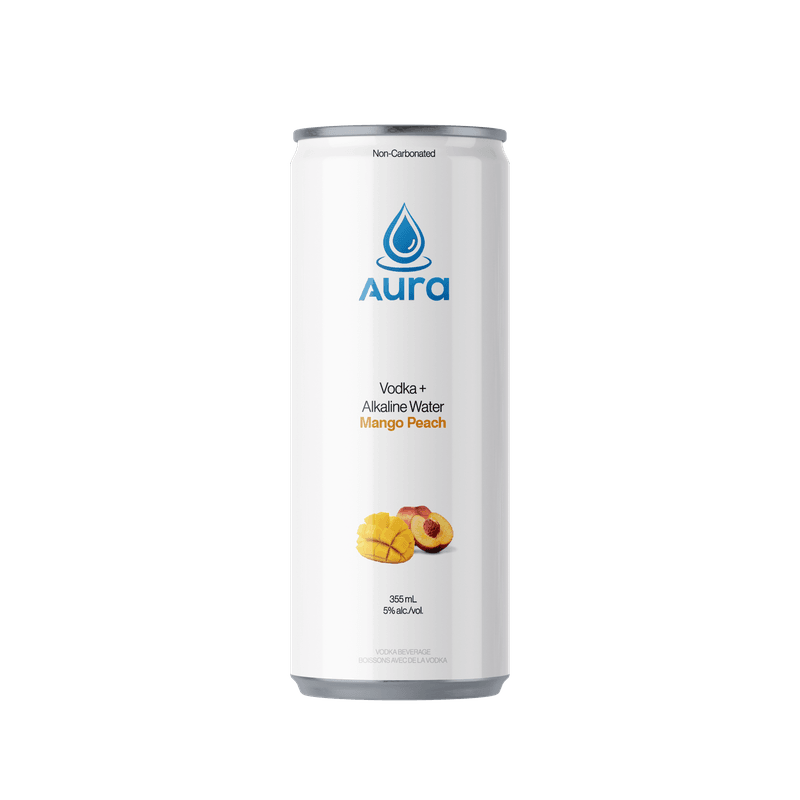
That distinction is why Aura is built as it is. Our vodka water cocktails are premium distilled vodka with alkaline water and natural flavour — still, never carbonated, no added sugar, no artificial sweeteners, no preservatives, gluten-free, in 355 mL cans across Cucumber Lime, Coconut Pineapple and Mango Peach. No bubbles means no bloating: a claim about how a drink sits, not about your health. More on why Aura.
To try the still approach yourself, browse the three flavours by the case of 24. Our direct and wholesale ordering delivers to Ontario addresses only; in British Columbia or Alberta, check where to buy — AGLC-licensed private retailers in Alberta, and BC Liquor Stores or licensed private retailers in BC.
Please enjoy Aura responsibly, and only if you are of legal drinking age in your province. This article summarises published research for general interest and is not medical advice; if you manage diabetes or take glucose-lowering medication, speak with your healthcare provider.
Sources
- Baker SG, Joffe BI, Shires R, Viljoen M, Lamprey JM, Seftel HC. "Alcohol-potentiated reactive hypoglycaemia depends on the nature of the carbohydrate ingested at the same time." Alcohol and Alcoholism, 1984;19(1):45–49. PMID 6388588. https://pubmed.ncbi.nlm.nih.gov/6388588/
- Wu KL, Chaikomin R, Doran S, Jones KL, Horowitz M, Rayner CK. "Artificially sweetened versus regular mixers increase gastric emptying and alcohol absorption." The American Journal of Medicine, 2006;119(9):802–804. DOI 10.1016/j.amjmed.2006.02.005. PMID 16945619. https://pubmed.ncbi.nlm.nih.gov/16945619/
- Meng Y, et al. "Sugar- and Artificially Sweetened Beverages Consumption Linked to Type 2 Diabetes, Cardiovascular Diseases, and All-Cause Mortality: A Systematic Review and Dose-Response Meta-Analysis of Prospective Cohort Studies." Nutrients, 2021;13(8):2636. DOI 10.3390/nu13082636. PMID 34444794. https://pmc.ncbi.nlm.nih.gov/articles/PMC8402166/
- Yale JF, Paty B, Senior PA. "Hypoglycemia." Diabetes Canada Clinical Practice Guidelines, Chapter 14. Canadian Journal of Diabetes, 2018. https://guidelines.diabetes.ca/cpg/chapter14
- Canadian Centre on Substance Use and Addiction. "Canada's Guidance on Alcohol and Health." CCSA, Ottawa, 2023. https://www.ccsa.ca/en/guidance-tools-resources/substance-use-and-addiction/alcohol/canadas-guidance-alcohol-and-health
- Belisario KL, Doggett A, MacKillop J. "The increase in risk classification using Canada's Guidance on Alcohol and Health: an empirical examination in a sample of community adults in Ontario." Health Promotion and Chronic Disease Prevention in Canada, 2025;45(2). DOI 10.24095/hpcdp.45.2.03. https://pmc.ncbi.nlm.nih.gov/articles/PMC11987587/