You trained hard yesterday, then had four or five drinks. This morning the warm-up feels normal and everything falls apart around minute six. That is real, and the published research on alcohol and exercise is far more specific than the version you hear on the gym floor. Here is what the evidence supports, where it is thin, and what to do about it tonight.
The short answer on alcohol and exercise
Four findings hold up reasonably well, and each carries a dose. The dose is the whole story.
- Muscle building: a very large dose — roughly 12 drinks — cut post-exercise muscle protein synthesis by 24–37% in one small crossover trial.
- Sleep: REM sleep is measurably disrupted from about two standard drinks upward, the lowest dose anyone has pooled.
- Next-day performance: a moderate evening dose cost 11% of time-to-exhaustion on a bike the next morning, while maximal strength was untouched.
- Rehydration: the diuretic effect of dilute alcohol after sweating is smaller than the popular story claims — but it climbs with concentration.
Muscle protein synthesis: the study everyone quotes
The reference point is Parr and colleagues in PLOS ONE, 2014. Eight physically active men completed resistance exercise plus cycling on three occasions, then took either 25 g whey protein, alcohol plus protein, or alcohol plus carbohydrate. The alcohol dose was 1.5 g per kilogram of body mass — described by the authors as 12 ± 2 standard drinks. Across the 2–8 hour recovery window, myofibrillar protein synthesis was 24% lower with alcohol plus protein and 37% lower with alcohol plus carbohydrate versus protein alone (both P < 0.05). Read it honestly: protein blunted the effect but did not abolish it.
The limits matter as much as the headline. Eight participants is a small sample, and the authors note their biopsy time points may have missed peak signalling responses. A 12-drink dose is also not what most people mean when they ask about drinking and workout recovery after two cans on a patio. Acute protein synthesis is only a proxy: nobody has tracked muscle actually gained over months at social doses. Call it evidence that a heavy night is costly, not proof that one drink erases a session.
Sleep is the lever with the lowest threshold
If you change one thing, change this. A 2025 systematic review and meta-analysis in Sleep Medicine Reviews pooled 27 studies and found REM sleep disrupted at a low dose — 0.50 g/kg or less, roughly two standard drinks — worsening as the dose climbed. The sedative benefit people chase runs the other way: faster sleep onset appeared only at high doses — around 0.85 g/kg, about five drinks — exactly the dose that wrecks the back half of the night.
The review is candid about what it could not resolve: effects on total sleep time, sleep efficiency and wake-after-sleep-onset carried large uncertainty. So the accurate claim is narrow — alcohol reliably changes sleep architecture at low doses, but whether it shortens your night is much less certain. Since sleep is where training adaptation consolidates, that is the most plausible route from last night's drinks to today's flat session.
Rehydration: less dramatic than you have been told
This cuts against standard gym advice. Shirreffs and Maughan dehydrated six healthy men by 2.01 ± 0.10% of body mass through exercise in the heat, then had them drink 2,212 ± 153 mL — 150% of the mass lost — of a beverage containing 0%, 1%, 2% or 4% alcohol. Total urine output over the following six hours did not differ significantly between trials (P = 0.307), though it trended upward with alcohol content. Peak urine flow came later with the 4% drink (P = 0.024), and blood and plasma volume recovered more slowly on that trial. Their conclusion: no meaningful difference whether the drink is alcohol-free or up to 2% alcohol, while 4% drinks tend to delay recovery.
Two caveats. Six men in 1997 is a tiny sample, and most canned drinks — including our vodka water cocktails at 5% ABV — sit above the highest concentration tested, in far smaller volumes than 2.2 L. No alcoholic drink is a rehydration beverage. Water and food do that job.
Next-day performance: aerobic capacity pays, strength mostly does not
Shaw and colleagues gave 12 recreationally active people either 1.09 g ethanol per kg of fat-free mass or water in the evening, then tested them the next morning. Time to exhaustion on a constant-power cycle test fell 11% — 181 ± 39 s versus 203 ± 34 s, P = .03, Cohen's d = 0.61. Vertical jump, isometric mid-thigh pull and biceps curl performance showed no difference at all.
That pattern is useful. If tomorrow is a heavy single or a technical strength session, you may well be fine. If it is intervals, a threshold run or anything that hurts for more than a minute, expect to be worse. Twelve participants is small and it is one lab, but the direction matches the wider literature.
What about alcohol before gym sessions?
Nobody needed a trial for this. Drinking before training adds impaired coordination and judgement to loaded movement, and none of the studies above tested it, because it is not a defensible thing to test. Skip it — the session can wait.
What this research does not show
- None of these trials tested long-term muscle mass, strength gains or body composition at social drinking doses.
- Sample sizes are 6, 8 and 12 people: mechanistic studies, not population evidence, and largely unreplicated at the doses most people actually drink.
- Participants were overwhelmingly male and physically active. Sex differences in alcohol pharmacokinetics are well documented and largely unaddressed here.
- Nothing here supports the idea that a particular product changes alcohol's effects on recovery. It does not. The ethanol is the same molecule regardless of what it arrives in — a still drink is not a healthier, safer or less intoxicating drink.
Where low calorie drinks and fitness goals genuinely overlap
The one lever the research supports is the boring one: total dose. Canada's Guidance on Alcohol and Health, published by the Canadian Centre on Substance Use and Addiction in 2023, defines a standard drink as 17.05 mL (13.45 g) of pure alcohol and sets a continuum of risk — two standard drinks or fewer per week is low risk, three to six moderate, seven or more increasingly high — and recommends not exceeding two drinks on any single day.
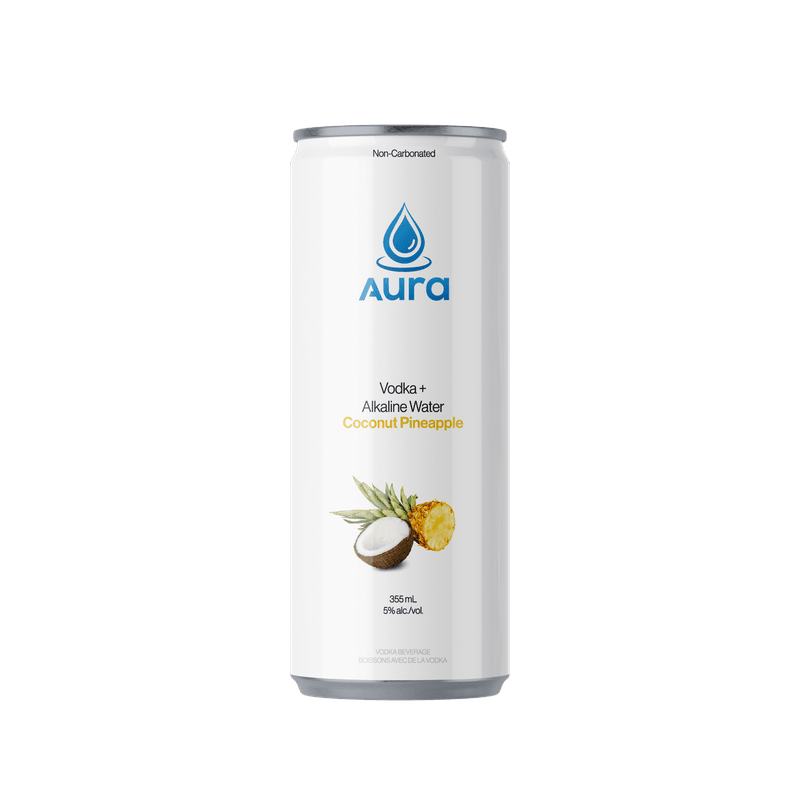
Run the arithmetic on a can. A 355 mL serving at 5% ABV holds about 17.8 mL of pure alcohol — just over one Canadian standard drink. That number is what lets you plan a night against a training week. Low calorie drinks fitness planning helps second-order only: Aura's cans run 100–110 calories with no added sugar, no artificial sweeteners and no preservatives, and are gluten-free, which keeps non-alcohol calories out of the equation. It does not change the ethanol. If the flat, still format makes one can feel like enough, that is portion control, not physiology — the format is explained on why Aura.
What to actually do tonight
- Put your hardest aerobic session after a dry night; move strength work to the morning after if something has to give.
- Stop drinking earlier rather than simply drinking later — the REM cost tracks the dose in your system while you sleep.
- Eat protein and rehydrate with water and electrolytes separately from whatever you are drinking. Don't count a cocktail toward either.
- Count in standard drinks, not cans, glasses or rounds.
Aura is a still vodka water — premium distilled vodka, alkaline water at pH 8.5+ and natural flavour, with zero carbonation. Cucumber Lime, Coconut Pineapple and Mango Peach, in 355 mL cans by the case of 24. Direct and wholesale ordering delivers to Ontario addresses only; in British Columbia or Alberta, check where to buy — BC Liquor Stores and licensed private retailers in BC, AGLC-licensed private retailers in Alberta. Must be of legal drinking age; please enjoy responsibly.
This article summarises published research for general interest and is not medical advice.
Sources
- Parr EB, Camera DM, Areta JL, Burke LM, Phillips SM, Hawley JA, Coffey VG. "Alcohol ingestion impairs maximal post-exercise rates of myofibrillar protein synthesis following a single bout of concurrent training." PLOS ONE, 2014;9(2):e88384. pmc.ncbi.nlm.nih.gov/articles/PMC3922864
- Gardiner C, Weakley J, Burke LM, Roach GD, Sargent C, Maniar N, Huynh M, Miller DJ, Townshend A, Halson SL. "The effect of alcohol on subsequent sleep in healthy adults: a systematic review and meta-analysis." Sleep Medicine Reviews, 2025;80:102030. DOI: 10.1016/j.smrv.2024.102030. research.monash.edu
- Shirreffs SM, Maughan RJ. "Restoration of fluid balance after exercise-induced dehydration: effects of alcohol consumption." Journal of Applied Physiology, 1997;83(4):1152–1158. journals.physiology.org
- Shaw AG, Chae S, Levitt DE, Nicholson JL, Vingren JL, Hill DW. "Effect of previous-day alcohol ingestion on muscle function and performance of severe-intensity exercise." International Journal of Sports Physiology and Performance, 2022;17(1):44–49. DOI: 10.1123/ijspp.2020-0790. PMID: 34225252. europepmc.org/article/MED/34225252
- Paradis C, Butt P, Shield K, Poole N, Wells S, Naimi T, Sherk A, & the Low-Risk Alcohol Drinking Guidelines Scientific Expert Panels. Canada's Guidance on Alcohol and Health: Final Report. Ottawa: Canadian Centre on Substance Use and Addiction, 2023. ISBN 978-1-77871-046-9. ccsa.ca