
You had a few drinks on Friday. By Saturday your stomach feels swollen and slow, and somewhere in the scroll you read that alcohol "destroys your microbiome" and gives you a "leaky gut." That claim does a lot of work. The honest version: alcohol and gut microbiome research is real and active, but most of it has been done in rodents, in cell cultures, or in people with alcohol use disorder — not in someone who had three drinks on a patio in Toronto. Here is what has actually been measured in humans.
The short version: the strongest human evidence points at dose and pace, not at which drink you choose — and comfort problems (gas, distension, morning heaviness) are a separate question from barrier problems, with a separate evidence base.
What alcohol and gut microbiome research actually measures
Popular coverage blends two different things: microbiome composition — which bacteria are present, read off 16S rRNA sequencing of a stool sample — and barrier function, often called permeability or "leaky gut," meaning whether material crosses the intestinal lining.
The second concept is shakier than headlines suggest. A widely cited review by Bischoff and colleagues in BMC Gastroenterology states plainly that "intestinal barrier" and "intestinal permeability" are "poorly defined, their assessment is a matter of debate, and their clinical significance is not clearly established" (Bischoff et al., 2014). Its summary table lists the available tests — lactulose/mannitol, sucralose, chromium-labelled EDTA, blood endotoxin assays — and attaches a limitation to nearly every one: "time consuming," "low specificity," "unclear specificity," "limited data."
What human studies show about alcohol intestinal permeability
The cleanest human experiment on acute drinking is small but specific. Writing in PLoS One in 2014, Bala and colleagues gave 25 healthy adults with no history of alcohol use disorder (11 men, 14 women, aged 21–56) a single measured dose: 2 mL of 40% v/v vodka per kilogram of body weight in 300 mL of juice. For a 70 kg adult that is roughly 44 g of pure alcohol — about 3.3 Canadian standard drinks, using the 13.45 g definition in Canada's Guidance on Alcohol and Health.
Serum endotoxin rose within 30 minutes, stayed elevated about three hours, and — this part rarely gets quoted — had fallen below baseline by 24 hours. Serum 16S bacterial DNA, a marker of bacterial products crossing from the gut, was significantly raised at 1, 4 and 24 hours. Acute-phase proteins LBP and sCD14 rose in the 21 participants measured. Women showed higher blood alcohol and higher endotoxin than men, significantly so at four hours. Reported comparisons cleared p<0.05.
Genuine finding — and also a transient spike, in a study where participant numbers varied by assay (8 for blood alcohol, 16 for endotoxin, 21–22 for the protein and DNA measures). A single heavy session moves gut-derived markers. That is not the same as lasting damage.
At the other end of the spectrum, Leclercq and colleagues studied alcohol-dependent patients in PNAS in 2014, measuring permeability with chromium-labelled EDTA. The result worth remembering: "some, but not all" developed gut leakiness. Those who did also showed altered microbiota composition and activity, and still had higher depression, anxiety and craving scores after three weeks of abstinence. Even at severe exposure, the effect was not universal.
Where animal data runs ahead of human data
The 2017 review "Alcohol and Gut-Derived Inflammation", in the U.S. National Institute on Alcohol Abuse and Alcoholism's Alcohol Research: Current Reviews, is useful because it names its sources. Read closely, the mechanism chain is largely preclinical:
- Tight-junction disruption by acetaldehyde and DNA adduct formation — cell culture and animal work.
- Suppression of Paneth cells and antimicrobial peptides — mouse studies.
- Protective diets: tributyrin preventing tight-junction disruption, glutamine easing leakiness, oats lowering endotoxin — all mice and rats.
- Circadian effects: alcohol-fed CLOCK mutant mice leaked more than wild-type. The parallel human finding, in shift workers with alcohol use disorder, was a correlation between low melatonin and gut leakiness — not a demonstrated cause.
The same review notes one dose detail that does apply to humans, citing 1973 work by Halsted: luminal alcohol at the far end of the small intestine can reach up to 200 mg/100 mL within an hour of drinking 2 to 2.5 standard drinks. Concentration at the tissue depends on how much and how fast — which is why pacing, not brand, is the actionable variable.
One randomised trial cuts against the simple story. In the Journal of Agricultural and Food Chemistry in 2022, Marques and colleagues gave 22 healthy men 330 mL a day of non-alcoholic beer (0.0%) or alcoholic beer (5.2%) for four weeks, double-blind. Both arms increased microbiota diversity; neither significantly changed body weight, fat mass or serum cardiometabolic biomarkers; faecal alkaline phosphatase, a barrier marker, only "tended to" increase. The authors read the effect as independent of alcohol and probably driven by beer polyphenols — which says nothing flattering about spirits-based drinks, since they carry essentially none.
Drinking and digestion: what to actually do
- Set the number before you start. Canada's Guidance on Alcohol and Health describes a continuum: 2 standard drinks or fewer per week is low risk, 3 to 6 moderate, 7 or more increasingly high. It flags more than 2 drinks in a single occasion as carrying increased acute risk. In the Bala data the endotoxin rise tracked the blood alcohol curve — the peak is what you control.
- Slow the curve. Food in the stomach and water between drinks flatten that peak. Unglamorous, and the best-supported advice here.
- Know your own baseline. Leclercq's "some, but not all," and the sex differences in Bala's data, say the same thing: response varies between people.
- Ignore the supplement pitch. Glutamine, butyrate and oat compounds have rodent evidence here. That is a reason to run a human trial, not a reason to buy a tub of powder.
Bloating from seltzer is a completely separate question
This is where drinks marketing quietly changes subjects. Bloating from seltzer and hard sparkling drinks is mechanical: dissolved carbon dioxide comes out of solution in your stomach as gas, producing distension and burping. That is a comfort problem, unrelated to the microbiome literature above.
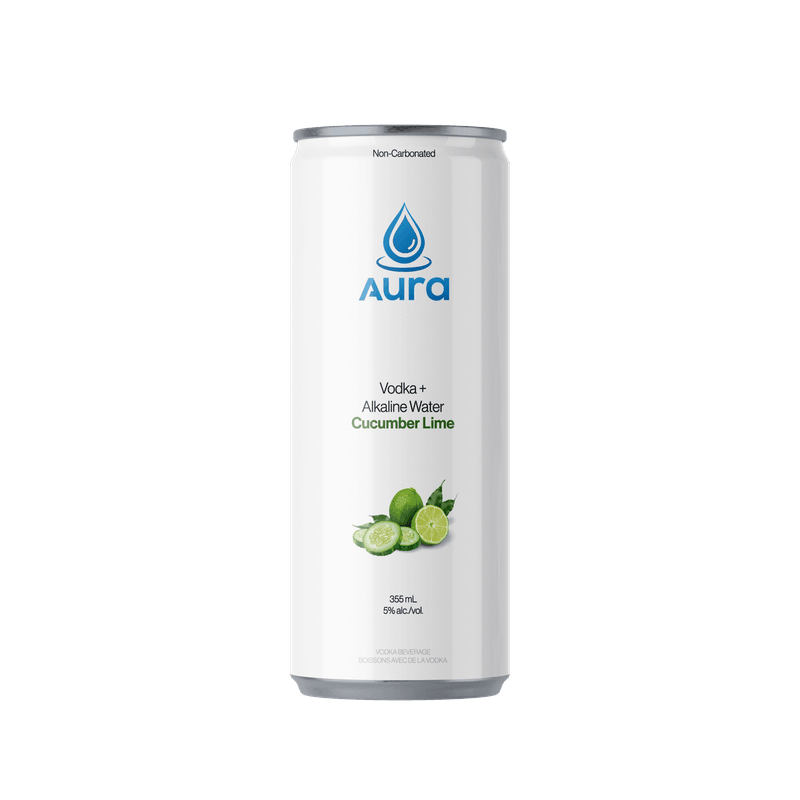
We make our vodka water cocktails still — zero carbonation, premium distilled vodka with alkaline water and natural flavour, no added sugar, no artificial sweeteners, gluten-free. No bubbles means no bloating, and that is the whole reason Aura exists; the full reasoning is on why Aura.
To be exact about what that is and is not: it is a comfort claim about gas, not a health claim. None of the studies above tested carbonation as a variable, and there is no published evidence that a still drink protects your gut barrier, changes your microbiome, or is safer than a carbonated one. The alcohol in a still can is the same alcohol.
The caveats
- Sample sizes are small. 25 people in the acute binge study, 22 men in the beer trial — early-stage human work, not settled science.
- Populations don't transfer. Findings in alcohol-dependent patients say little about drinking within Canada's guidance.
- Markers are not outcomes. A transient endotoxin rise or a diversity shift is a measurement, not a diagnosis — and higher diversity is not automatically better.
- Causation is often unresolved. Dysbiosis in heavy drinkers may reflect altered diet, sleep and medication as much as ethanol itself.
- What none of it shows: that any alcoholic drink is good for your gut, that one format is healthier than another, or that "leaky gut" is a settled clinical concept.
If you want a still, unsweetened option for the nights you do drink, Aura comes in Cucumber Lime, Coconut Pineapple and Mango Peach — 355 mL cans, by the case of 24. Our own direct and wholesale ordering delivers to Ontario addresses only; in British Columbia and Alberta, check where to buy, or look for us at BC Liquor Stores and licensed private retailers in BC, and AGLC-licensed private retailers in Alberta. Please enjoy responsibly, and only if you are of legal drinking age in your province.
This article summarises published research for general interest and is not medical advice.
Sources
- Bala S, Marcos M, Gattu A, Catalano D, Szabo G. "Acute binge drinking increases serum endotoxin and bacterial DNA levels in healthy individuals." PLoS One, 2014;9(5):e96864. doi:10.1371/journal.pone.0096864. PMID 24828436. View
- Leclercq S, Matamoros S, Cani PD, et al. "Intestinal permeability, gut-bacterial dysbiosis, and behavioral markers of alcohol-dependence severity." Proceedings of the National Academy of Sciences USA, 2014;111(42):E4485–E4493. doi:10.1073/pnas.1415174111. PMID 25288760. View
- Bishehsari F, Magno E, Swanson G, et al. "Alcohol and Gut-Derived Inflammation." Alcohol Research: Current Reviews, 2017;38(2):163–171. doi:10.35946/arcr.v38.2.02. PMID 28988571. View
- Marques C, Dinis L, Barreiros Mota I, et al. "Impact of Beer and Nonalcoholic Beer Consumption on the Gut Microbiota: A Randomized, Double-Blind, Controlled Trial." Journal of Agricultural and Food Chemistry, 2022;70(41):13062–13070. doi:10.1021/acs.jafc.2c00587. PMID 35834180. View
- Bischoff SC, Barbara G, Buurman W, et al. "Intestinal permeability — a new target for disease prevention and therapy." BMC Gastroenterology, 2014;14:189. doi:10.1186/s12876-014-0189-7. PMID 25407511. View
- Canadian Centre on Substance Use and Addiction. Canada's Guidance on Alcohol and Health: Final Report. Ottawa, 2023. View