You have a headache, a cold or a stiff back, there's a dinner on tonight, and you want to know whether it's fine to have a drink. That's the real question behind most searches about alcohol and medication, and the honest answer is: it depends on the drug, the dose and how much you drink. Some combinations are a small concern, some are a real one. Here's what Health Canada and the published research actually say about the common over-the-counter (OTC) drugs in Canadian medicine cabinets, with the evidence and its limits laid out.
The short answer: can you drink on medication?
For most OTC products, the research doesn't support a blanket "never" or a casual "it's fine." Alcohol interacts with drugs in two main ways. In their review in Alcohol Research & Health, pharmacist Ron Weathermon and physician David Crabb describe pharmacokinetic interactions, where alcohol changes how the body breaks down a drug, and pharmacodynamic interactions, where alcohol adds to a drug's effects, especially sedation in the central nervous system. They also note that some interactions happen even at moderate drinking levels.
So the question to ask isn't "is alcohol bad with medicine?" It's: which of those two mechanisms applies to the product in my hand, and how much am I planning to drink?
Acetaminophen and alcohol: what Health Canada's label actually says
Acetaminophen (the ingredient in Tylenol and many cold-and-flu combination products) gets the most frightening headlines. Health Canada's position is more specific than the headlines. In its September 15, 2016 labelling update, Health Canada required clearer OTC acetaminophen labels that tell people to use the lowest effective dose, not to exceed the adult maximum of 4,000 mg in 24 hours, and not to mix these products with alcohol if they drink three or more drinks a day. The update also notes that people with risk factors such as liver disease, or who drink three or more drinks a day, may need to take less than the label's standard dose. It also added "contains acetaminophen" in bold red text on the front of the package.
The reason for the concern is metabolic. Weathermon and Crabb explain that when the liver enzyme CYP2E1 breaks down acetaminophen, it produces a toxic by-product, and heavy drinking increases CYP2E1 activity. They also say plainly that "the specific drinking levels at which acetaminophen toxicity is enhanced are still unknown."
What the trials found
The best-controlled evidence is more reassuring than the scare stories about therapeutic doses. In a multicentre, double-blind, placebo-controlled trial published in BMC Medicine in 2007, Kuffner and colleagues enrolled 443 adults entering alcohol detoxification centres. 308 received acetaminophen at 4 g a day for three days (258 completed) and 135 received placebo (114 completed). Peak mean ALT, a liver enzyme marker, was 57 ± 45 IU/L with acetaminophen and 55 ± 48 IU/L with placebo, with no statistical difference. The authors concluded that three days at the maximum recommended dose "appears safe in newly-abstinent alcoholic patients."
Read that carefully, though. These participants had stopped drinking. The authors say the results don't cover people who keep drinking while taking acetaminophen, don't cover people with decompensated liver disease, don't extend beyond three days, and "should not be extrapolated" to overdoses. The study shows that sticking to the labelled dose matters. It doesn't show that heavy drinking and acetaminophen are a safe pairing.
What to do today
- Check every product's ingredient list. Cold-and-flu, sinus and "PM" products often contain acetaminophen too, and doubling up is the easy way to go over 4,000 mg without noticing.
- If you regularly have three or more drinks a day, follow the Health Canada label and talk to a pharmacist before using acetaminophen.
- For an occasional drink, the bigger risk is going over the dose, not the drink itself. Count your milligrams.
Antihistamine and alcohol: the drowsiness stacks
This is the interaction people tend to underestimate. Weathermon and Crabb write that alcohol "can substantially enhance the sedating effects" of first-generation antihistamines such as diphenhydramine, especially in older adults. Newer, less-sedating antihistamines such as cetirizine and loratadine cause less drowsiness, but the authors still say users "should be warned against using alcohol."
- Many allergy pills, motion-sickness tablets and night-time cold products contain a first-generation antihistamine. Check the label for diphenhydramine or similar ingredients.
- Even if you pick a "non-drowsy" product, don't drive or operate anything after combining it with a drink. Alcohol's effect on driving doesn't go away because the pill label says non-drowsy.
Sleep aids and a nightcap
Many OTC sleep aids sold in Canada use a sedating antihistamine as the active ingredient, so the stacking effect above applies directly. Herbal products aren't exempt either: Weathermon and Crabb list chamomile, echinacea and valerian as products commonly used as sleep aids that "may produce enhanced sedative effects" when combined with alcohol. The practical rule is simple: choose the sleep aid or the drink on a given night, not both.
Pain relievers: ibuprofen and aspirin
With anti-inflammatory pain relievers (NSAIDs), the concern is your stomach and bleeding, not sedation. The same review notes that aspirin and ibuprofen prolong bleeding and that "this effect also appears to be enhanced by concurrent alcohol use," and that aspirin may inhibit a stomach enzyme that breaks down alcohol, which could raise blood alcohol levels. If you take an NSAID with a drink, take it with food, stay within the labelled dose, and ask a pharmacist first if you have a history of ulcers or take a blood thinner.
How common is mixing alcohol and medication?
Very common. Using the U.S. National Health and Nutrition Examination Survey (NHANES 1999 to 2010; 26,657 adults), Breslow, Dong and White reported in 2015 that 41.5% (95% CI 40.3 to 42.7) of current drinkers used at least one prescription medication known to interact with alcohol. Among drinkers aged 65 and older, the figure was 77.8% (95% CI 75.7 to 79.7). This is U.S. data rather than Canadian, but the point carries over: if you drink and take medication, you're in a very large group.
Caveats: what the evidence does not show
- The prevalence figures don't measure same-time use. Breslow and colleagues measured drinking over the past year and medications over the past month, and they state that they had no "same-time data." They also looked only at prescription drugs, not OTC products.
- The reassuring acetaminophen trial is narrow. It lasted three days, used recently abstinent participants and measured lab markers, not long-term outcomes.
- The review is older. Weathermon and Crabb's overview is from 1999. Its mechanisms are still taught, but it summarises earlier studies rather than producing new data, and the authors admit key thresholds are unknown.
- Your situation matters more than averages. Age, liver health, other prescriptions and how much you actually drink all change the risk. That's why a pharmacist's check beats any blog post, this one included.
Where Aura fits in, and where it doesn't
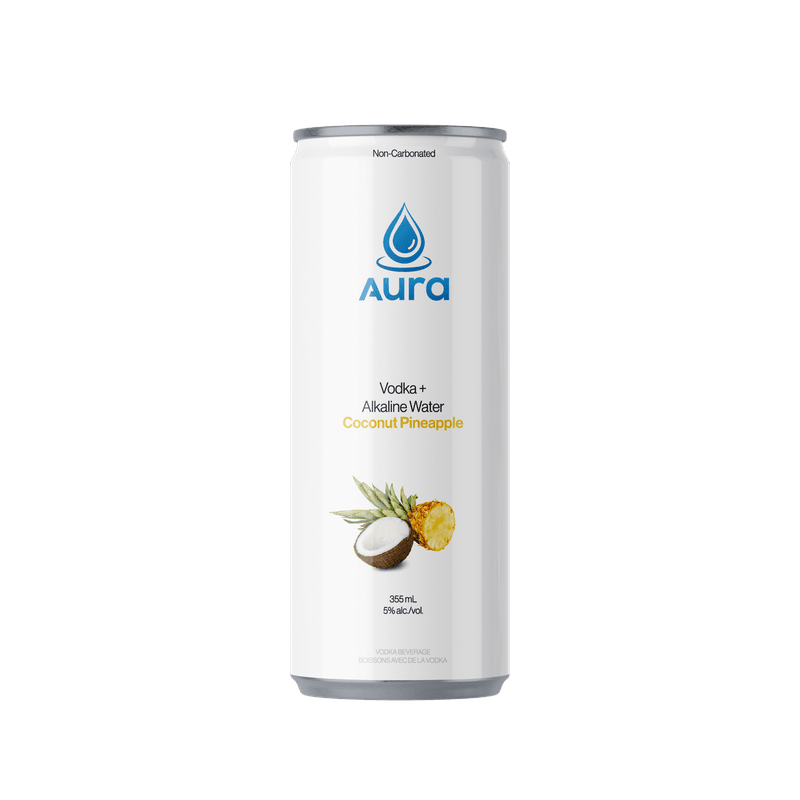
To be clear: nothing in a can changes any of the above. Aura is premium vodka with alkaline water and natural flavour, and the alcohol in it interacts with medication exactly like the alcohol in any other drink. Aura isn't safer to mix with medication, and it isn't a health product. What it does offer is a clear label. One 355mL can is easy to count, and if you're tracking drinks against something like the "three or more a day" acetaminophen threshold, counting is the whole point.
It's also a still drink, with zero carbonation, so it's a simple, unfussy pour when you do decide to have one. Read more about why Aura is made the way it is, or browse our vodka water cocktails in Cucumber Lime, Coconut Pineapple and Mango Peach.
Bottom line
Alcohol and medication can coexist for many healthy adults, but only if you read the label, keep to the dose and know which interaction you're dealing with. Acetaminophen: watch total milligrams and the three-drinks-a-day line. Antihistamines and sleep aids: the sedation adds up, so skip the drink or skip the pill. NSAIDs: think stomach and bleeding. When in doubt, ask a pharmacist before you pour.
When you're medication-free and ready to unwind, Aura is available in British Columbia, Alberta and Ontario. Our own direct and wholesale ordering delivers to Ontario addresses only. In BC and Alberta, find us at your local retailer through where to buy. Please enjoy responsibly and only if you are of legal drinking age in your province.
This article summarises published research for general interest and is not medical advice. Talk to a pharmacist or doctor about your own medications.
Sources
- Health Canada. "Stronger, clearer labels for over-the-counter acetaminophen products to further address the risk of liver damage." Recalls and safety alerts, September 15, 2016. recalls-rappels.canada.ca
- Weathermon R, Crabb DW. "Alcohol and Medication Interactions." Alcohol Research & Health. 1999;23(1):40–54. PMID: 10890797. PMC6761694
- Kuffner EK, Green JL, Bogdan GM, Knox PC, Palmer RB, Heard K, Slattery JT, Dart RC. "The effect of acetaminophen (four grams a day for three consecutive days) on hepatic tests in alcoholic patients – a multicenter randomized study." BMC Medicine. 2007;5:13. doi:10.1186/1741-7015-5-13. PMID: 17537264. PMC1894983
- Breslow RA, Dong C, White A. "Prevalence of alcohol-interactive prescription medication use among current drinkers: United States, 1999 to 2010." Alcoholism: Clinical and Experimental Research. 2015;39(2):371–379. doi:10.1111/acer.12633. PMID: 25597432. PMC4331237