You just finished a hard session and there is a drink in front of you at dinner. The useful question is not whether alcohol is "bad" — it is how much, how soon, and what it costs you tomorrow. The alcohol and muscle recovery research answers that more precisely than the headlines suggest: the large measured impairments come from large doses taken right after exercise, while small doses have repeatedly failed to produce the same effect. Here is what the studies measured, and what to do tonight.
What alcohol and muscle recovery research actually measured
Four outcomes get studied: rebuilding muscle protein, refilling glycogen, rehydrating, and next-day performance. They do not respond the same way, and lumping them together is where most advice goes wrong.
Muscle protein synthesis: a real effect, at a very large dose
The most-cited drinking after workout study is Parr and colleagues (PLOS ONE, 2014). Eight physically active men (21.4 ± 4.8 years, 79.3 ± 11.9 kg) trained, then received 25 g whey protein alone, alcohol plus protein, or alcohol plus carbohydrate. The alcohol dose was 1.5 g per kg of body mass — 12 ± 2 standard drinks by the authors' count, roughly eight Canadian standard drinks for a 75 kg athlete, spread over three hours.
Versus protein alone, myofibrillar protein synthesis fell 24% with alcohol plus protein and 37% with alcohol plus carbohydrate (both p < 0.05). Protein blunted the effect but did not erase it. Two things matter: the effect is real, and the dose that produced it is a heavy drinking session, not a drink with dinner. One or two drinks were never tested.
Glycogen: the damage is mostly indirect
Burke and colleagues (Journal of Applied Physiology, 2003) tested this in trained cyclists — six over 8 hours, nine over 24 — using muscle biopsies. When 1.5 g/kg of alcohol displaced carbohydrate from the recovery diet, glycogen storage dropped sharply: 24.4 ± 7 versus 44.6 ± 6 mmol/kg wet weight at 8 hours, and 68 ± 5 versus 82 ± 5 at 24 hours (both P < 0.05).
When the same alcohol was added on top of full carbohydrate intake, the picture changed: only a trend at 8 hours (36.2 ± 8 mmol/kg, P = 0.1), and no difference at 24 hours (85 ± 9 versus 82 ± 5). The authors concluded that the direct effect on post-exercise glycogen synthesis "is unclear," and that the main effect is indirect — alcohol displaces the carbohydrate you should have eaten. Eat your recovery meal and you remove most of the glycogen problem.
Rehydration: alcohol is a weaker diuretic than the gym-floor version claims
Shirreffs and Maughan (Journal of Applied Physiology, 1997) dehydrated subjects by 2.01 ± 0.10% of body mass, then gave them drinks of 0%, 1%, 2% or 4% alcohol at 150% of the fluid lost (2,212 ± 153 mL). Six-hour urine output did not differ significantly between trials (P = 0.307), though it trended up with dose; blood and plasma volume restoration was slower on the 4% drink (P = 0.013 and P = 0.050).
Their conclusion: alcohol "has a negligible diuretic effect when consumed in dilute solution," with "no difference in recovery from dehydration" up to 2% alcohol — but 4% "tends to delay the recovery process." Note the ceiling: most canned drinks, ours included, sit above 4%. This is not permission to rehydrate with alcohol. It shows dilution and volume matter, and that dehydration panic is misplaced next to the other three outcomes.
Dose and timing: the clearest signal in the whole literature
Two studies from one New Zealand group — same protocol, different doses — give the sharpest answer on alcohol athletic performance. Ten men performed 300 maximal eccentric quadriceps contractions, then drank alcohol or a matched non-alcoholic beverage; torque was measured at 36 and 60 hours.
- At 1 g/kg (roughly five to six Canadian standard drinks for a 75 kg person), Barnes and colleagues (2010) found losses at 36 hours of 40.9%, 42.8% and 44.8% for isometric, concentric and eccentric torque, versus 28.7%, 31.9% and 25.9% in the control condition (all p < 0.05). Alcohol roughly doubled the eccentric strength loss.
- At 0.5 g/kg (under three Canadian standard drinks for the same person), Barnes and colleagues (2011) found significant strength loss over time under both conditions, but "no difference between treatments ... at any of the measured time points (all P > 0.05)."
Halving the dose removed the measurable penalty — the most useful result in this literature.
Next-day performance runs through sleep
The most consistent next-day mechanism is not muscle at all — it is sleep. A 2025 systematic review and meta-analysis in Sleep Medicine Reviews by Gardiner and colleagues, pooling 27 studies, found REM sleep delayed and shortened at doses as low as 0.50 g/kg — about two standard drinks — worsening with more. Falling asleep faster only appeared at 0.85 g/kg or higher (~5 drinks), and came with worse REM disruption afterward. Effects on total sleep time and sleep efficiency were too uncertain to call.
What to actually do
- Eat first, and fully. Hit your carbohydrate and protein targets before the first drink, not instead of it.
- Keep it to one or two. Harm appeared at 1 g/kg; 0.5 g/kg showed nothing. Canada's Guidance on Alcohol and Health (CCSA, 2023) defines a standard drink as 17.05 mL or 13.45 g of pure alcohol, puts lowest risk at two drinks a week or fewer, and flags more than two per occasion.
- Finish early. REM disruption is dose-dependent and starts low; an earlier last drink is the cheapest fix available.
- Protect the hard sessions. Go dry in the 24–36 hours after heavy eccentric work — downhill running, slow lowering phases — where the strength deficit was largest.
- Drink water alongside. Volume, not format, restored fluid balance in the 1997 trial.
What this research does not show
Parr's study had eight participants; both Barnes studies had ten; Burke's had six and nine. These are small, young, all-male samples, none replicated at scale. Acute protein-synthesis measurements do not prove long-term changes in muscle mass — no trial has shown that moderate drinking measurably shrinks a training programme's results over months. Burke calls the direct glycogen effect "unclear," and the eccentric-damage protocol is deliberately extreme.
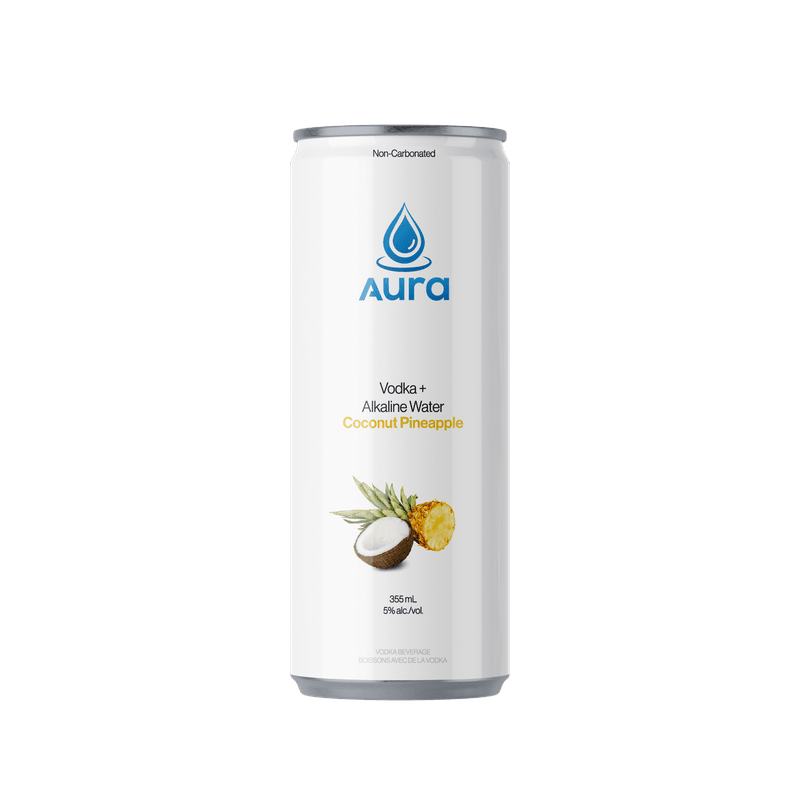
And nothing here makes any alcoholic drink good for recovery. Fitness friendly cocktails are a marketing category, not a physiological one. Aura is a canned vodka water — premium distilled vodka, alkaline water and natural flavour, with no added sugar, no artificial sweeteners, no preservatives, and gluten-free. It is also still, with zero carbonation, which is a texture and comfort difference, not a health one: the same alcohol is in the can either way, and none of the research above becomes less true because a drink has no bubbles. For the full ingredient story, read why Aura.
Aura comes in Cucumber Lime, Coconut Pineapple and Mango Peach — 355 mL cans, by the case of 24, available across British Columbia, Alberta and Ontario. In Ontario, order our vodka water cocktails direct for delivery to an Ontario address. Elsewhere, check where to buy: AGLC-licensed private retailers in Alberta, BC Liquor Stores and licensed private retailers in British Columbia.
Train hard, eat the recovery meal, keep the count low, and finish early enough to sleep properly. Then pick the drink you actually enjoy. Please enjoy Aura responsibly, and only if you are of legal drinking age in your province.
This article summarises published research for general interest and is not medical advice.
Sources
- Parr EB, Camera DM, Areta JL, Burke LM, Phillips SM, Hawley JA, Coffey VG. "Alcohol Ingestion Impairs Maximal Post-Exercise Rates of Myofibrillar Protein Synthesis following a Single Bout of Concurrent Training." PLOS ONE, 2014;9(2):e88384. DOI: 10.1371/journal.pone.0088384. Read the study
- Burke LM, Collier GR, Broad EM, Davis PG, Martin DT, Sanigorski AJ, Hargreaves M. "Effect of alcohol intake on muscle glycogen storage after prolonged exercise." Journal of Applied Physiology, 2003;95(3):983–990. DOI: 10.1152/japplphysiol.00115.2003. PMID: 12740311. Read the abstract
- Shirreffs SM, Maughan RJ. "Restoration of fluid balance after exercise-induced dehydration: effects of alcohol consumption." Journal of Applied Physiology, 1997;83(4):1152–1158. DOI: 10.1152/jappl.1997.83.4.1152. PMID: 9338423. Read the abstract
- Barnes MJ, Mündel T, Stannard SR. "Post-exercise alcohol ingestion exacerbates eccentric-exercise induced losses in performance." European Journal of Applied Physiology, 2010;108(5):1009–1014. DOI: 10.1007/s00421-009-1311-3. PMID: 20012446. Read the abstract
- Barnes MJ, Mündel T, Stannard SR. "A low dose of alcohol does not impact skeletal muscle performance after exercise-induced muscle damage." European Journal of Applied Physiology, 2011;111(4):725–729. DOI: 10.1007/s00421-010-1655-8. PMID: 20878178. Read the abstract
- Gardiner C, Weakley J, Burke LM, Roach GD, Sargent C, Maniar N, Huynh M, Miller DJ, Townshend A, Halson SL. "The effect of alcohol on subsequent sleep in healthy adults: A systematic review and meta-analysis." Sleep Medicine Reviews, 2025;80:102030. DOI: 10.1016/j.smrv.2024.102030. PMID: 39631226. Read the abstract
- Canadian Centre on Substance Use and Addiction. Canada's Guidance on Alcohol and Health: Final Report. Ottawa, Ont.: CCSA, 2023. Read the report (PDF)