Maybe you snore after drinking. Maybe a partner has noticed you stop breathing for a moment at night. Either way, your question about alcohol and sleep apnea is a practical one: does an evening drink make your breathing during sleep worse? The research says yes. Two 2018 meta-analyses both link alcohol to more disturbed breathing during sleep. One pooled controlled lab trials and the other pooled population studies. The effect is largest in people who already snore or have obstructive sleep apnea (OSA). Below is what the evidence shows, where it is weak, and what you can do about it tonight.
The short answer on alcohol and sleep apnea
Obstructive sleep apnea happens when the soft tissues of the throat collapse during sleep and partly or fully block the airway. Sleep clinicians count these events with the apnea-hypopnea index (AHI): the number of breathing pauses or shallow-breathing episodes per hour of sleep. Alcohol matters because it acts on the same muscles and reflexes that keep that airway open.
What the controlled trials show
The most direct evidence on drinking before bed and breathing comes from a 2018 systematic review and meta-analysis in Sleep Medicine Reviews by Kolla and colleagues. It pooled 14 randomized controlled trials with 422 participants, 71.9% of them men. After alcohol, AHI rose by an average of 2.33 events per hour (95% CI 1.41 to 3.25). Mean blood-oxygen saturation fell by 0.60 points (95% CI -0.72 to -0.49), and the lowest oxygen reading of the night fell by 1.25 points (95% CI -2.00 to -0.50). Individual breathing events also lasted longer.
The averages hide the most important finding. In habitual snorers, AHI rose by 4.20 events per hour (95% CI 1.19 to 6.50). In people already diagnosed with OSA, it rose by 7.10 events per hour (95% CI 3.59 to 10.61). Clinicians generally treat an AHI under 5 as normal, so a rise of about two events matters little for a healthy sleeper. A rise of seven matters a lot for someone whose airway is already unstable. The authors concluded that alcohol is a modifiable risk factor that can lead to OSA developing or getting worse.
What the population studies show
A separate meta-analysis in Sleep Medicine by Simou, Britton and Leonardi-Bee (2018) looked at real-world drinking rather than lab doses. It searched studies published between 1985 and 2015 and found 21 that gave relative-risk estimates. Pooled, higher alcohol consumption was linked to a 25% higher risk of sleep apnoea (RR 1.25, 95% CI 1.13 to 1.38). The association held across different study designs and definitions, and it was stronger in low- and middle-income countries.
Alcohol, airway muscle tone and why the first hour matters
The likely mechanism was described decades ago. In a small 1982 study in the Journal of Neurology, Neurosurgery, and Psychiatry, Issa and Sullivan recorded seven patients overnight, once without alcohol and once right after drinking. In the five patients with obstructive sleep apnea, alcohol made airway blockages more frequent and longer, and oxygen levels dropped sharply in the first hour of sleep. The two other patients were ordinary snorers without apnea. After alcohol, both developed frank obstructive sleep apnea during that first hour.
The authors proposed two explanations for the link between alcohol and the airway during sleep:
- Lower muscle tone. Alcohol relaxes the muscles of the throat (oropharynx) that hold the airway open, so it collapses more easily. The same slackness makes the tissue vibrate, which is why snoring after drinking is so common.
- Blunted arousal. Normally a blocked airway triggers a brief partial waking that restores breathing. Alcohol appears to dampen that alarm, so each pause lasts longer before the body responds.
This also explains why timing matters. The worst effects in that study came soon after drinking, while alcohol levels were still high.
Who should be most careful about a late drink
- People diagnosed with OSA. This group showed the largest increase in breathing events in the pooled trials.
- Habitual snorers. Snorers showed a clear increase, and the 1982 study found alcohol can tip simple snoring into apnea.
- People with possible undiagnosed apnea. Warning signs include loud snoring, pauses or gasping that someone else has seen, morning headaches and heavy daytime sleepiness. Many people with OSA don't know they have it.
- CPAP users. The trials did not test whether alcohol reduces how well CPAP works. Don't skip your device on nights you drink, and ask your sleep clinician about alcohol.
- Anyone taking sedating medication. Alcohol combined with sleep aids or other sedatives can depress breathing further. Check with your pharmacist before mixing them.
What to do tonight
- Move your last drink earlier. The effects researchers measured were strongest when alcohol was taken close to bedtime. Giving your body more time before you lie down is a sensible step. Note that the studies did not establish a specific safe cut-off time.
- Drink less in the evening. More alcohol means more muscle relaxation. Count standard drinks: Health Canada defines one as 17.05 mL, or 13.45 g, of pure alcohol. For broader weekly limits, see the CCSA's Canada's Guidance on Alcohol and Health (January 2023).
- Use your treatment. If you have a CPAP or an oral appliance, use it every night, especially after drinking.
- Run a simple check. Ask a bed partner, or use a snore-recording app, to compare nights you drink with nights you don't. A clear difference is useful information to bring to your doctor.
- Get assessed. In Canada, your family doctor can refer you for a sleep study if you have warning signs. Alcohol can make apnea worse, but untreated apnea is a problem in its own right.
Caveats: what the research does not show
- The samples are small. The 14 trials together include 422 people, and the classic mechanism study had seven patients. Results also varied between trials (I² = 62% for the main AHI result).
- Most participants were men. At 71.9% male, the trial data say less about women.
- Lab nights are not real life. Trials tested a dose given on a single night under monitoring. They don't show what years of moderate drinking do.
- The population data are messy. The Simou meta-analysis found very high heterogeneity (I² = 82%) and signs of publication bias. Observational studies also can't rule out confounders such as body weight or smoking. In the eight studies that reported average intake, people with apnea drank about two UK units more per week, but that difference was not statistically significant.
- No safe threshold has been identified. None of these studies defines an amount or a timing that is risk-free for people with apnea.
- No drink type was tested against another. The research is about alcohol itself. Nothing in it suggests that the mixer, the water, the flavour or the absence of carbonation changes what alcohol does to your airway.
Where Aura fits, and where it doesn't
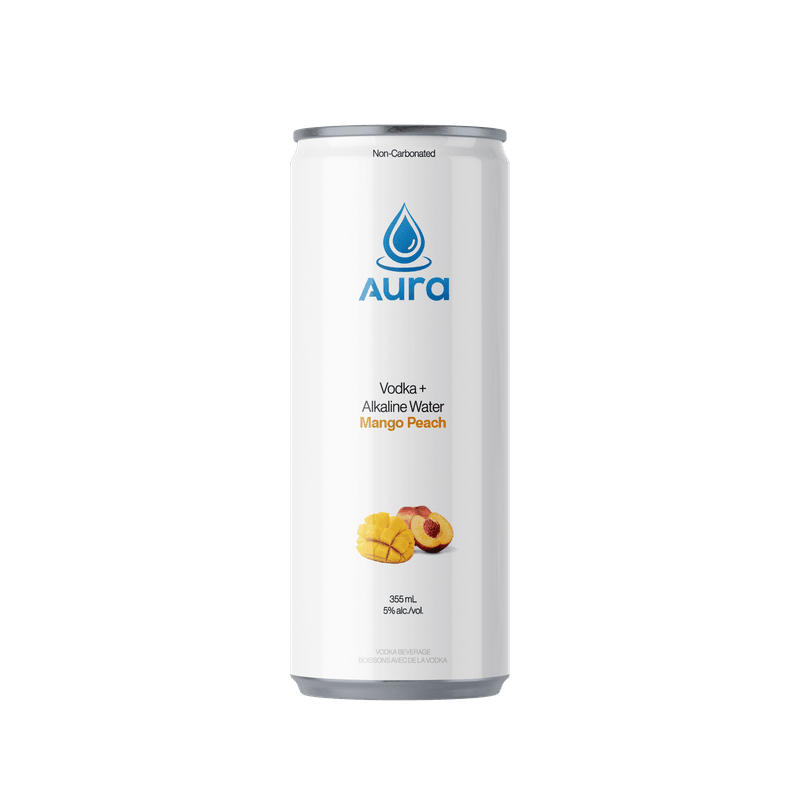
Aura is a still vodka water: premium vodka, alkaline water (pH 8.5+) and natural flavour. It has no carbonation, no added sugar, no artificial sweeteners and no preservatives. We built it as the still alternative to seltzers because some people prefer a drink without bubbles. That comfort preference has nothing to do with sleep apnea. The alcohol in a can of Aura relaxes your throat muscles exactly as the same amount of alcohol in any other drink would. Aura is not a sleep aid and not a safer choice for your airway. If you enjoy one, the same advice applies: have it earlier in the evening and count it toward your total.
You can browse our vodka water cocktails in Cucumber Lime, Coconut Pineapple and Mango Peach, or read why Aura is made the way it is. Aura is sold across British Columbia, Alberta and Ontario. Our direct and wholesale ordering delivers to Ontario addresses only. In Alberta, look for AGLC-licensed private retailers; in BC, check BC Liquor Stores and licensed private retailers. Our where to buy page lists locations.
If late drinks have been costing you sleep, try one change this week: make your last drink earlier, or skip it on work nights, and see how you feel. When you do want something to sip, find Aura near you through our where to buy page. Please enjoy responsibly and only if you are of legal drinking age in your province (19 in BC and Ontario, 18 in Alberta).
This article summarises published research for general interest and is not medical advice. If you think you may have sleep apnea, speak with your doctor.
Sources
- Kolla BP, Foroughi M, Saeidifard F, Chakravorty S, Wang Z, Mansukhani MP. The impact of alcohol on breathing parameters during sleep: a systematic review and meta-analysis. Sleep Medicine Reviews. 2018;42:59-67. doi:10.1016/j.smrv.2018.05.007. PMID: 30017492. https://pubmed.ncbi.nlm.nih.gov/30017492/
- Simou E, Britton J, Leonardi-Bee J. Alcohol and the risk of sleep apnoea: a systematic review and meta-analysis. Sleep Medicine. 2018;42:38-46. doi:10.1016/j.sleep.2017.12.005. PMID: 29458744. https://pubmed.ncbi.nlm.nih.gov/29458744/
- Issa FG, Sullivan CE. Alcohol, snoring and sleep apnea. Journal of Neurology, Neurosurgery, and Psychiatry. 1982;45(4):353-359. doi:10.1136/jnnp.45.4.353. PMID: 7077345. https://pubmed.ncbi.nlm.nih.gov/7077345/
- Health Canada. Low-risk alcohol drinking guidelines. Government of Canada; page dated 2025-03-25. https://www.canada.ca/en/health-canada/services/substance-use/alcohol/low-risk-alcohol-drinking-guidelines.htm
- Canadian Centre on Substance Use and Addiction. Canada's Guidance on Alcohol and Health: Final Report. CCSA; January 2023. https://ccsa.ca/canadas-guidance-alcohol-and-health-final-report