You had three drinks with dinner, fell asleep in what felt like four minutes, and then snapped awake at 3:07 a.m. with your heart going and no chance of drifting off again. That pattern is not imagination. It is one of the most consistently replicated findings in the peer-reviewed literature on alcohol and sleep: alcohol gets you unconscious faster and then quietly takes the back half of the night away from you. Here is what the studies actually show, what they do not, and what you can change tonight.
A baseline first, because Canada is not sleeping well to begin with. Drawing on Canadian Health Measures Survey data from 10,976 respondents aged 18 to 79, Chaput, Wong and Michaud reported in Statistics Canada's Health Reports (2017) that adults aged 18 to 64 average 7.12 hours a night, about a third sleep less than the recommended seven, and 43% of men and 55% of women report trouble falling or staying asleep at least sometimes. Alcohol lands on top of that, not instead of it.
What the evidence on alcohol and sleep actually says
The most recent synthesis is a 2024 systematic review and meta-analysis by Gardiner and colleagues in Sleep Medicine Reviews (PMID 39631226), pooling 27 studies of healthy adults. Two things stand out. First, alcohol delays the onset of REM sleep and reduces how much REM you get. Second, that effect starts low: REM disruption appeared at doses of 0.50 g per kg of body weight or less — which the authors put at roughly two standard drinks — and got progressively worse as the dose rose. Shorter time to fall asleep only showed up at high doses, at or above 0.85 g/kg, or about five drinks.
The earlier qualitative review by Ebrahim and colleagues (2013) reached a compatible picture across the wider literature: at every dose studied, alcohol shortened the time to fall asleep, consolidated the first half of the night, and increased disruption in the second half. Delaying the first REM period was, in their words, the most recognisable effect of alcohol on REM sleep, and it was present at all doses.
The alcohol REM sleep story in detail
REM is the stage most associated with emotional processing and memory consolidation. Alcohol is a sedative, and sedation pushes the brain toward deep slow-wave sleep early while shoving REM later. Chan and colleagues (2013) ran a placebo-controlled crossover study in 24 light social drinkers aged 18 to 21, with a mean blood alcohol concentration of 0.084% at lights out. REM was reduced overall (p = 0.001), REM onset was delayed (p = 0.019), and the loss was concentrated in the first half of the night (p < 0.001). Slow-wave sleep rose in the first half (p = 0.017) and fell in the second (p = 0.01).
Does alcohol affect sleep quality, or just sleep timing?
Quality. And the 3 a.m. wake-up has two measurable mechanisms behind it.
- The sedative wears off and overshoots. Stein and Friedmann's review in Substance Abuse (2005) notes alcohol is cleared at roughly a glass of wine per hour, so five drinks at 10 p.m. puts blood alcohol near zero around 3 a.m. — and arousal is heightened for two to three hours after it reaches zero. The sedation does not fade to neutral; it rebounds past it.
- Your nervous system stays switched on. Pietilä and colleagues (2018) tracked 4,098 Finnish employees across 12,411 recorded days with wearable heart-rate monitors. Against their own alcohol-free nights, physiological recovery during the first three hours of sleep fell by 9.3 percentage units after a low dose, 24.0 after a moderate dose and 39.2 after a high dose. Heart rate rose 1.4, 4.0 and 8.7 bpm respectively.
In the Chan study that showed up as more wake time after sleep onset in the second half of the night (p = 0.034) and lower sleep efficiency (p = 0.042). You are not sleeping badly because you are wired at 3 a.m. You are wired at 3 a.m. because you are sleeping badly.
How long before bed actually matters
More than most people assume. Landolt and colleagues (1996) gave 10 healthy middle-aged men 0.55 g/kg of ethanol six hours before bedtime — long enough that blood alcohol was effectively gone by lights out. Sleep efficiency and total sleep time still fell, REM was still reduced, and wakefulness in the second half of the night doubled. Ten men averaging 61 years old is a very small study, so do not over-read it. But it is a real signal that “I stopped hours ago” is not the same as “it is out of my system.”
What to actually do tonight
- Put a hard stop on the last drink three to four hours before bed, and treat earlier as better rather than as sufficient.
- Count the dose, not the hours you were out. The dose-response relationship was the clearest single signal in the Gardiner meta-analysis.
- Stay inside Canada's Guidance on Alcohol and Health (CCSA, 2023): two standard drinks or less per week to likely avoid alcohol-related consequences, and no more than two on any single occasion.
- Do not use alcohol as a sleep aid. Stein and Friedmann note tolerance to the sedative effect develops within three to seven days, so the dose creeps while the disruption stays.
- Hold your wake time fixed after a late night. Sleeping in moves the problem to tomorrow night.
- Use pre-portioned servings. A 355 mL can is a countable unit in a way a poured drink is not.
What the research does not show
This is where wellness marketing usually goes off the rails, so let us be blunt.
- It does not show any drink is gentler on your sleep than another. None of the studies above compared beverage types — they measured ethanol dose. Same dose, same alcohol.
- It does not show low doses are safe for sleep. Gardiner found REM disruption at roughly two drinks.
- It does not settle the rebound question. Stein and Friedmann describe REM rebound in the second half of the night; Chan and colleagues explicitly found none (p = 0.262). Both are in the literature.
- It does not resolve total sleep time. Gardiner reported large uncertainty in the pooled effects on total sleep time, sleep efficiency and wake after sleep onset. The REM finding is far more solid than the “how long did I sleep” finding.
Caveats worth stating plainly
Most laboratory alcohol-and-sleep studies are small — 10 to 30 participants is typical — often skewed by age or sex, and run on people who are not in their own beds. Chan's participants were 18 to 21 and light drinkers; Landolt's were 10 men near 61. The one large real-world study here, Pietilä's, is observational, and its authors flag that they did not know exact doses or exact drinking times. None of these designs establish long-term causation.
Where a can of Aura fits — and where it doesn't
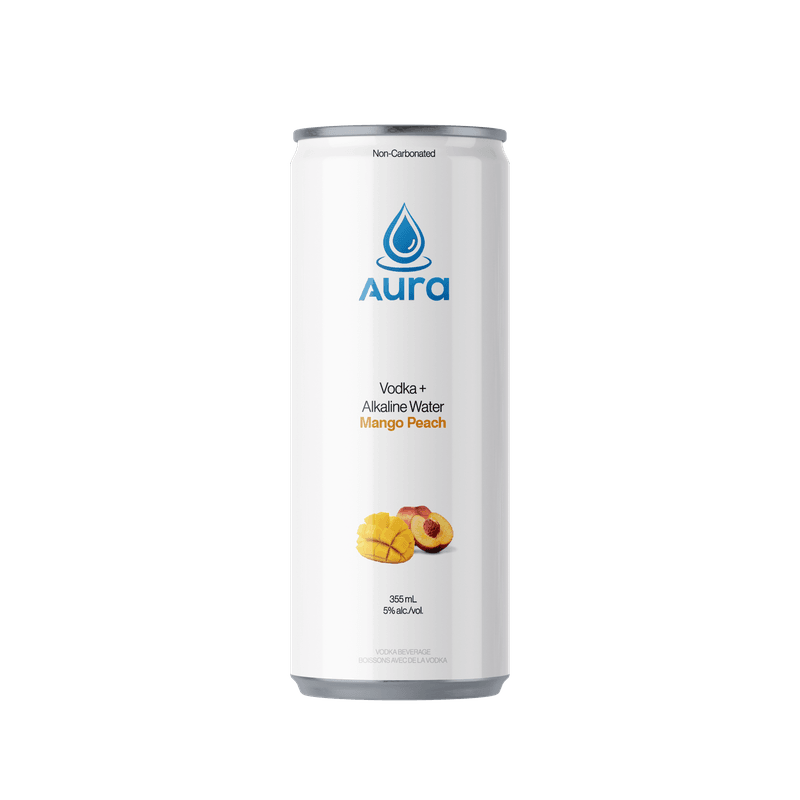
If you have been searching for a better mornings vodka, the honest answer is that no can delivers that. The dose and the timing do. Aura is a still vodka water cocktail — premium distilled vodka, alkaline water and natural flavour, with no added sugar, no artificial sweeteners and no preservatives, gluten-free — and it carries the same alcohol as anything else at the same serving. No bubbles means no bloating, which is a comfort claim about carbonation, not a health or sleep claim, and we are not going to dress it up as one.
What a can does give you is a fixed, countable serving in three flavours — Cucumber Lime, Coconut Pineapple, Mango Peach — so a two-drink ceiling is something you can hold to rather than estimate.
Have a look at our vodka water cocktails, read why Aura is still rather than sparkling, or find where to buy across British Columbia, Alberta and Ontario. Please enjoy responsibly, and only if you are of legal drinking age in your province.
This article summarises published research for general interest and is not medical advice.
Sources
- Gardiner C, Weakley J, Burke LM, Roach GD, Sargent C, Maniar N, Huynh M, Miller DJ, Townshend A, Halson SL. “The effect of alcohol on subsequent sleep in healthy adults: a systematic review and meta-analysis.” Sleep Medicine Reviews, 2024. PMID 39631226. pubmed.ncbi.nlm.nih.gov/39631226
- Ebrahim IO, Shapiro CM, Williams AJ, Fenwick PB. “Alcohol and sleep I: effects on normal sleep.” Alcoholism: Clinical and Experimental Research, 2013;37(4):539–549. doi:10.1111/acer.12006. PMID 23347102. pubmed.ncbi.nlm.nih.gov/23347102
- Chan JKM, Trinder J, Andrewes HE, Colrain IM, Nicholas CL. “The acute effects of alcohol on sleep architecture in late adolescence.” Alcoholism: Clinical and Experimental Research, 2013;37(10):1720–1728. doi:10.1111/acer.12141. PMC3987855
- Pietilä J, Helander E, Korhonen I, Myllymäki T, Kujala UM, Lindholm H. “Acute effect of alcohol intake on cardiovascular autonomic regulation during the first hours of sleep in a large real-world sample of Finnish employees: observational study.” JMIR Mental Health, 2018;5(1):e23. doi:10.2196/mental.9519. PMID 29549064. PMC5878366
- Landolt HP, Roth C, Dijk DJ, Borbély AA. “Late-afternoon ethanol intake affects nocturnal sleep and the sleep EEG in middle-aged men.” Journal of Clinical Psychopharmacology, 1996;16(6):428–436. PMID 8959467. pubmed.ncbi.nlm.nih.gov/8959467
- Stein MD, Friedmann PD. “Disturbed sleep and its relationship to alcohol use.” Substance Abuse, 2005;26:1–13. doi:10.1300/j465v26n01_01. PMID 16492658. PMC2775419
- Chaput JP, Wong SL, Michaud I. “Duration and quality of sleep among Canadians aged 18 to 79.” Health Reports, Statistics Canada, Catalogue no. 82-003-X, 2017. statcan.gc.ca
- Canadian Centre on Substance Use and Addiction. Canada's Guidance on Alcohol and Health, 2023. ccsa.ca