You logged four drinks on Saturday. Your app added roughly 400 calories and moved on — and then the week's numbers didn't behave the way that arithmetic said they should. The short answer from alcohol calories research is that the 7-calories-per-gram figure is real and well established, but it describes the energy sitting in the glass, not what your body does with it. Those are two different questions, and only the first is settled. Here's what the primary literature says, including the findings that cut against the tidy version, plus a formula you can run on the can in your fridge tonight.
Alcohol calories research: where the ethanol 7 calories per gram figure comes from
The number comes from the Atwater general factor system — the same convention that assigns 4 kcal/g to protein and carbohydrate and 9 kcal/g to fat. The FAO's Food Energy — Methods of Analysis and Conversion Factors (Food and Nutrition Paper 77, 2003) states that the system "also includes alcohol with a rounded value of 29 kJ/g (7.0 kcal/g or an unrounded value of 6.9 kcal/g)." That rounding is your first hint: 7 is a labelling convention, not a measurement taken on you.
Against a Canadian serving size the maths gets concrete. Canada's Guidance on Alcohol and Health (Canadian Centre on Substance Use and Addiction, January 2023) defines a standard drink as "17.05 millilitres or 13.45 grams of pure alcohol" — a 341 mL bottle of 5% beer, a 142 mL glass of 12% wine, or a 43 mL shot of 40% spirits. At 7 kcal/g that's about 94 calories of ethanol per standard drink, identical across all three, because the ethanol is identical. Everything above 94 comes from the mixer.
Your body puts ethanol at the front of the queue
Here is what the calorie label cannot express. In his review Alcohol metabolism (Clinics in Liver Disease, 2012), Arthur Cederbaum notes that "alcohol is not stored and remains in body water until eliminated," and that "alcohol will be oxidized preferentially over other nutrients." Roughly 90% is cleared by oxidation, under 10% leaving unchanged in breath, sweat and urine. He puts average metabolic capacity at about 170–240 g per day for a 70 kg person — around 7 g per hour.
Set that against 13.45 g per standard drink and you get a rule of thumb: roughly two hours of dedicated metabolic work per drink, regardless of what else you ate. Your liver doesn't queue drinks behind dinner. Dinner queues behind the drinks.
The measurable consequence was published in 1992. Suter, Schutz and Jéquier put eight healthy men through two 48-hour sessions in an indirect-calorimetry chamber (The effect of ethanol on fat storage in healthy subjects, New England Journal of Medicine). Ethanol at 96 ± 4 g/day cut 24-hour lipid oxidation by 49.4 ± 6.7 g/day when added to the diet (36 ± 3%, P<0.001) and by 44.1 ± 9.3 g/day when isocalorically substituted for fat and carbohydrate (31 ± 7%, P<0.0025). Carbohydrate and protein oxidation were not significantly altered.
Note that fat oxidation fell even when ethanol replaced other calories — a fuel-priority effect, not an arithmetic one. And 24-hour energy expenditure rose: 7 ± 1% with added ethanol (P<0.001), 4 ± 1% with substitution (P<0.025). Some of those 7 calories per gram go to the metabolising itself.
What the alcohol and weight studies actually found
If the mechanism were the whole story, drinkers would reliably gain weight. The alcohol and weight studies do not show that.
Greg Traversy and Jean-Philippe Chaput, of the CHEO Research Institute in Ottawa, reviewed the field in Alcohol Consumption and Obesity: An Update (Current Obesity Reports, 2015). Their conclusion: "recent prospective studies show that light-to-moderate alcohol intake is not associated with adiposity gain while heavy drinking is more consistently related to weight gain." Experimental evidence, they add, is "also mixed" — and moderate drinkers "may enjoy a healthier lifestyle in general that may protect them from weight gain."
The largest single result runs the other way. Wang and colleagues followed 19,220 US women of normal BMI for 12.9 years (Archives of Internal Medicine, 2010); 7,942 (41.3%) became overweight or obese and 732 (3.8%) obese. Adjusted relative risks of becoming overweight or obese across baseline intakes of 0, >0–<5, 5–<15, 15–<30 and ≥30 g/day were 1.00, 0.96, 0.86, 0.70 and 0.73 (P for trend <.001). For becoming obese: 1.00, 0.75, 0.43, 0.39 and 0.29 (P for trend <.001). An inverse association — the opposite of what naive calorie maths predicts.
Martin Yeomans reconciled the halves in Alcohol, appetite and energy balance (Physiology & Behavior, 2010). Lab work "clearly shows that energy consumed as alcohol is additive to that from other dietary sources," and drinking before or with a meal "tends to increase food intake." Yet the epidemiology "suggests that moderate alcohol intake may protect against obesity, particularly in women" — an effect he suspects "may be secondary to personality and habitual beverage preferences."
Where the simple calorie maths misleads
- 7 is rounded. FAO's unrounded figure is 6.9 kcal/g, and it's a population average, not your metabolism.
- Some is burned off as heat. Suter's chamber data put the rise in 24-hour energy expenditure at 4–7%.
- The calories are additive. Yeomans found people don't compensate at the next meal, so a drink's calories land on top of the day — and the appetite nudge on top of that.
- Suppressed fat oxidation is not "stored as fat." Ethanol changes which fuel burns first; storage still depends on your total energy balance for the day.
- The cohort data are confounded. Wang used self-reported weight and a single baseline questionnaire; Traversy and Chaput warn explicitly about healthy-user effects.
Run the numbers on your own can tonight
Ethanol's density is 0.789 g/mL — exactly what CCSA's own figures imply, since 13.45 ÷ 17.05 = 0.789. So:
- Volume in mL × (ABV ÷ 100) × 0.789 = grams of ethanol.
- Grams of ethanol × 7 = calories from alcohol.
- Add the sugar and carbohydrate calories from the panel. That total is your real number.
Run it across a few drinks and the pattern falls out fast: the first number barely moves between drinks of equal strength, while the second swings enormously. That second number is the only one a low calorie vodka drink can change — no added sugar does nothing to the ethanol arithmetic, it just stops the mixer adding a second bill on top.
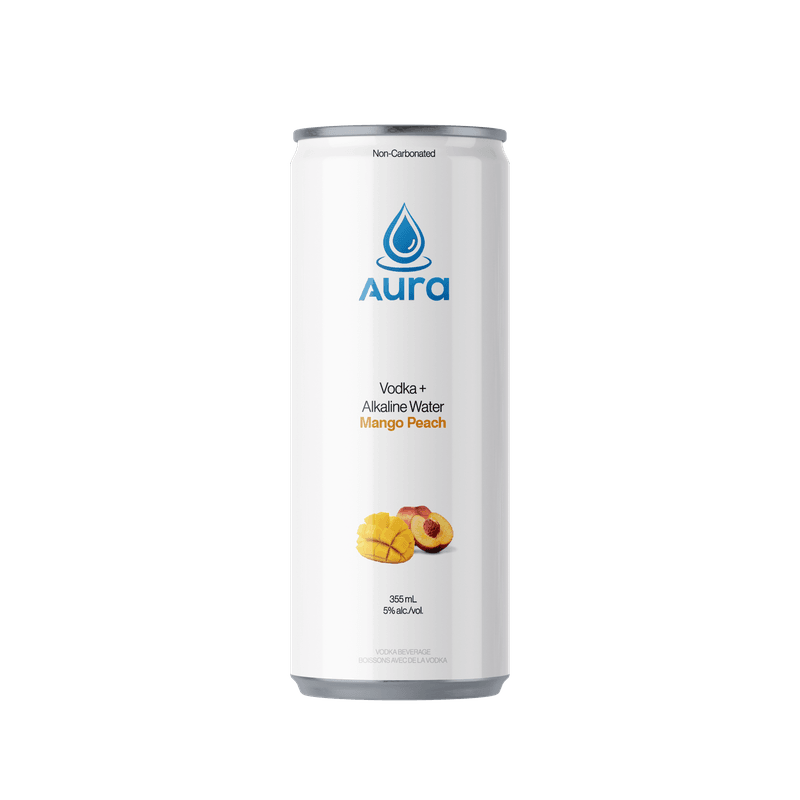
That's the honest case for our vodka water cocktails: Aura is premium distilled vodka, alkaline water and natural flavour — still, zero carbonation, no added sugar, no artificial sweeteners, no preservatives, gluten-free, in Cucumber Lime, Coconut Pineapple and Mango Peach. The reasoning behind that formulation is set out on why Aura.
What this research does not show
- Suter's study is eight men in a metabolic chamber over 24-hour windows — a mechanism study, not a weight-outcome trial.
- Wang's inverse association is observational and women-only. It does not license the claim that drinking prevents weight gain; unmeasured differences between drinkers and non-drinkers are the likelier explanation.
- No result here makes any alcoholic drink healthy. Canada's Guidance on Alcohol and Health places risk of harm as low at 2 standard drinks or fewer per week, moderate at 3 to 6, and "increasingly high" at 7 or more.
- Aura is not healthier, safer or less intoxicating than any other drink of the same strength. The ethanol in the can is the same ethanol, and its calories and risks travel with it. The absence of carbonation is a comfort and taste difference, not a health claim.
This article summarises published research for general interest and is not medical advice.
Aura is stocked across British Columbia, Alberta and Ontario — find a shelf near you at where to buy, or order a case of 24 × 355 mL cans direct for delivery to Ontario addresses. Please enjoy responsibly, and only if you're of legal drinking age in your province.
Sources
- Suter, P.M., Schutz, Y., & Jéquier, E. (1992). The effect of ethanol on fat storage in healthy subjects. New England Journal of Medicine, 326(15), 983–987. DOI: 10.1056/NEJM199204093261503. PMID: 1545851. PubMed
- Traversy, G., & Chaput, J.-P. (2015). Alcohol Consumption and Obesity: An Update. Current Obesity Reports, 4(1), 122–130. DOI: 10.1007/s13679-014-0129-4. PMID: 25741455. Springer
- Wang, L., Lee, I.-M., Manson, J.E., Buring, J.E., & Sesso, H.D. (2010). Alcohol consumption, weight gain, and risk of becoming overweight in middle-aged and older women. Archives of Internal Medicine, 170(5), 453–461. DOI: 10.1001/archinternmed.2009.527. PMID: 20212182. PubMed
- Yeomans, M.R. (2010). Alcohol, appetite and energy balance: is alcohol intake a risk factor for obesity? Physiology & Behavior, 100(1), 82–89. DOI: 10.1016/j.physbeh.2010.01.012. PMID: 20096714. PubMed
- Cederbaum, A.I. (2012). Alcohol metabolism. Clinics in Liver Disease, 16(4), 667–685. DOI: 10.1016/j.cld.2012.08.002. PMID: 23101976. PMC
- Food and Agriculture Organization of the United Nations (2003). Food Energy — Methods of Analysis and Conversion Factors. FAO Food and Nutrition Paper 77, Chapter 3. Rome: FAO. FAO
- Paradis, C., Butt, P., Shield, K., Poole, N., Wells, S., Naimi, T., & Sherk, A. (2023). Canada's Guidance on Alcohol and Health: Final Report. Ottawa, Ont.: Canadian Centre on Substance Use and Addiction. ISBN 978-1-77871-046-9. CCSA (PDF)