
If your face, neck and chest turn red within minutes of your first drink — and your heart starts thumping while everyone else is still sipping — you are not imagining it, and you are not simply "a lightweight." What you are experiencing is the alcohol flush reaction, and it has a specific, well-documented genetic cause. It is not an allergy to vodka. It is not dehydration. It is not something you can train away. It is your body signalling that it cannot clear a toxic by-product of alcohol fast enough.
Here is the direct answer, before anything else: the flush is caused by acetaldehyde building up in your blood because of a variant in the ALDH2 gene. The practical response is to drink less and slower — not to mask the redness. The research on why is genuinely useful, and worth ten minutes of your time.
What the alcohol flush reaction actually is
Your body breaks alcohol down in two steps. First, alcohol dehydrogenase converts ethanol into acetaldehyde — a reactive, toxic compound. Second, aldehyde dehydrogenase 2 (ALDH2) converts acetaldehyde into harmless acetate. If step two is slow, acetaldehyde pools in your bloodstream, dilates blood vessels, and produces the visible flush.
The culprit is a single-letter change in the ALDH2 gene known as rs671, or the ALDH2*2 allele. In their review in Disease Models & Mechanisms (2022), Chen, Kraemer and Mochly-Rosen describe this E504K missense variant as producing sharply reduced ALDH2 enzyme activity, with carriers reporting facial flushing, palpitations, tachycardia, muscle weakness, headache and nausea.
That cluster of symptoms is what most people mean when they say alcohol intolerance. It is a metabolic bottleneck, not an immune reaction — which is why antihistamines aimed at "the redness" address a symptom rather than the cause.
Asian flush explained: how common is ALDH2 deficiency?
The phrase "Asian flush" is a nickname, not a diagnosis, and the numbers behind it are substantial. In their 2009 paper in PLoS Medicine, Brooks and colleagues report that roughly 36% of East Asians show the flushing response, and estimate at least 540 million ALDH2-deficient people worldwide — about 8% of the global population.
Population survey data lines up with that. Yook and colleagues, writing in Scientific Reports (2024), analysed 5,572 adults from the 2019 Korea National Health and Nutrition Examination Survey and found an overall alcohol flushing prevalence of 40.56% — 43.74% in men and 37.4% in women.
It is not only an East Asian variant
This is where the popular framing gets it wrong. The same 2022 Disease Models & Mechanisms review identifies five additional ALDH2 missense variants found in African, Latino, South Asian and Finnish populations, together affecting an estimated 120 million people — roughly 1.5% of the world. In a country as demographically mixed as Canada, assuming the flush belongs to one ancestry group means a lot of people never connect their symptoms to a real, named biological mechanism.
Why the flush is a signal worth understanding
Plenty of people treat flushing as a cosmetic nuisance to be pushed through. The evidence suggests it is better read as information.
Brooks and colleagues found that ALDH2 heterozygotes carried two to three times the acetaldehyde in their saliva compared with people with fully active ALDH2 — and noted that salivary acetaldehyde levels run 10 to 20 times higher than blood levels. Their review of case-control studies reported odds ratios for oesophageal squamous cell carcinoma in ALDH2-deficient heterozygotes ranging from 3.7 to 18.1 after adjustment for alcohol consumption, with prospective data indicating a relative hazard for future upper aerodigestive tract cancers roughly 12 times higher. The authors estimated that if moderate and heavy-drinking ALDH2 heterozygotes reduced to light drinking, 53% of oesophageal squamous cell carcinomas in the Japanese male population might be prevented.
Two things follow. First, the risk is a product of the variant and the drinking — Brooks and colleagues are explicit that ALDH2 deficiency does not raise oesophageal cancer risk in non-drinkers. Second, if you flush, that reaction is doing you the favour of making an invisible exposure visible.
What the research does not show
Reported honestly, the evidence has real limits:
- Self-report is imperfect. The Korean prevalence figures rest on a questionnaire, not genotyping. The authors state plainly that "the accuracy of alcohol flushing status determined solely through self-reported symptoms compared with genetic testing cannot be ensured," and note recall bias and that flushing can be driven by factors beyond ALDH2.
- Correlation is not cause. That same study found current smokers had higher odds of flushing (adjusted OR 1.525, 95% CI 1.200–1.938), peaking at 20–29 pack-years (adjusted OR 1.725, 95% CI 1.266–2.349). It is a cross-sectional association — it does not establish that one causes the other.
- Odds ratios vary widely. A range of 3.7 to 18.1 across studies is a wide range. Brooks and colleagues caution that the magnitude of risk differs by population depending on how much alcohol matters relative to other factors.
- Masking is not addressed. Widely shared advice suggests taking an H2 blocker before drinking to suppress the redness. Even setting aside that this does nothing to clear acetaldehyde, the pharmacokinetics point the wrong way: in a randomised crossover study of 24 healthy men published in Alimentary Pharmacology & Therapeutics (1994), Burnham and colleagues found famotidine increased plasma alcohol AUC by 29% (P = 0.006) and peak concentration by 23% (P = 0.013). In fairness to the data, those authors judged the effect "unimportant clinically." The honest summary: suppressing a warning light is not the same as fixing the engine, and this is a question for your doctor, not a blog.
- No drink changes your genotype. That includes ours. A still vodka water and a vodka soda deliver the same ethanol; nothing about a can's format, water source or flavour affects ALDH2 activity, acetaldehyde clearance, flushing or intoxication.
What you can actually do
- Count, don't estimate. Canada's Guidance on Alcohol and Health (CCSA, 2023) places 2 standard drinks or less per week at low risk, 3–6 at moderate risk, and 7 or more at increasingly high risk. Read the ABV on whatever you're holding and work out the standard drinks before you pour.
- Slow the rate. The flush tracks acetaldehyde accumulation, so pace and total volume are the levers you control. Alternate with water.
- Don't stack exposures. Given what the data suggest about smoking and acetaldehyde together, pairing drinking with tobacco is the combination to avoid.
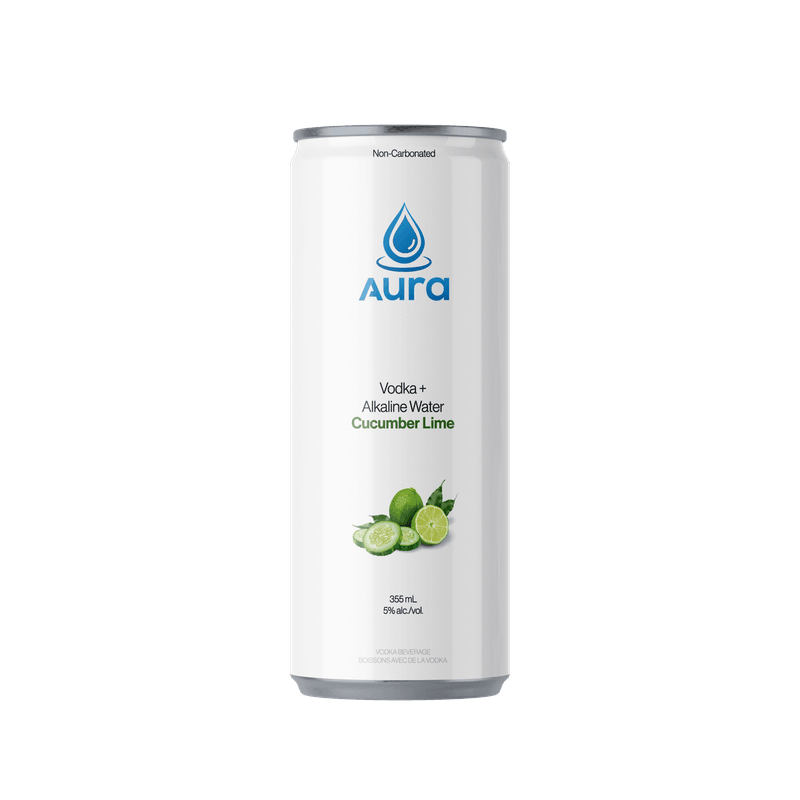
- Choose a format you'll sip, not shoot. Our vodka water cocktails are still — zero carbonation, no bubbles, no fizz — with no added sugar, no artificial sweeteners and no preservatives, and they're gluten-free. That's a comfort and taste decision, not a health one. The reason we made them still is bloating, not biology: why Aura explains it.
- Talk to a physician if flushing comes with chest pain, breathing trouble or severe symptoms — that's beyond the scope of any article.
Where to find Aura in Canada
Aura comes in Cucumber Lime, Coconut Pineapple and Mango Peach, in 355mL cans sold by the case of 24, available across British Columbia, Alberta and Ontario. Our own direct and wholesale ordering delivers to Ontario addresses only. In Alberta, look for AGLC-licensed private retailers; in British Columbia, BC Liquor Stores and licensed private retailers — where to buy has the current list.
If you flush, the most useful thing you can do is treat it as data. Drink less, drink slower, and pick something you genuinely enjoy sipping. When that's a still, unsweetened vodka water, our vodka water cocktails are waiting. Please enjoy responsibly, and only if you are of legal drinking age in your province.
This article summarises published research for general interest and is not medical advice. Speak with a healthcare professional about your own circumstances.
Sources
- Brooks PJ, Enoch M-A, Goldman D, Li T-K, Yokoyama A. "The Alcohol Flushing Response: An Unrecognized Risk Factor for Esophageal Cancer from Alcohol Consumption." PLoS Medicine, 2009. doi:10.1371/journal.pmed.1000050. Read the paper
- Chen C-H, Kraemer BR, Mochly-Rosen D. "ALDH2 variance in disease and populations." Disease Models & Mechanisms, 2022;15(6):dmm049601. doi:10.1242/dmm.049601. Read the paper
- Yook HJ, Lee G-N, Lee JH, Han K, Park YM. "Epidemiologic relationship between alcohol flushing and smoking in the Korean population: the Korea National Health and Nutrition Examination Survey." Scientific Reports, 2024;14:15710. doi:10.1038/s41598-024-66521-z. PMCID: PMC11231332. Read the paper
- Burnham DB, Miller D, Karlstadt R, Friedman CJ, Palmer RH. "Famotidine increases plasma alcohol concentration in healthy subjects." Alimentary Pharmacology & Therapeutics, 1994;8(1):55–61. PMID: 8186347. doi:10.1111/j.1365-2036.1994.tb00160.x. Read the abstract
- Canadian Centre on Substance Use and Addiction. "Canada's Guidance on Alcohol and Health." CCSA, 2023. Read the guidance