You have seen the headline — "two drinks a week" — and it probably made you feel vaguely guilty about the can in your hand. Here is the short version of the alcohol guidelines Canada now works from: nobody banned your Friday drink, and that number is not a limit or a cliff edge. It is one point on a scale, chosen using a published definition of "acceptable risk." See how it was picked and the guidance becomes usable rather than alarming.
What the alcohol guidelines Canada uses in 2023 actually say
In January 2023 the Canadian Centre on Substance Use and Addiction (CCSA) published Canada's Guidance on Alcohol and Health: Final Report, from a process Health Canada funded starting in July 2020. It sets no limit. It describes a continuum of risk by average weekly consumption:
- 0 drinks a week: no alcohol-related risk.
- 1–2 drinks a week: low risk — "you are likely to avoid alcohol-related consequences for yourself or others."
- 3–6 drinks a week: moderate risk — increased risk of several cancers, including breast and colon cancer.
- 7 or more drinks a week: increasingly high risk, with heart disease and stroke risk rising, every extra drink adding more.
A separate statement covers single occasions: more than 2 standard drinks at one sitting is associated with increased risk of harm to self and others, including injury and violence. The CCSA also states there is no known safe amount when pregnant or trying to conceive.
The arithmetic matters here. A Canadian standard drink is 17.05 mL (13.45 g) of pure alcohol — a 341 mL bottle of 5% beer, a 142 mL glass of 12% wine, a 43 mL shot of 40% spirits. A 355 mL can at 5% ABV holds 17.75 mL, so it counts as about 1.04 standard drinks; a generous 6 oz wine pour is about 1.2.
How this differs from the old low risk drinking guidelines
Canada's 2011 Low-Risk Alcohol Drinking Guidelines allowed up to 15 drinks a week for men and 10 for women. The drinking guidelines 2023 produced look different: one continuum for everyone, no separate male and female thresholds, at a far lower reference point. Three things drove the change.
1. The 2011 guidance was already flagged as weak
The Public Health Agency of Canada appraised the 2011 low risk drinking guidelines with AGREE II and scored them 60.7% overall, with rigour of development and editorial independence below the 60% minimum. They were recommended for use only with modifications.
2. The evidence base moved
Systematic reviews since 2011 found no lower-risk threshold for alcohol and several cancers, and the supposed protective effect of light drinking on ischemic heart disease became far less certain. The 2023 modelling did not reproduce the famous J-shaped curve. It did see a protective association at one drink a week — but the uncertainty intervals crossed the null, "which means there is not enough evidence to confirm the protective effect."
3. The threshold is a risk-tolerance choice
Almost every headline dropped this part. The CCSA modelled years of life lost, then applied conventional risk thresholds. A 1-in-1,000 lifetime risk of an alcohol-attributable death corresponds to 2 standard drinks a week (95% UI: <1 to 6 for females, <1 to 8 for males). A 1-in-100 threshold — historically the one used for alcohol guidelines — corresponds to 6 drinks a week. The "2" and the "6" are the same evidence read at two levels of acceptable risk. The old limits fare badly under that model: 29 g/day for males equated to 757 years of life lost per 1,000 lifetimes.
What the research does and does not establish
A meta-analysis of 107 cohort studies covering 4,838,825 participants and 425,564 deaths (Zhao et al., JAMA Network Open, 2023) found the apparent longevity advantage of light drinking largely disappeared after adjustment: relative risk moved from 0.85 (95% CI 0.81–0.88) to a non-significant 0.93 (95% CI 0.85–1.01, P = .08). "A drink a day is good for you" does not survive scrutiny.
It cuts both ways, though. In that same analysis, significant increases in all-cause mortality appeared only at 25 g/day or more for women (RR 1.22, P = .03) and 45 g/day or more for men. Low-volume drinking was not shown to extend life; on that outcome, it was not shown to shorten it either. The CCSA reference points sit lower because they model cumulative years of life lost across many diseases, including cancers with no apparent safe threshold — not because a mortality signal was found at two drinks a week.
Canadian data support the direction, in small increments. Among 145,760 Canadian drinkers followed up to 17 years (Clay et al., Drug and Alcohol Review, 2025), each additional standard drink per week carried a hazard ratio of 1.009 for all-cause mortality (95% CI 1.007–1.012). Dose-dependent, consistent, and per drink small. It accumulates; it does not detonate.
The caveats worth knowing
- No randomised trials exist. The CCSA says so plainly; everything rests on observational studies, many adjusting only for age and sex.
- Uncertainty is wide. The 2-drink threshold's interval reaches 6 to 8 drinks — not a rounding error.
- Patterns could not be modelled. The underlying studies used weekly averages, so the report could not model how binge drinking affects risk.
- It is a population average. The CCSA writes that its conclusions "do not necessarily apply to any individual and their unique socio-behavioural, genetic and medical circumstances," and that the literature was not adequate to cover mental-health and social outcomes.
- Critics were heard. The consultation appendix records submissions arguing the methods may overestimate risk at low intake; the CCSA replied that the direction of measurement bias in cohort studies is unknown.
So how much alcohol is safe — and what should you do today?
The honest answer to how much alcohol is safe: no level is entirely risk-free, and the guidance asks you to choose a level of risk rather than obey a rule. In practice:
- Count standard drinks, not containers. Multiply mL by ABV, divide by 17.05, once, for the drinks you actually buy.
- Pick your zone deliberately. Under 3 a week, 3–6, or 7-plus — decide it, don't discover it at month's end.
- Watch the occasion, not just the week. Six on Saturday is not the same as one a night, at identical weekly totals. Alcohol-free days and water in between are the cheapest lever you have.
- Know you have company. In Statistics Canada's 2023 Canadian Community Health Survey, 54% of adults in the provinces drank nothing in the past seven days; 15% had 1–2, 15% had 3–6, 15% had 7 or more.
The scale of the reframing: among 1,502 Ontario adults, 52.2% exceeded the new low-risk threshold versus 11.3% under the 2011 guidelines — 4.6 times as many reclassified, nobody's drinking changed.
Where Aura fits
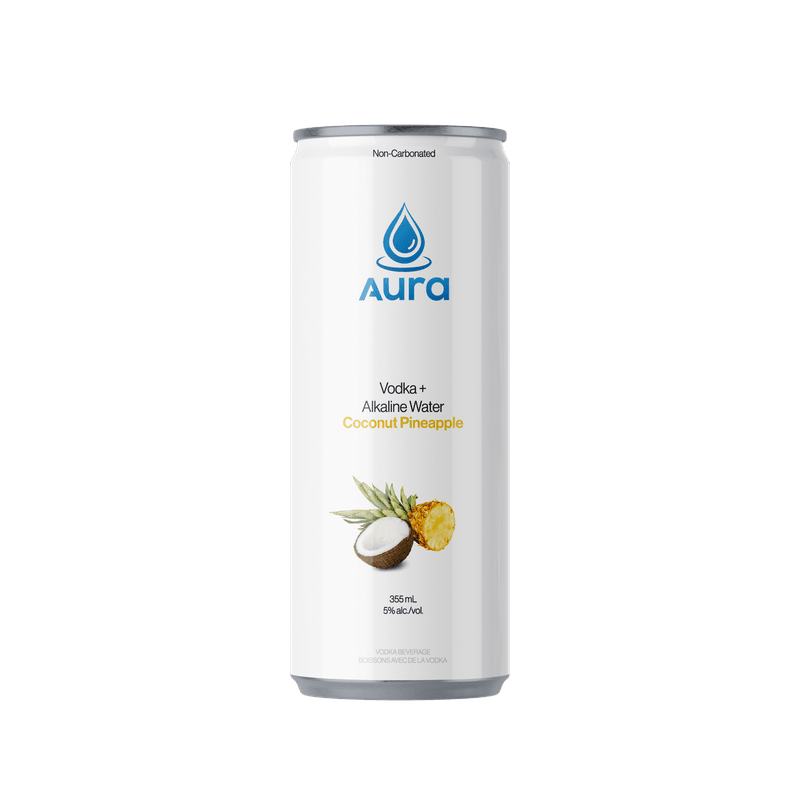
We will not pretend our can is a health product. Our vodka water cocktails contain the same ethanol the CCSA counts, and one can counts toward your week like any drink of the same size and strength. What Aura offers is something easy to count and pace: premium vodka, alkaline water and natural flavour, no added sugar, no artificial sweeteners, no preservatives, gluten-free. It is a still drink — no carbonation at all, which is the point of why Aura. That is a comfort and taste difference, not a health claim.
Aura comes in 355 mL cans by the case of 24 — Cucumber Lime, Coconut Pineapple, Mango Peach — across British Columbia, Alberta and Ontario. Our direct and wholesale ordering delivers to Ontario addresses only; in BC and Alberta, check where to buy (BC Liquor Stores and licensed private retailers in BC, AGLC-licensed private retailers in Alberta).
Pick the zone you are comfortable with, count honestly, and make the drinks you do have worth it. If a still, no-bubbles vodka water is your kind of drink, find where to buy Aura near you — responsibly, and only if you are of legal drinking age in your province.
This article summarises published research for general interest and is not medical advice.
Sources
- Canadian Centre on Substance Use and Addiction. Canada's Guidance on Alcohol and Health: Final Report. Ottawa, Ont.: CCSA, January 2023. ccsa.ca
- Zhao J, Stockwell T, Naimi T, Churchill S, Clay J, Sherk A. Association Between Daily Alcohol Intake and Risk of All-Cause Mortality: A Systematic Review and Meta-analyses. JAMA Network Open. 2023;6(3):e236185. doi:10.1001/jamanetworkopen.2023.6185. PMID: 37000449. PMC10066463
- Clay JM, Callaghan RC, Sherk A, Naimi TS, Stockwell T, Asbridge M. Alcohol consumption and mortality among Canadian drinkers: a national population-based survival analysis (2000–2017). Drug Alcohol Rev. 2025;44(2):434–447. doi:10.1111/dar.13993. PMC11814365
- Belisario KL, Doggett A, MacKillop J. The increase in risk classification using Canada's Guidance on Alcohol and Health: an empirical examination in a sample of community adults in Ontario. Health Promot Chronic Dis Prev Can. 2025;45(2):85–97. doi:10.24095/hpcdp.45.2.03. PMC11987587
- Statistics Canada. A snapshot of alcohol consumption levels in Canada, 2023. The Daily, 2 October 2024; Canadian Community Health Survey 2023. statcan.gc.ca