You are at the cooler with a can in your hand, trying to answer two ordinary questions: how much alcohol is in this, and what is in it besides alcohol? Turn the can around and you often find less information than a bag of chips carries. That is not a brand cutting corners — it is how the rules work. The short version on alcohol labelling Canada enforces: the label must tell you the strength of the drink, but it is generally not required to tell you the dose, the calories, or, for many products, the ingredients. Here is what must legally appear on a can, what is optional, and how to fill the gaps yourself in about ten seconds.
Alcohol labelling Canada rules: what must appear on the can by law
Two federal frameworks do most of the work: the Food and Drug Regulations (FDR) and the Safe Food for Canadians Regulations (SFCR). The Canadian Food Inspection Agency's industry guidance for beverage alcohol sets out the mandatory core, and it is shorter than most people expect:
- Alcohol by volume. Any beverage at 1.1% alcohol or more must declare the percentage by volume — "5% alc./vol." or an equivalent format — on the principal display panel [B.02.003, FDR].
- A common name, in English and French [B.01.012(2), FDR; 206(1), SFCR]. For standardized products like beer, wine or rum, that name is the prescribed one; for everything else it is the name the product is generally known by.
- Net quantity — the 355 mL or 750 mL on the front — with type-height rules set out in the SFCR.
- The name and principal place of business of the responsible company, so a product can be traced back to someone.
- Allergens, gluten sources and added sulphites at 10 parts per million or more, which must be declared even on products that are exempt from listing ingredients [B.01.010.1(2), FDR].
- Country of origin for certain categories, such as imported brandy [B.02.060, FDR] and standardized wines [B.02.108, FDR].
That is close to the whole mandatory list. Notice what is absent: no calories, no sugar, no standard-drink count, and — for many products — no ingredients at all.
What is not required, and why
Alcoholic beverages above 0.5% alcohol are generally exempt from carrying a Nutrition Facts table [B.01.401(2)(b)(i), FDR], and from the front-of-package nutrition symbol while that exemption holds [B.01.350(13)(a), FDR]. The exemption is conditional: make a nutrient content claim — "zero sugar," "90 calories" — and the Nutrition Facts table becomes mandatory [B.01.401(3), FDR]. Declaring alcohol by volume does not count as a nutrient content claim [B.01.502(2)(j), FDR], which is why a bottle can shout "13.5% alc./vol." and still carry no nutrition panel.
There is also no federal requirement to print the number of standard drinks in the container. That matters more than it sounds, because Canada's national drinking guidance is written entirely in standard drinks — and the number on the can is a percentage, not a count.
Alcohol ingredient labelling: why some cans list everything and others list nothing
This is the part most people get wrong. Canada does not exempt alcohol from ingredient lists across the board. It exempts standardized alcoholic beverages — products that meet a prescribed compositional standard, such as beer, wine and rum [B.01.008(2)(f), FDR] — plus a named list of spirits including Scotch whisky, Irish whisky, Armagnac and Cognac brandy, Bourbon, Tennessee whisky, Tequila and Mezcal [B.01.008(2)(f.1), FDR].
Everything else follows the normal food rule and needs a full ingredient list. In practice that means canned cocktail ingredients are usually disclosed, because a canned mixed drink is not a standardized beverage — it is spirit blended with water, flavour and whatever else the maker chose. So the counterintuitive result of alcohol ingredient labelling in Canada is that a $4 can often tells you more about its contents than a $40 bottle of wine does.
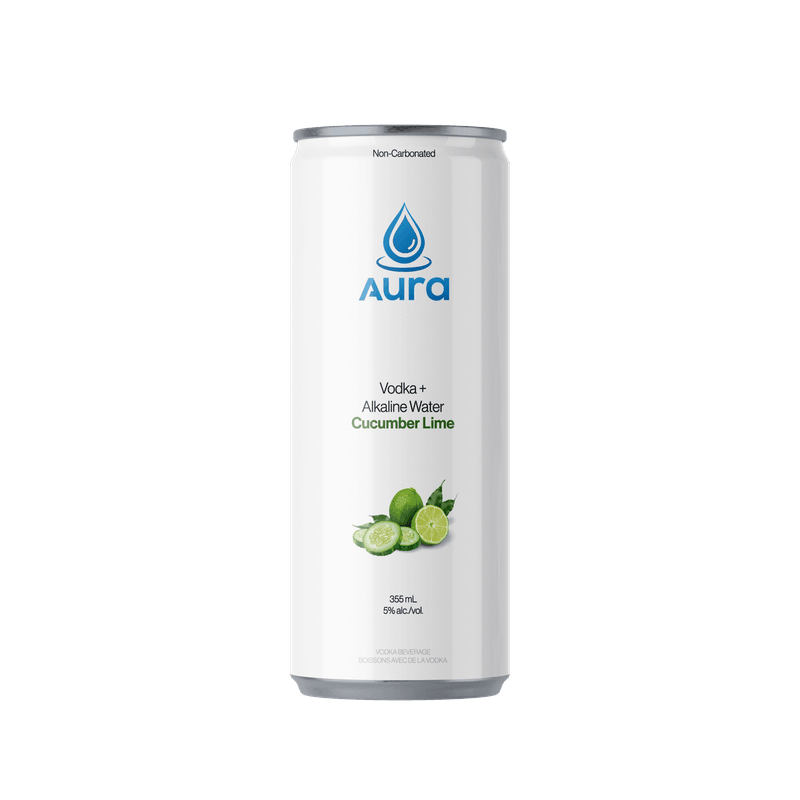
It is why the make-up of our vodka water cocktails is easy to state, and why why Aura reads the way it does: premium distilled vodka, alkaline water at pH 8.5 or higher, and natural flavour — no added sugar, no artificial sweeteners, no preservatives, gluten-free, and still, with zero carbonation.
So what is on an alcohol label — and how do you read the gaps?
Here is the practical skill. If you want to know what is on an alcohol label but not printed on it, you can calculate the most useful missing number yourself.
- Find the pure alcohol. Multiply the container volume in millilitres by the %ABV, then divide by 100. A 355 mL can at 5% alc./vol. contains 17.75 mL of pure alcohol.
- Convert to standard drinks. The Canadian Centre on Substance Use and Addiction (CCSA) defines a standard drink as 17.05 mL, or 13.45 g, of pure alcohol. So that 355 mL can at 5% is about 1.04 standard drinks — just over one.
- Read claims as regulatory signals. A can carrying "zero sugar" must also carry a Nutrition Facts table. No claim, no panel — the absence of nutrition information tells you nothing about the product's contents.
- Check the allergen line even on exempt products. Sulphites at 10 ppm or more, gluten sources and priority allergens have to be declared regardless.
What the research actually shows about better labels
CCSA commissioned a systematic review of enhanced alcohol container labels, published in 2022 by Hobin and colleagues. It searched ten databases and included 62 articles reporting 54 primary studies: 15 articles on nutrition information, 45 on health messages, 18 on standard drink information and 12 on drink limit guidelines. The clearest finding was on comprehension — exposure to standard drink labels, compared with alcohol-by-volume labels alone, consistently produced more accurate estimates of how much alcohol was in a container.
The effects on behaviour are much weaker, and the review says so. In the real-world quasi-experiment in Whitehorse, Yukon, the increase in participants who could accurately estimate the number of standard drinks in a container was 6.3% at the intervention site versus 5.5% at the comparison site — an adjusted odds ratio of 1.06, 95% CI 0.59 to 1.93, which does not exclude no effect at all. Intentions to use the information to stay within national guidelines moved 2.9% versus 0.3% (AOR 1.04, 95% CI 0.75 to 1.46). The review also found no published real-world evaluation of alcohol nutrition labels, and mixed or null results for their effect on how much people actually drink.
The caveats, including the one that cuts against more labelling
A randomized trial published in Preventive Medicine by Vanderlee and colleagues, with an analytical sample of 3,880 Canadian adults surveyed in November and December 2024, tested how nutrition information changed perceptions of a wine product. Compared with 16.5% in the no-label control, 28.3% of participants shown a Nutrition Facts table rated the wine as at least "a little healthy" (AOR 1.97, 95% CI 1.57–2.47), and 23.8% did so with textual nutrition information (AOR 1.60, 95% CI 1.27–2.02). An "Alcohol Facts" style table produced no significant difference from control (18.8%).
The lesson applies to us as much as anyone: food-style information on an alcoholic product can make people read it as healthier when nothing about the alcohol has changed. So, explicitly: none of this research shows that any canned drink is healthier, safer or less intoxicating than another. A gram of alcohol is a gram of alcohol, still or sparkling, long ingredient list or none. Aura has no carbonation, which some people find more comfortable to drink — a preference, not a health claim. Other limits worth naming: much of this evidence comes from online surveys and lab tasks rather than real purchases, designs and sample sizes vary widely, and label preferences differ by country.
This article summarises published research and federal regulations for general interest. It is not medical advice, and it is not legal advice on label compliance.
Reading your next can
Read the %ABV, do the two-step standard drink math, check whether an ingredient list is present — if it is not, the product is probably standardized rather than secretive — and treat any nutrition claim as a signal that a full panel must be nearby. That is most of what a careful shopper in Canada can extract from a label today.
If you want a drink whose ingredients fit in one line, try our vodka water cocktails in Cucumber Lime, Coconut Pineapple or Mango Peach — 355 mL cans, sold by the case of 24. Our own direct and wholesale ordering delivers to Ontario addresses only; if you are in British Columbia or Alberta, check where to buy and look for Aura through BC Liquor Stores and licensed private retailers in BC, or AGLC-licensed private retailers in Alberta. Please enjoy responsibly, and only if you are of legal drinking age in your province.
Sources
- Canadian Food Inspection Agency. Alcoholic beverages — Food labelling for industry. Government of Canada. inspection.canada.ca
- Government of Canada. Food and Drug Regulations, C.R.C., c. 870, section B.01.008 (list of ingredients and exemptions). Justice Laws Website. laws-lois.justice.gc.ca
- Hobin, E., Jansen, R., Vanderlee, L., & Berenbaum, E. (2022). Enhanced alcohol container labels: A systematic review. Ottawa, Ont.: Canadian Centre on Substance Use and Addiction. ISBN 978-1-77178-855-7. ccsa.ca (PDF)
- Canadian Centre on Substance Use and Addiction (2023). Canada's Guidance on Alcohol and Health: Final Report. Ottawa, Ont.: CCSA. ccsa.ca (PDF)
- Vanderlee, L., White, C. M., Hammond, D., & Hobin, E. (2026). The impact of nutrition information labels on alcohol containers in Canada: an online randomized trial. Preventive Medicine, 202, 108475. doi:10.1016/j.ypmed.2025.108475. PMID 41308701. pubmed.ncbi.nlm.nih.gov