You and a friend split the same case at the same backyard party. Same number of cans, same hours, same food. You feel fine; they don't. Before anyone blames willpower or tolerance, look at the physiology: alcohol metabolism men vs women is a real, measurable difference, and it starts with something as unglamorous as how much water your body is made of. Here is what the peer-reviewed evidence actually supports, what it does not, and how to turn it into a drink count you can use tonight in Canada.
Alcohol metabolism men vs women: the short answer
Two mechanisms get cited constantly. Only one of them is on solid ground.
- Total body water (strong evidence). Ethanol distributes into body water and does not bind to plasma protein. Women, on average, carry a higher proportion of body fat and therefore less water per kilogram. Same dose, smaller solvent volume, higher concentration.
- First-pass gastric metabolism (contested). The famous 1990 finding that women break down less alcohol in the stomach wall before it reaches the bloodstream has been challenged by later work and may be far smaller than the original headline suggested.
- Everything else. Body size, food in the stomach, drinking speed, medication and genetics all move blood alcohol more than most people assume.
The practical version: for the same drink, the same body weight and the same hour, a woman will typically reach a higher blood alcohol concentration than a man. That is a dosing fact, not a moral one — and it means drink counting, not "how do I feel right now," is the tool that works.
Body water is the factor that actually carries the weight
The reference dataset here is Watson, Watson and Batt's 1980 paper in the American Journal of Clinical Nutrition, which pooled dilution-study measurements from 458 adult males and 265 adult females to build total body water (TBW) prediction equations still used in forensic and clinical work today (PMID 6986753). Their equations are: males, TBW = 2.447 − 0.09516 × age + 0.1074 × height + 0.3362 × weight; females, TBW = −2.097 + 0.1069 × height + 0.2466 × weight (litres, cm, kg).
Run the arithmetic on two 35-year-old, 70 kg people. A 175 cm man comes out at roughly 41.4 L of body water. A 165 cm woman comes out at roughly 32.8 L. Identical alcohol dose, about 26% higher concentration in the woman. Hold height constant at 175 cm for both and the gap narrows but does not close — roughly 22%. That calculation is ours, using their published equations, and it is an average-case illustration rather than a prediction about any individual.
This is not a fringe view. Maskell and colleagues, writing in Forensic Science International in 2020, compared methods across data from 173 men and 63 women for ethanol distribution volume and 582 men and 884 women for total body water, and concluded that blood-alcohol calculations are more reliable using TBW, with root-mean-square errors of 9.09–12.84% versus 11.72–15.08% for volume of distribution (PMID 33099270). Even the better method carries roughly 10% error. Keep that in mind before anyone tries to calculate their way to a legal BAC.
First-pass metabolism: the famous finding, and the pushback
In January 1990, Frezza and colleagues published in the New England Journal of Medicine a study of 20 men and 23 women (six alcoholics in each group) given 0.3 g/kg of ethanol both orally and intravenously, with gastric biopsies to measure alcohol dehydrogenase. In the non-alcoholic subjects, women's first-pass metabolism and gastric alcohol dehydrogenase activity were 23% and 59%, respectively, of the men's (PMID 2248624). That single result is the source of nearly every "women's stomachs don't break down alcohol" line you have ever read.
Then it got complicated. In 1996, Ammon and colleagues in Clinical Pharmacology & Therapeutics gave six women and six men ethanol by intravenous, oral and intraduodenal routes after a standardised lunch and found total first-pass metabolism was "not pronounced in either males (9.1% ± 4.0%) or females (8.4% ± 3.1%)" — a minor effect that did not differ by gender (PMID 8646821). Lieber's group continued to argue the stomach metabolises clinically meaningful amounts and that gastric enzyme activity is reduced in women and inhibited by common drugs such as aspirin and H2-blockers (PMID 8974331). Note the sample sizes on both sides: 43 people and 12 people. Neither settles it.
Honest summary: body water explains most of the observed sex differences in blood alcohol. First-pass gastric metabolism may add something, the size of that something is disputed, and you should not build a drinking plan on it.
What this means for standard drinks in Canada
Canada gives you a unit that removes the guesswork. Per the Canadian Centre on Substance Use and Addiction's 2023 Canada's Guidance on Alcohol and Health, a standard drink is 17.05 mL or 13.45 g of pure alcohol — a 341 mL bottle of 5% beer, a 142 mL glass of 12% wine, or a 43 mL shot of 40% spirits.
The guidance deliberately uses the same risk continuum for everyone: 2 drinks or fewer per week is the low-risk zone, 3–6 raises cancer risk, and 7 or more significantly raises heart disease and stroke risk. On sex, the report is careful: physiological differences at low levels of use "have only a small impact on lifetime risk of death," but above 6 standard drinks per week "the health risks increase more steeply for females than for males." It also flags that more than 2 standard drinks on a single occasion carries a significantly increased risk of harm to yourself and others. Meanwhile Statistics Canada's 2023 Canadian Community Health Survey found nearly twice as many men (20%) as women (11%) reported 7 or more drinks in the past week — the sex difference in behaviour is larger than the one in biology.
How to count what is actually in your can
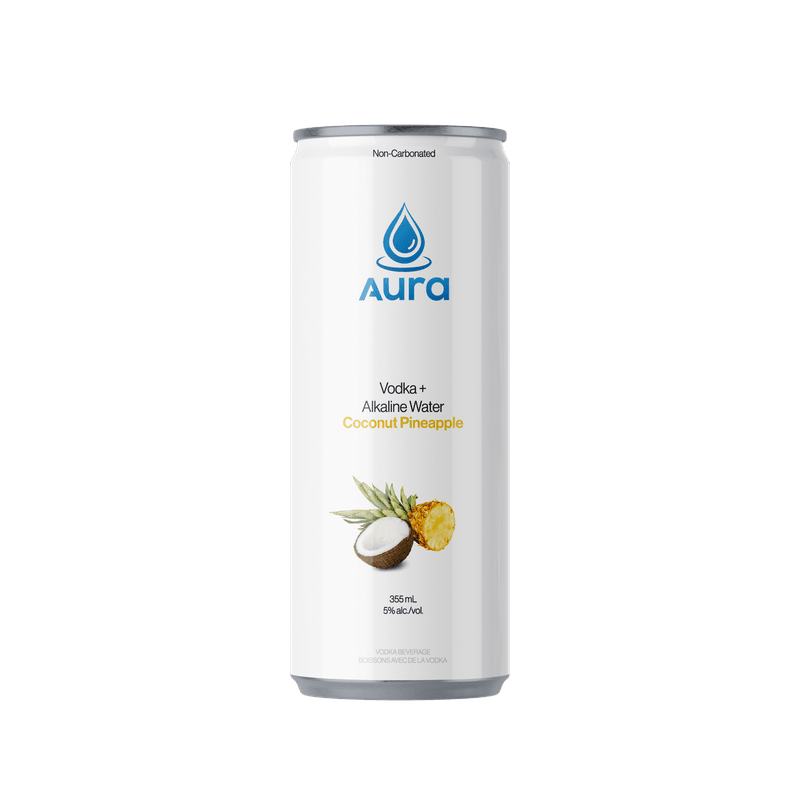
The formula: standard drinks = mL × ABV% ÷ 100 ÷ 17.05. Aura cans are 355 mL, so take the ABV printed on the can and run it. At 5% ABV, a 355 mL can holds 17.75 mL of pure alcohol — 1.04 Canadian standard drinks, so four cans is four standard drinks and change. That arithmetic is identical whether you are drinking our vodka water cocktails, a beer or a glass of wine. Aura is a still drink with no carbonation, and that changes the mouthfeel, not the maths — the alcohol is the same alcohol.
What the research does not show
- It does not give you a personal BAC calculator. Even the best anthropometric method carries around 10% error, and no formula accounts for what you ate, how fast you drank or what medication you take.
- It does not mean women should simply "drink less and it's fine." Canada's guidance sets the same weekly continuum for everyone because risk rises for both sexes.
- It does not make any product safer. A still drink, a sparkling one and a shot with the same ethanol content deliver the same ethanol. Absorption comfort and bloating are not health claims, and nothing here suggests Aura is healthier, safer or less intoxicating.
- The first-pass literature is genuinely unresolved, with small samples on both sides and contradictory results.
Five things to do today
- Count in standard drinks, not containers. Do the ABV maths once and remember your number.
- Pre-decide the count before the first drink, not after the third.
- Eat first. Food slows gastric emptying and blunts the peak.
- Alternate with water and hold a one-per-hour ceiling as a floor-level rule, not a licence.
- Never use a formula to decide you are fit to drive. If you have been drinking, do not drive.
If you want a lower-count option that still feels like a real drink, look at our vodka water cocktails in Cucumber Lime, Coconut Pineapple and Mango Peach, read why Aura makes a still vodka water with no added sugar, and check where to buy across British Columbia, Alberta and Ontario. Direct and wholesale orders from us deliver to Ontario addresses only; in Alberta, ask your AGLC-licensed private retailer, and in BC, BC Liquor Stores and licensed private retailers. Must be of legal drinking age. Please enjoy responsibly.
This article summarises published research for general interest and is not medical advice.
Sources
- Frezza M, di Padova C, Pozzato G, Terpin M, Baraona E, Lieber CS. "High blood alcohol levels in women. The role of decreased gastric alcohol dehydrogenase activity and first-pass metabolism." New England Journal of Medicine, 1990;322(2):95–99. PMID 2248624. DOI 10.1056/NEJM199001113220205. pubmed.ncbi.nlm.nih.gov/2248624
- Ammon E, Schäfer C, Hofmann U, Klotz U. "Disposition and first-pass metabolism of ethanol in humans: is it gastric or hepatic and does it depend on gender?" Clinical Pharmacology & Therapeutics, 1996;59(5):503–513. PMID 8646821. DOI 10.1016/S0009-9236(96)90178-2. pubmed.ncbi.nlm.nih.gov/8646821
- Lieber CS, Gentry RT, Baraona E. "First pass metabolism of ethanol." Alcohol and Alcoholism Supplement, 1994;2:163–169. PMID 8974331. pubmed.ncbi.nlm.nih.gov/8974331
- Watson PE, Watson ID, Batt RD. "Total body water volumes for adult males and females estimated from simple anthropometric measurements." American Journal of Clinical Nutrition, 1980;33(1):27–39. PMID 6986753. pubmed.ncbi.nlm.nih.gov/6986753
- Maskell PD, Jones AW, Heymsfield SB, Shapses S, Johnston A. "Total body water is the preferred method to use in forensic blood-alcohol calculations rather than ethanol's volume of distribution." Forensic Science International, 2020;316:110532. PMID 33099270. DOI 10.1016/j.forsciint.2020.110532. pubmed.ncbi.nlm.nih.gov/33099270
- Paradis C, Butt P, Shield K, Poole N, Wells S, Naimi T, Sherk A, et al. Canada's Guidance on Alcohol and Health: Final Report. Canadian Centre on Substance Use and Addiction, January 2023. ISBN 978-1-77871-046-9. ccsa.ca
- Statistics Canada. "A snapshot of alcohol consumption levels in Canada: Half of Canadian adults reported not drinking any alcohol in the past seven days, 2023." The Daily, 2 October 2024, Canadian Community Health Survey 2023. www150.statcan.gc.ca