You are holding a can that says "alkaline" and you want to know one thing: does that word mean anything, or is it a sticker? Here is the direct answer. Alkaline alcoholic drinks are drinks whose finished liquid sits above pH 7.0 — the neutral point — usually because they are built on alkaline water and carry little or no citrus, juice or carbonation. Almost everything else behind the bar sits on the other side of that line. That is chemistry you can check.
What makes a drink alkaline rather than acidic
pH runs from 0 to 14: below 7 is acidic, 7 is neutral, above 7 is alkaline. The scale is logarithmic, so a drink at pH 3.0 is ten times more acidic than one at pH 4.0 and a hundred times more acidic than one at pH 5.0. Small-looking gaps are large real ones.
Here is the part most people get backwards: the alcohol is not what makes a drink acidic. Ethanol is a very weak acid and barely gives up hydrogen ions in water, so a neutral grain spirit sits close to neutral on its own. The acidity comes from what you add — lime, juice, tonic, dissolved carbon dioxide — and from the acids fermentation produces in wine and beer. "Alkaline liquor" is not a category of spirit; it is a category of finished drink.
Why most cocktails and mixers land on the acidic side
The best dataset is a 2016 Journal of the American Dental Association study in which Reddy and colleagues measured the pH of 379 commercially available beverages, in triplicate, at 25 °C: 93% of the 379 beverages (354 of them) came in below pH 4.0, and 39% below pH 3.0. Only 7% reached pH 4.0 or higher, and no category tested was alkaline. Lemon juice measured pH 2.25, Coca-Cola Classic 2.37, Pepsi 2.39 — the mixers a standard highball is built from. The mixer, not the spirit, sets the pH.
Fermented drinks bring their own acid. A 2023 study in Dental Materials Journal cycled 50 human enamel specimens (five groups of 10) through eight days in red wine, white wine, distilled spirit, beer or water; every alcoholic beverage tested showed an erosive effect on enamel, with white wine the most erosive and the distilled spirit the least. That ordering is the tell.
The water underneath the drink does most of the work
If the spirit is near neutral, the largest ingredient — water — decides a lot. Health Canada's Guideline Technical Document on pH (2015) sets an operational guideline for finished drinking water of "a range of 7.0 to 10.5," so Canadian tap water is meant to be neutral-to-alkaline. Bottled water often is not: Reddy measured Aquafina at pH 6.11 ± 0.23 and Dasani at 5.03 ± 0.04, against 7.20 ± 0.05 for a municipal tap sample.
Carbonation pushes the other way. Dissolved carbon dioxide forms carbonic acid, which is why sparkling water is measurably acidic with nothing added: Reddy's team measured Perrier at pH 5.25 ± 0.10, S. Pellegrino at 4.96 ± 0.09 and Canada Dry Club Soda at 5.24 ± 0.03. You cannot carbonate a drink and keep it alkaline. Note the honest wrinkle, though: still Dasani (5.03) measured more acidic than that club soda in the same study. Still does not automatically mean alkaline — it only removes one source of acid.
What alkaline water adds is buffering capacity: resistance to a pH swing when acid arrives. In a 2012 in vitro study in Annals of Otology, Rhinology & Laryngology, Koufman and Johnston found bicarbonate-rich artesian water at pH 8.8 irreversibly inactivated human pepsin in the lab, with acid-buffering capacity that "far exceeded" the two most popular bottled waters — which, like most tap water, run pH 6.7 to 7.4.
How to spot alkaline alcoholic drinks on a Canadian shelf
Four checks, in order of usefulness:
- Is a pH stated? Brands that genuinely build on alkaline water publish the number. If nobody will tell you, assume it is not alkaline.
- Still or carbonated? Seltzer, soda, sparkling and spritz all contain carbonic acid by definition. A still drink is the only place alkaline water with alcohol survives as alkaline.
- Read the ingredients for acids. Citric acid, malic acid, juice and juice concentrate drag pH down whatever water was used.
- Check the base. A distilled spirit contributes almost no acid; wine- and malt-based ready-to-drinks carry fermentation acids.
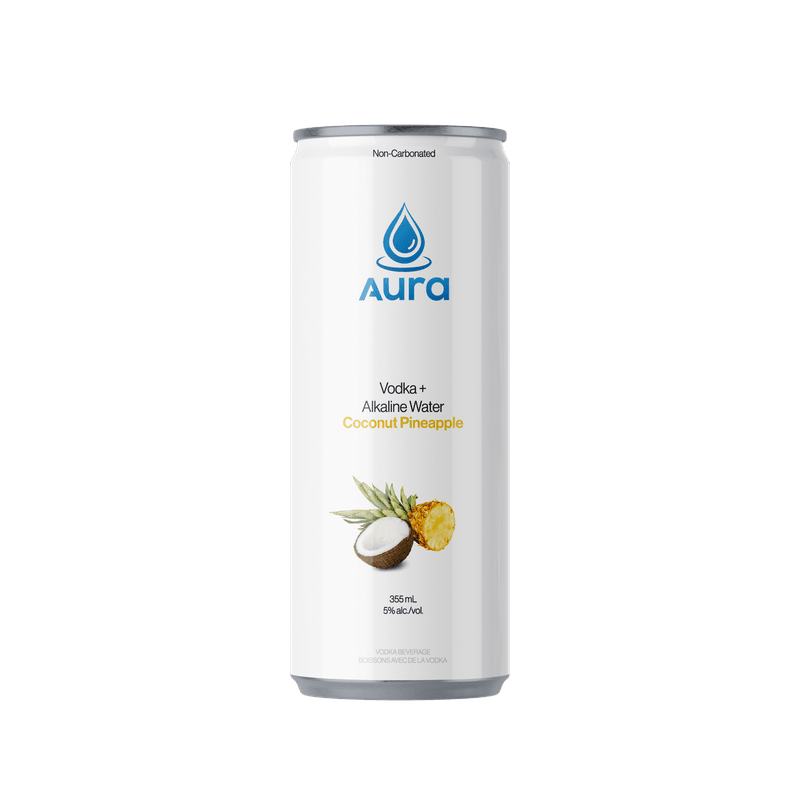
Run those four checks and the shelf thins fast. Aura sits in that thin slice deliberately: a still canned vodka water on alkaline water at pH 8.5 or higher, with premium distilled vodka and natural flavour, no added sugar, no artificial sweeteners, no preservatives, gluten-free. No carbonation means no carbonic acid working against the base — and no bubbles means no bloating, the difference most people notice first. See the build behind our vodka water cocktails, or read why Aura.
What this research does not show
This is the part most "alkaline alcohol" marketing skips.
- Alkaline water is not a proven health intervention. A 2016 BMJ Open systematic review by Fenton and Huang, both based in Alberta, screened 8,278 citations and 252 abstracts and found one study meeting inclusion criteria and no randomised trials at all. That single cohort study found no association between dietary acid load and bladder cancer (OR = 1.15, 95% CI 0.86 to 1.55, p = 0.36). Their conclusion: promoting alkaline diets and alkaline water for cancer prevention or treatment "is not justified."
- Drinks do not change your body's pH. Health Canada's pH document states there is "no convincing evidence that pH at the levels found in drinking water can significantly alter the pH of the body." Blood pH is held in a narrow range by your lungs and kidneys.
- The pepsin finding was in vitro. Koufman and Johnston worked in test tubes, not people. It establishes no clinical benefit and says nothing about alcohol.
- Carbonation and absorption is a small, mixed literature. Roberts and Robinson (2007, Journal of Forensic and Legal Medicine) gave 21 fasted subjects vodka neat, with still water, and with carbonated water. Fourteen of 21 absorbed faster with the carbonated mixer, but 7 showed no change or a decrease (p = 0.006). One small lab study, and a third of the sample went the other way — a hypothesis, not a fact about you.
Most importantly, the alcohol is identical either way. A still alkaline drink is not healthier, safer or less intoxicating than an acidic one. The Canadian Centre on Substance Use and Addiction defines a standard drink as 17.05 mL or 13.45 g of pure alcohol, and its 2023 guidance sets a continuum of risk: low at 2 standard drinks or fewer per week, moderate at 3 to 6, increasingly high at 7 or more. Alkalinity does not move you along it. Comfort and taste are real reasons to pick a drink; health claims are not.
Where to buy in Canada
Aura is available across British Columbia, Alberta and Ontario in Cucumber Lime, Coconut Pineapple and Mango Peach — 355 mL cans, by the case of 24. Direct and wholesale ordering from us delivers to Ontario addresses only. In Alberta, look to AGLC-licensed private retailers; in British Columbia, BC Liquor Stores and licensed private retailers, via where to buy.
If you have been buying seltzers and quietly disliking the bloat, the fix is not another flavour — it is a different build. Try a still can made with alkaline water and taste the difference. Start with our vodka water cocktails.
Please enjoy responsibly, and only if you are of legal drinking age in your province. This article summarises published research for general interest and is not medical advice.
Sources
- Reddy A, Norris DF, Momeni SS, Waldo B, Ruby JD. "The pH of beverages in the United States." Journal of the American Dental Association, 2016;147(4):255–263. DOI: 10.1016/j.adaj.2015.10.019. PMID: 26653863. pubmed.ncbi.nlm.nih.gov/26653863
- Lan Z, Zhao IS, Li J, Li X, Yuan L, Sha O. "Erosive effects of commercially available alcoholic beverages on enamel." Dental Materials Journal, 2023;42(2):236–240. DOI: 10.4012/dmj.2022-155. PMID: 36624075. pubmed.ncbi.nlm.nih.gov/36624075
- Koufman JA, Johnston N. "Potential benefits of pH 8.8 alkaline drinking water as an adjunct in the treatment of reflux disease." Annals of Otology, Rhinology & Laryngology, 2012;121(7):431–434. DOI: 10.1177/000348941212100702. PMID: 22844861. pubmed.ncbi.nlm.nih.gov/22844861
- Fenton TR, Huang T. "Systematic review of the association between dietary acid load, alkaline water and cancer." BMJ Open, 2016;6(6):e010438. DOI: 10.1136/bmjopen-2015-010438. PMID: 27297008. pubmed.ncbi.nlm.nih.gov/27297008
- Roberts C, Robinson SP. "Alcohol concentration and carbonation of drinks: the effect on blood alcohol levels." Journal of Forensic and Legal Medicine, 2007;14(7):398–405. DOI: 10.1016/j.jflm.2006.12.010. PMID: 17720590. pubmed.ncbi.nlm.nih.gov/17720590
- Health Canada. Guidelines for Canadian Drinking Water Quality: Guideline Technical Document — pH. Ottawa, published August 2015. canada.ca
- Paradis C, Butt P, Shield K, et al. Canada's Guidance on Alcohol and Health: Final Report. Ottawa: Canadian Centre on Substance Use and Addiction, January 2023. ISBN 978-1-77871-046-9. ccsa.ca