You are standing in a Canadian grocery aisle in front of two bottles of water. One is $1.50. The one beside it is $4.50 and says "pH 9.5, ionised, alkaline." Before you pay triple, you want one question answered: is there anything behind that number? Here is a plain reading of the alkaline water research as it stands today: what has been tested in humans, what held up, and what to do with the answer.
The short version: the cleanest finding in the literature is a test-tube result about a stomach enzyme, the human trials are small and measure surrogate markers rather than anything you would feel, and the best systematic review to date found no meaningful difference between alkaline water and ordinary mineral water. It is fine to drink. It is not what the shelf-talker says it is.
What alkaline water research means by "alkaline"
Alkaline water is simply water with a pH above 7. The scale is logarithmic, so pH 9 water is ten times less acidic than pH 8 water — but both are still overwhelmingly water. Health Canada and the Federal-Provincial-Territorial Committee on Drinking Water set an operational guidance range of 7.0 to 10.5 for finished drinking water — a range that exists to manage treatment efficiency and pipe corrosion, not to deliver a health benefit. Much of the tap water Canadians drink already sits on the alkaline side of neutral. Water gets that elevated pH one of three ways, and the route matters more than the number:
- Geology. Water moving through limestone or basalt picks up bicarbonate, calcium and magnesium, which raise pH and add minerals.
- Electrolysis. An ioniser splits the stream to produce an alkaline fraction; the mineral profile depends on the source water.
- Addition. Minerals or bicarbonate salts dosed into purified water to a target pH.
Hold on to that. Nearly every trial that found anything used water carrying a heavy mineral load, so pH and minerals are tangled together and the studies cannot tell you which did the work.
Does alkaline water work? What the human trials found
Blood viscosity after dehydration (n = 100)
Weidman and colleagues ran a randomised, double-blind, parallel-arm trial in 100 healthy adults aged 25 to 49, comparing a commercial electrolysed high-pH water against a commercial purified water after exercise-induced dehydration. High-shear blood viscosity fell 6.30% in the alkaline arm versus 3.36% in the control arm (p = 0.03). That is the headline quoted everywhere. Rarely quoted is the rest of the table: plasma osmolality showed no difference (p = 0.751), body mass change none (p = 0.963), and all bioimpedance measures came in at p > 0.24. The hydration markers were flat. The authors noted large inter-individual variability and conceded that a gold-standard hydration biomarker "has proved elusive."
Acid-base balance in athletes (n = 16)
Chycki and colleagues published a double-blind, placebo-controlled trial in PLOS ONE with 16 male combat sport athletes — eight per arm — drinking 2.6 to 3.2 litres a day of pH 9.13 water for three weeks. Resting blood pH rose from 7.36 to 7.44 (p = 0.001), bicarbonate from 23.87 to 26.76 mmol/L (p = 0.001), urine pH from 5.75 to 6.62 (p = 0.017), and lower-limb mean power from 7.98 to 9.38 J/kg (p = 0.001). The control group changed on nothing. Real results — but note the dose: that water carried 840 mg/dm³ of minerals, including 357.8 mg/dm³ of bicarbonate, at roughly three litres a day. This is as much a bicarbonate-loading study as a pH study, and eight people per arm is a thin base for a general claim.
Pepsin, in a test tube
The most cited finding of all is Koufman and Johnston's 2012 work: pH 8.8 artesian bicarbonate water irreversibly inactivated human pepsin and buffered hydrochloric acid far better than conventional-pH bottled waters. A plausible mechanism for reflux relief — and entirely in vitro. No patients were treated. A test tube is not a throat.
Where the alkaline water benefits evidence runs out
Now the part the marketing skips. Sunardi and colleagues ran a systematic review in Reviews on Environmental Health, searching five databases from January 2000 through July 2022. Ten articles met inclusion criteria, and only two concerned alkaline water at all. Their finding: alkaline and oxygenated water "did not show any significant difference on gut microbiota, urine pH, blood parameter, or fitness parameter" compared with mineral water. Read that against the Chycki urine pH result and you have a flat contradiction sitting in the literature — not a scandal, just what a field of a dozen small studies with no large replication looks like from the inside.
A 2026 narrative review in Frontiers in Medicine landed in the same place: "blood pH homeostasis in healthy individuals prevents any clinically meaningful change in blood pH" whatever you drink; claims of systemic alkalinisation, enhanced immunity, anti-aging and disease prevention "are not supported by robust clinical evidence"; and the effects are "modest and likely driven more by mineral composition than pH alone." The authors advised against recommending it routinely in primary care.
The caveats, stated plainly
- Small samples. Sixteen athletes and one hundred adults are the biggest numbers here.
- Surrogate endpoints. Blood viscosity and urine pH are measurable, not noticeable. Nobody feels their high-shear viscosity.
- Confounded exposure. pH and minerals move together in almost every trial, and the Frontiers reviewers think the minerals do most of the work.
- Contradiction, not consensus. One trial found a urine pH shift; the systematic review found none.
- Commercial test products. Some trials pitted named retail waters against named retail comparators; independent replication is thin.
- Not universally benign. The Frontiers review flags caution for chronic kidney disease, long-term proton pump inhibitor use, and endurance athletes at risk of dilutional hyponatremia.
What to actually do with this
- Don't pay a premium for a pH number alone. Turn the bottle around and read the mineral analysis — bicarbonate, calcium, magnesium in mg/L. That is what the positive studies were actually delivering.
- If you get reflux, it is a cheap, low-risk thing to try alongside whatever your doctor has you on — not a treatment, and the pepsin evidence is a test-tube result.
- Hydrating around exercise? Plain water plus electrolytes has a far larger evidence base.
- Discount any claim about "alkalising your body." Your kidneys and lungs hold blood pH in a narrow band; a beverage does not move it.
- If you have kidney disease, take PPIs long term, or are pregnant, ask a clinician before making it a daily habit.
So why build an alkaline water vodka on it anyway?
Here is the honest answer, since this article has spent its whole length demanding honesty from everyone else. We build our vodka water cocktails on alkaline water at pH 8.5+ for taste and how it carries flavour — not for anything in the studies above. A mineral-bearing alkaline base gives us a rounder, softer canvas for premium distilled vodka and natural flavour, with no added sugar, no artificial sweeteners and no preservatives to hide behind. That is a formulation choice, and we will not dress it up as medicine.
To be clear about what we are not claiming: Aura is not healthier, safer or less intoxicating than any other drink at the same strength. The alcohol in the can is the same alcohol. What we do claim is a build you can taste — Aura is a still drink with zero carbonation. No bubbles, no fizz, no seltzer edge, no bloated feeling halfway through the second can. That is comfort and drinkability, not a health benefit, and the distinction matters here as much as it does in the research. The full rationale is on why Aura.
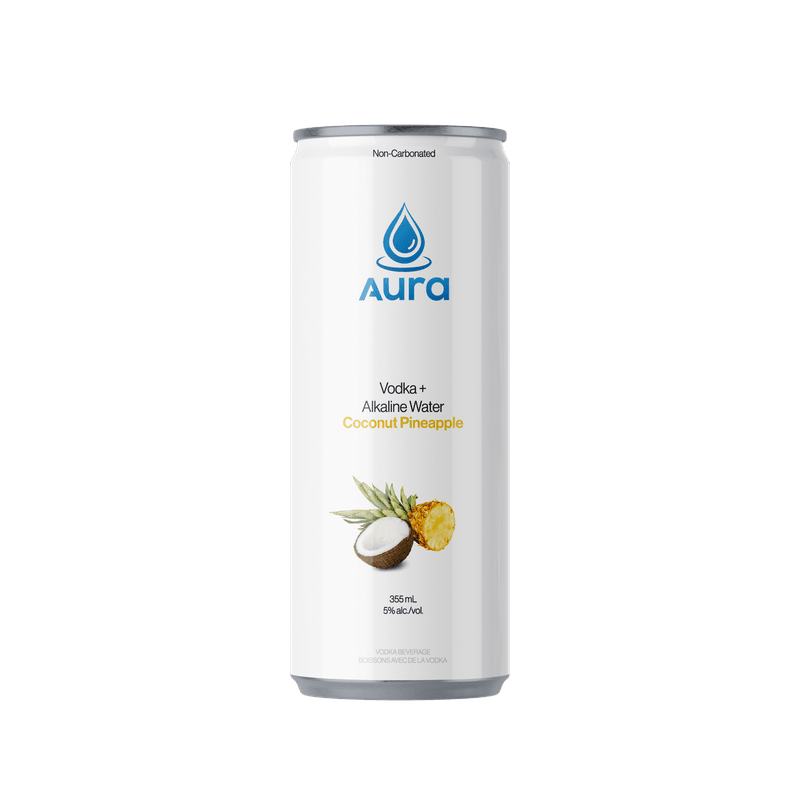
Aura comes in Cucumber Lime, Coconut Pineapple and Mango Peach — 355 mL cans by the case of 24, available across British Columbia, Alberta and Ontario. Ordering from us direct or wholesale delivers to Ontario addresses only. In Alberta, find Aura at AGLC-licensed private retailers; in British Columbia, at BC Liquor Stores and licensed private retailers.
Read the labels, ignore the pH theatre, and pick the drink you enjoy holding for an hour. If that is a still, unsweetened vodka water, order a case for Ontario delivery or find a stockist in your province at where to buy.
Please enjoy Aura responsibly and only if you are of legal drinking age in your province. Canada's Guidance on Alcohol and Health (Canadian Centre on Substance Use and Addiction, 2023) describes a continuum of risk: 1–2 standard drinks per week is low risk, 3–6 moderate, 7 or more increasingly high.
This article summarises published research for general interest and is not medical advice. Speak to a healthcare professional about your own situation.
Sources
- Weidman J, Holsworth RE Jr, Brossman B, Cho DJ, StCyr J, Fridman G. "Effect of electrolyzed high-pH alkaline water on blood viscosity in healthy adults." Journal of the International Society of Sports Nutrition, 2016. DOI 10.1186/s12970-016-0153-8; PMID 27932937. Full text
- Chycki J, Kurylas A, Maszczyk A, Golas A, Zajac A. "Alkaline water improves exercise-induced metabolic acidosis and enhances anaerobic exercise performance in combat sport athletes." PLOS ONE, 2018. DOI 10.1371/journal.pone.0205708. Full text
- Sunardi D, Chandra DN, Medise BE, Manikam NRM, Friska D, Lestari W, Insani PNC. "Health effects of alkaline, oxygenated, and demineralized water compared to mineral water among healthy population: a systematic review." Reviews on Environmental Health, 39(2):339–349, 2024. DOI 10.1515/reveh-2022-0057; PMID 36571558. PubMed record
- Koufman JA, Johnston N. "Potential Benefits of pH 8.8 Alkaline Drinking Water as an Adjunct in the Treatment of Reflux Disease." Annals of Otology, Rhinology & Laryngology, 121(7):431–434, 2012. DOI 10.1177/000348941212100702; PMID 22844861. Journal page
- Alebrahim H, Alsaei A, Sefen P, Hasan M, Ramadhan A, Deen GR. "The health benefits of alkaline water: is it a fact or marketing myth?" Frontiers in Medicine, vol. 13, 2026. DOI 10.3389/fmed.2026.1849818. Full text
- Federal-Provincial-Territorial Committee on Drinking Water; Health Canada, Water and Air Quality Bureau. "Guidelines for Canadian Drinking Water Quality: Guideline Technical Document — pH of Drinking Water," 2016. Government of Canada Publications
- Canadian Centre on Substance Use and Addiction. "Canada's Guidance on Alcohol and Health," 2023. CCSA