If you like a vodka tonic, a rum and cola or anything finished with a squeeze of lime, you may have wondered: are cocktails bad for teeth? The honest short answer is that the alcohol usually isn't the main problem for enamel. The mixers are. Many of the most popular mixers are strongly acidic, and acid is what drives dental erosion. The good news is that how you drink matters about as much as what you drink, and there are changes you can make tonight.
Below: what published research measured, what it doesn't show, and a practical checklist for drinkers in Canada and beyond.
Are cocktails bad for teeth? The short answer
Dental erosion is the chemical loss of tooth surface caused by acid, not by bacteria. It is different from cavities. In a 2016 paper in the Journal of the American Dental Association, Reddy and colleagues define it as dissolution of tooth structure "when the environment is acidic (pH < 4.0)" and note that research points to low pH as the primary determinant of a beverage's erosive potential (Reddy et al., 2016).
So whether a cocktail is hard on your teeth depends mostly on three things:
- How acidic the mixer is (its pH, and how much acid it carries).
- How often your teeth are exposed during the day.
- How long the drink stays in contact with your teeth, for example slow sipping, swishing or holding it in your mouth.
How acidic are common mixers? What the pH data shows
The JADA study tested 379 commercially available beverages bought in Birmingham, Alabama, measuring each in triplicate at 25°C right after opening. Overall, 93% (354 of 379) had a pH below 4.0. The authors classed 39% as "extremely erosive" (pH below 3.0), 54% as "erosive" (pH 3.0 to 3.99) and only 7% as "minimally erosive" (pH 4.0 or higher) (Reddy et al., 2016).
Several familiar cocktail ingredients landed near the bottom of the scale:
- Lemon juice: pH 2.25, the most acidic drink in the study.
- Coca-Cola Classic: pH 2.37. Pepsi measured 2.39.
- Schweppes Tonic Water: pH 2.54.
- Sprite: pH 3.24.
- San Pellegrino sparkling mineral water: pH 4.96, against 7.20 for the local tap water.
Lists of dental erosion drinks tend to focus on soda, so the tonic water teeth question surprises people: tonic tastes bitter rather than sour, but in this dataset it was more acidic than most sports drinks. Lemon and lime juice, the backbone of sours, margaritas and countless highballs, are more acidic still. The authors also note that citric acid can pull calcium out of enamel through chelation, which may add to erosion even at a higher pH.
What about the drinks once they're mixed?
A 2026 laboratory study in the International Journal of Dentistry tested ready-to-drink alcoholic beverages, including a vodka-citrus drink and a whiskey-and-cola, on bovine enamel. All of the ready-to-drink beverages had a pH between 2.75 and 3.04. Apart from the mineral-water control, every drink significantly reduced enamel surface hardness, increased surface roughness and caused measurable surface loss (p < 0.05). The severity tracked most closely with citric acid content and buffering capacity (de Paiva et al., 2026).
How acidic drinks soften enamel
Enamel is mostly mineral. When a liquid below roughly pH 4 bathes the tooth surface, it starts dissolving that mineral and leaves a softened outer layer. A single drink won't wear a tooth down. The concern is repetition: softened enamel is more easily worn away, and repeated exposures over months and years add up to permanent loss. Dentin, the layer under enamel, is softer and can become sensitive once exposed.
That is the acidic drinks enamel connection in a nutshell, and it's why habits matter. The clinical data suggest that how often and how long the acid sits on your teeth matter at least as much as how acidic one drink is.
What the research says about habits
A case-control study at King's College London compared 300 patients who had dietary erosive tooth wear with 300 age-matched controls (O'Toole et al., 2017). Key findings:
- Three or more acid intakes a day was strongly associated with erosive wear (odds ratio 10.92; 95% CI 4.40 to 27.10).
- Acidic drinks stayed strongly associated with wear whether they were taken with meals or not (odds ratio up to 11.84).
- Habits that keep liquid in the mouth before swallowing, such as holding or swishing a drink, were associated with an odds ratio of 10.34.
- Brushing within 10 minutes of an acid intake was not significantly associated with erosive wear after adjusting for diet (OR 1.41; 95% CI 0.82 to 2.42).
Should you wait before brushing?
You've probably heard you should wait 30 to 60 minutes after something acidic before you brush. The evidence here is more mixed than that advice suggests. In a lab study from the University of Bern, eroded enamel samples kept in human saliva for 30 minutes, 2 hours or 4 hours did no better than samples given no saliva at all once they were brushed. The authors concluded that the recommendation to postpone brushing "should be reconsidered" (Lussi et al., 2014).
A 2020 systematic review and meta-analysis pooled the in situ and in vitro studies. It included 12 of 565 screened studies and found no significant difference in wear of human enamel between delayed and immediate brushing (P = 0.13). It did find a benefit in cow enamel, which is often used in the lab. A subgroup analysis found that fluoride toothpaste significantly reduced wear of human enamel (P = 0.02). The authors' clinical takeaway: delaying brushing by itself "is not capable of preventing erosive enamel wear" (Hong et al., 2020).
Practical ways to protect your teeth when you drink cocktails
Based on the research above, here's what you can actually do:
- Have acidic drinks in one sitting. Frequency was one of the strongest signals in the King's College data, so two drinks with dinner beat the same two drinks spread across a long afternoon.
- Don't swish or hold. Swallow normally rather than letting a tart drink sit around your teeth.
- Use a fluoride toothpaste. This was the one brushing-related factor that held up in the meta-analysis.
- Don't stress about the exact brushing minute. Neither the clinical nor the pooled lab data clearly support waiting as protection on its own. Brushing gently with fluoride toothpaste is the sensible default, and your dentist can advise you if you already have wear.
- Go easy on the citrus. A wedge for aroma adds less acid than a heavy pour of lemon or lime juice.
- Alternate with plain water. This is common sense rather than something these studies tested.
Caveats: what this research does not show
It's worth being clear about the limits:
- pH isn't everything. The JADA study measured only pH, and only for products bought in one US city. Canadian formulations can differ. In the ready-to-drink study, damage tracked citric acid content and buffering capacity, so pH alone doesn't tell the whole story.
- Lab is not mouth. The ready-to-drink study soaked bovine enamel for 120 minutes. That's far longer than real drinking, and it had no saliva, no swallowing and no pellicle, the protective protein film on teeth.
- Studies disagree on brushing. The meta-analysis found that human and cow enamel responded differently, which is a reminder of how much depends on the test setup.
- Association isn't causation. The King's College study was a case-control design that relied on questionnaires about past habits. Its large odds ratios have wide confidence intervals.
- None of these studies tested Aura. We have not published dental testing of our drinks. An alkaline water base does not make a finished flavoured drink "tooth-safe", and we make no such claim.
Where Aura fits
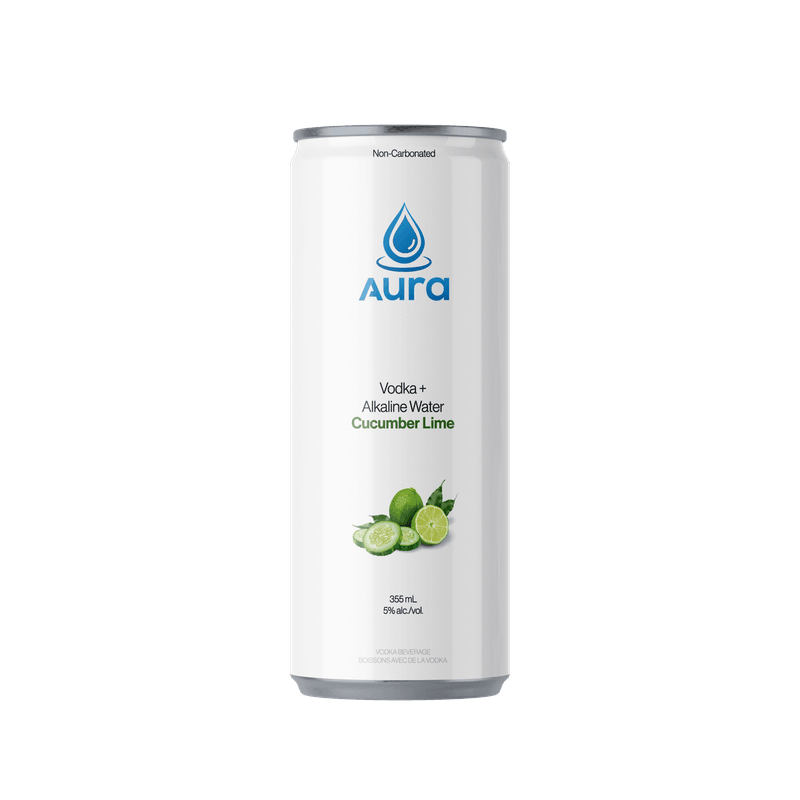
Aura is a still vodka water: premium vodka, alkaline water (pH 8.5+) and natural flavour, with no carbonation, no added sugar, no artificial sweeteners and no preservatives. Notably, sparkling mineral water measured lower in pH than plain tap water in the JADA data. Even so, the habits above apply to any drink, including ours. It's the same alcohol either way, so pace yourself. You can read more about why Aura is made the way it is, or browse our vodka water cocktails: Cucumber Lime, Coconut Pineapple and Mango Peach.
Ready to try a still alternative to the usual soda-and-tonic mixers? Aura is available across British Columbia, Alberta and Ontario. We deliver direct to Ontario addresses. In BC and Alberta, find us through where to buy, including BC Liquor Stores, licensed private retailers in BC and AGLC-licensed private retailers in Alberta. Please enjoy responsibly and only if you are of legal drinking age in your province.
This article summarises published research for general interest and is not medical or dental advice. Talk to your dentist about your own teeth.
Sources
- Reddy A, Norris DF, Momeni SS, Waldo B, Ruby JD. The pH of beverages in the United States. Journal of the American Dental Association. 2016;147(4):255-263. doi:10.1016/j.adaj.2015.10.019. PMID 26653863. PMC4808596
- de Paiva MAA, Forte AG, da Cunha JL, de Souza Silva PV, de Sousa EBG, de Oliveira AFB. Analysis of the Surface Morphology of Dental Enamel Exposed to Ready-to-Drink Alcoholic Beverages. International Journal of Dentistry. 2026;2026:9930736. doi:10.1155/ijod/9930736. PMID 41550961. doi.org/10.1155/ijod/9930736
- O'Toole S, Bernabé E, Moazzez R, Bartlett D. Timing of dietary acid intake and erosive tooth wear: A case-control study. Journal of Dentistry. 2017;56:99-104. doi:10.1016/j.jdent.2016.11.005. PMID 27856311. doi.org/10.1016/j.jdent.2016.11.005
- Lussi A, Lussi J, Carvalho TS, Cvikl B. Toothbrushing after an erosive attack: will waiting avoid tooth wear? European Journal of Oral Sciences. 2014;122(5):353-359. doi:10.1111/eos.12144. PMID 25131337. doi.org/10.1111/eos.12144
- Hong DW, Lin XJ, Wiegand A, Yu H. Does delayed toothbrushing after the consumption of erosive foodstuffs or beverages decrease erosive tooth wear? A systematic review and meta-analysis. Clinical Oral Investigations. 2020;24(12):4169-4183. doi:10.1007/s00784-020-03614-9. PMID 33052542. doi.org/10.1007/s00784-020-03614-9