You are three beers in, someone hands you a vodka drink, and the rhyme starts up: "beer before liquor, never been sicker." So you hesitate. Here is the direct answer, and you can act on it tonight: drink order is not what decides how you feel tomorrow. It has been tested in a randomized controlled trial, and order made no measurable difference. What did predict a bad morning was how drunk people got — the one lever you actually control.
Does "beer before liquor" hold up in a controlled trial?
The cleanest test of the folklore appeared in the American Journal of Clinical Nutrition in 2019. Köchling and colleagues ran a multiarm, matched-triplet crossover trial with 90 participants aged 19 to 40 (mean age 23.9, 50% female), matched by age, gender, body composition, drinking habits and usual hangover frequency.
- One study group drank beer to a breath alcohol concentration of ≥0.05%, then wine to ≥0.11%.
- A second group did the same in the opposite order.
- A control group of 28 drank only beer, or only wine.
- At least a week later, participants crossed over to the opposite order.
Hangover was scored the next day on the Acute Hangover Scale. The result: "neither type nor order of consumed alcoholic beverages significantly affected hangover intensity (P > 0.05)." The authors concluded that the findings dispel the traditional myths of "grape or grain but never the twain" and "beer before wine and you'll feel fine."
What did matter came out of the regression analysis: perceived drunkenness and vomiting were the strongest predictors of hangover intensity. Not sequence. Not grain versus grape. How intoxicated you actually got.
Does mixing drinks make it worse, or does it just mean you drank more?
This is the more useful version of the question. Mixing alcohol types does not appear to add an extra chemical penalty — but it travels with behaviour that does. A night that starts on beer at a patio and ends on shots is usually a night with more total ethanol in it, drunk faster, later, and with less counting.
Be clear about what the evidence supports. The 2019 trial tested order and type, not the "you drank more" explanation, and it was open-label. So treat that account as the most plausible reading of why mixing feels worse, not as something proven. What the trial does license is this: hold total intake and drunkenness steady, and swapping drink categories mid-evening is not the thing hurting you.
Congener content: bourbon, vodka, and how much it really buys you
Congeners are the minor compounds besides ethanol left behind by fermenting and distilling, and they are far more abundant in dark spirits like bourbon than in a clean vodka. This is the one part of the folklore with real experimental support — and the effect is smaller than people expect.
Rohsenow and colleagues (Alcoholism: Clinical and Experimental Research, 2010) studied 95 healthy heavy drinkers aged 21 to 33. Each drank to a mean breath alcohol concentration of 0.11 g% on vodka on one night and bourbon on another, with a matched placebo night, randomized for type and order, with overnight polysomnography and next-morning neurocognitive testing. The findings:
- People felt worse after bourbon than after vodka. Congener content affected subjective hangover severity.
- Next-day performance was the same either way. Alcohol impaired sustained attention and speed, but bourbon was no worse than vodka on those tests.
- Sleep did not explain it. Alcohol reduced sleep efficiency and REM sleep, but bourbon drinkers slept no worse than vodka drinkers.
The authors' own summary is blunt: "Congener content affects only how people feel the next day so does not increase risk." Their 2010 review of the congener literature puts the magnitude plainly — ethanol effects "had a considerably stronger effect on hangover than did congener content," and it notes the paucity of studies means these results need more work before anyone should lean on them hard.
Where the form of the drink might matter a little
Roberts and Robinson (Journal of Forensic and Legal Medicine, 2007) gave 21 subjects (12 male, 9 female) three vodka solutions on separate occasions after an overnight fast: neat vodka at 37.5% vol, vodka with still water at 18.75%, and vodka with carbonated water at 18.75%.
Two findings, both needing care. First, 20 of 21 subjects absorbed the diluted alcohol faster than the neat spirit (p<0.001) — the opposite of the assumption that watering a drink down always slows things. Second, the carbonated mixer sped absorption for 14 of 21 subjects, mean rate 4.39±0.45 mg/100ml/min against 1.08±0.36 for the still mixer (p=0.006); seven subjects showed no change or a decrease.
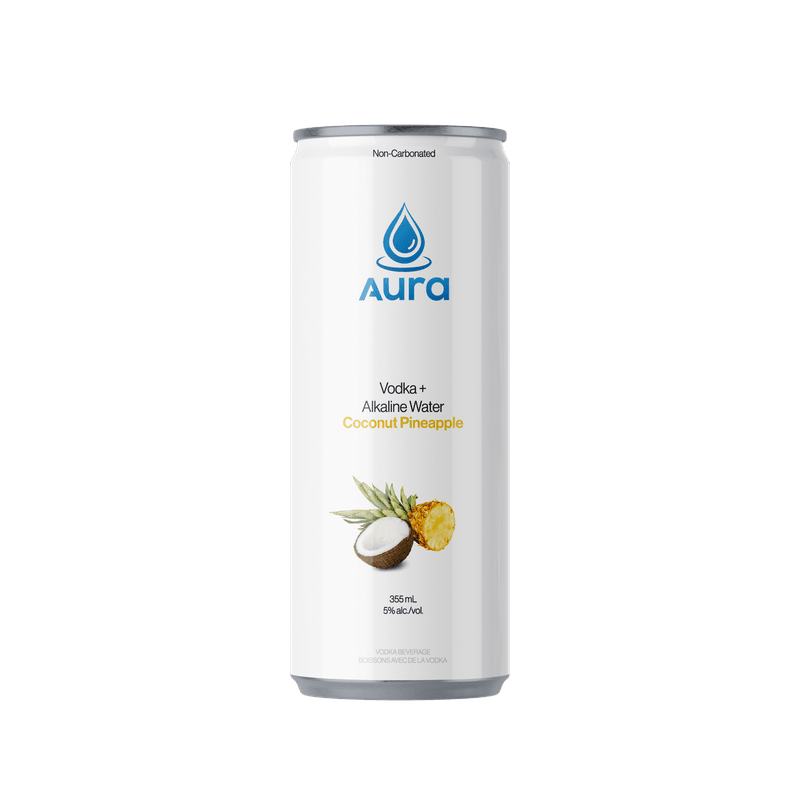
Aura is a still vodka water — no carbonation at all, which is also why no bubbles means no bloating. But read that study honestly: 21 people, a five-minute drinking window, an empty stomach, and a third of the sample moving the other way. It does not make a still drink safer, healthier or less intoxicating. The same alcohol is in the can either way.
Why the hangover myths persist anyway
Rhymes are sticky, and a rule that scans is easier to recall than an accurate one. The folklore is also nearly unfalsifiable in daily life: the nights you switch to spirits late are often your heaviest nights, so the rule gets confirmed by a pattern it did not cause. Nobody remembers the four uneventful nights they also mixed drink types.
What to actually do this weekend
Canada's Guidance on Alcohol and Health (CCSA, January 2023) defines a standard drink as 17.05 mL or 13.45 g of pure alcohol: a 341 mL beer at 5%, a 142 mL glass of wine at 12%, or a 43 mL shot of spirits at 40%. Its risk continuum is 2 drinks or fewer per week (low), 3 to 6 (moderate), 7 or more (increasingly high), and it notes that more than 2 on any single occasion raises the risk of injury and harm.
- Count ethanol, not drink names. For any can: mL × ABV% ÷ 100 ÷ 17.05 = standard drinks. Do this once for whatever you buy and you will never have to guess again.
- Target the predictor, not the order. The 2019 trial says drunkenness and vomiting drive hangover severity. Setting a number before you start beats policing sequence.
- Slow the clock. The CCSA report notes it takes roughly two hours for the alcohol in one standard drink to clear the body. Spacing beats sequencing.
- Eat first. The absorption study used an overnight fast and a five-minute drinking window — close to a worst case, and nothing like dinner and a long evening.
- If dark spirits reliably wreck you, switch. The congener evidence supports a modest improvement in how you feel — nothing more.
What this research does not show
These are small, short studies: 90 people in one trial, 95 in another, 21 in the third. A 2019 review in Alcohol and Alcoholism makes the general point that many human hangover studies are not well controlled, vary in dose and timing, and are often unblinded. A review by Penning and colleagues found that hormones, electrolytes, free fatty acids, triglycerides, lactate, cortisol and glucose were not significantly correlated with hangover severity, and that dehydration markers such as vasopressin were not either — immune factors showed the most convincing relationship. Hangover is not a solved problem.
Nothing here says a canned vodka water is healthier, safer or less intoxicating than any other drink. It is not a low-alcohol product, and it carries the same risks as any alcoholic beverage. Choosing a still drink over a sparkling one is a preference about comfort and taste, not a health decision.
Drink what you actually like
If the order rule was the only thing keeping you from switching drinks, retire it. Pick what you enjoy, count it honestly, pace it. Aura's three flavours — Cucumber Lime, Coconut Pineapple and Mango Peach — are still vodka water cocktails made with premium vodka and alkaline water, with no added sugar, no artificial sweeteners and no preservatives. Browse our vodka water cocktails or read why Aura. Ordering direct or wholesale from us delivers to Ontario addresses only; in British Columbia or Alberta, check where to buy — Aura is stocked through BC Liquor Stores and licensed private retailers in BC, and AGLC-licensed private retailers in Alberta.
Please enjoy Aura responsibly, and only if you are of legal drinking age in your province. This article summarises published research for general interest and is not medical advice.
Sources
- Köchling J, Geis B, Wirth S, Hensel KO. "Grape or grain but never the twain? A randomized controlled multiarm matched-triplet crossover trial of beer and wine." American Journal of Clinical Nutrition, 2019;109(2):345–352. doi:10.1093/ajcn/nqy309. PMID 30753321. https://pubmed.ncbi.nlm.nih.gov/30753321/
- Rohsenow DJ, Howland J, Arnedt JT, Almeida AB, Greece J, Minsky S, Kempler CS, Sales S. "Intoxication with bourbon versus vodka: effects on hangover, sleep, and next-day neurocognitive performance in young adults." Alcoholism: Clinical and Experimental Research, 2010;34(3):509–518. doi:10.1111/j.1530-0277.2009.01116.x. PMID 20028364. https://pubmed.ncbi.nlm.nih.gov/20028364/
- Rohsenow DJ, Howland J. "The role of beverage congeners in hangover and other residual effects of alcohol intoxication: a review." Current Drug Abuse Reviews, 2010;3(2):76–79. doi:10.2174/1874473711003020076. PMID 20712591. https://pubmed.ncbi.nlm.nih.gov/20712591/
- Roberts C, Robinson SP. "Alcohol concentration and carbonation of drinks: the effect on blood alcohol levels." Journal of Forensic and Legal Medicine, 2007;14(7):398–405. doi:10.1016/j.jflm.2006.12.010. PMID 17720590. https://pubmed.ncbi.nlm.nih.gov/17720590/
- Penning R, van Nuland M, Fliervoet LA, Olivier B, Verster JC. "The pathology of alcohol hangover." Current Drug Abuse Reviews, 2010;3(2):68–75. doi:10.2174/1874473711003020068. PMID 20712596. https://pubmed.ncbi.nlm.nih.gov/20712596/
- Palmer E, Tyacke R, Sastre M, Lingford-Hughes A, Nutt D, Ward RJ. "Alcohol Hangover: Underlying Biochemical, Inflammatory and Neurochemical Mechanisms." Alcohol and Alcoholism, 2019;54(3):196–203. doi:10.1093/alcalc/agz016. PMID 30916313. https://pubmed.ncbi.nlm.nih.gov/30916313/
- Paradis C, Butt P, Shield K, Poole N, Wells S, Naimi T, Sherk A, & the Low-Risk Alcohol Drinking Guidelines Scientific Expert Panels. Canada's Guidance on Alcohol and Health: Final Report. Ottawa, Ont.: Canadian Centre on Substance Use and Addiction, January 2023. ISBN 978-1-77871-046-9. https://www.ccsa.ca/sites/default/files/2023-01/CCSA_Canadas_Guidance_on_Alcohol_and_Health_Final_Report_en.pdf