You paid for the way the drink tastes. So the real question behind cans vs bottles is not which looks better on a patio table — it is which format protects aroma, which one actually gets recycled where you live, and what each costs you in exchange. Here is what the published evidence supports, what it does not, and what to do with your next case.
One note first: Aura is a still vodka water — premium distilled vodka, alkaline water at pH 8.5+, natural flavour, zero carbonation. No bubbles means none of the usual "protect the fizz" advice applies; for a still drink, the questions that matter are aroma loss, light and end-of-life.
Cans vs bottles: what to do today
- Buy the freshest stock and drink it within weeks, not seasons. Aroma loss into a can lining is time-dependent; lab models measure it over days to weeks.
- Store everything dark and cool — a cupboard or the fridge, not a sunny windowsill, a glass-front display or a hot car in July.
- Choosing glass? Choose brown over green, and green over clear. The gap in light protection between colours is measured in multiples.
- Return empties to the deposit system, not the curb. It is the stream with audited recovery numbers attached.
- Judge "recyclable drink packaging" by your province's return system, not the label symbol. The symbol is a claim; the return rate is a result.
Flavour scalping: the lining quietly drinks some of your aroma
Every aluminium can has a polymer lining between metal and liquid. It prevents corrosion and metal contact — and it also absorbs aroma molecules, which the literature calls flavour scalping. That lining is the honest cost of aluminum can drinks; glass, with no lining, has nothing to scalp into.
You and O'Keefe (Food Science & Nutrition, 2018) tested commercial linings of three chemistries — epoxy, polyolefin and acrylate — against five aroma compounds (d-limonene, octanal, nonanal, decanal, eugenol) at 4.1–4.2 ppb, and 1,006 ppb for eugenol. At room temperature, roughly 50% of the aroma molecules left solution within 5 days, and binding was nearly complete at 9–14 days for every lining tested. Headspace limonene was unmeasurable by day 11, with 8.8 ng scalped per square centimetre of lining.
The honest part: the study could not rank the linings. Binding slopes did not differ significantly across chemistries (p > .05), and the authors wrote that their precision "may not be good enough to make clear conclusions regarding which can lining polymer" scalps more — only 2–3 replicate vessels per pair, too few time points to fit rate constants. The liquid was acidified water spiked with one compound at a time, nothing like a finished drink, at an aggressive 2.1 mL per square centimetre of lining. A sealed 355mL can has a different ratio, and the paper does not model one.
That is a genuine point for bottles in any canned cocktail packaging comparison, and it is why the strongest case for cans sits elsewhere.
Light: where glass clearly loses
Gabriel and colleagues (Kvasny Prumysl, 2022) measured light transmittance in commercial 0.5 L beer bottles and built a Packaging Riboflavin Index (PRFI): the share of transmitted light landing in riboflavin's absorption band, where 100 means no protection.
Clear glass scored 82.6 and passed about 86–88% of visible light; blue, 69.7. Green ran 18.1 to 57.5 depending on shade and wall thickness. Brown scored 1.0–3.6; the darkest brown bottle gave 83 times the protection of clear and 59 times that of the lightest green. Their illumination test matched that ordering: degradation rates of 60.6 ± 1.0 (clear), 50.1 ± 1.0 (blue) and 28.6 ± 1.0 (green) × 10⁻⁵ min⁻¹, while one brown bottle degraded so little the change fell below measurement error and no rate could be calculated.
Cans sidestep the problem by being opaque. The authors state beer "is perfectly protected only in completely opaque packaging, such as metal barrels or cans" — and that is the fair way to report it: a statement about opacity, not a measurement they ran on cans.
What the light study does not show about a vodka water
The lightstruck reaction is beer chemistry: it needs riboflavin as a photosensitiser and hop-derived isohumulones as substrate, yielding 3-methyl-2-butene-1-thiol, detectable at 4–35 ng/L in beer. A vodka water has neither ingredient, so "83 times better" cannot be transferred to it and called evidence. What transfers is the principle: opaque packaging transmits no light, and glass colour changes the dose by an order of magnitude. How much a still cocktail changes under light is an open question nobody has published on.
Linings and migration: the trade-off nobody should oversell
Health Canada's Survey of Bisphenol A in Soft Drink and Beer Products from Canadian Markets (2010) tested 38 products bought in Ottawa in April 2009, pairing can and bottle formats of the same brands. BPA was detected in every canned sample: 0.019–0.21 µg/L in soft drinks, 0.081–0.54 µg/L in beer. Glass and PET were almost all below the 0.0045 µg/L detection limit. Health Canada concluded exposure from canned beverages is "extremely low" and poses no health risk to the general population. Read that as a real difference in migration and nothing more: it is a 2010 survey of 2009 stock, lining chemistry has shifted since, and it is not a safety claim in either direction.
Recyclable drink packaging: the Canadian numbers surprise people
Most of us assume aluminium wins recycling outright. In Ontario it does not. The Beer Store's 2025 Responsible Stewardship Report, filed with Ontario's regulator, reports a 2025 recovery rate of 72% for metal cans in its own system against 86% for all glass bottles (89% refillable, 77% non-refillable). Under the Ontario Deposit Return Program, cans came in at 71% versus 79% for glass — though cans dominate volume, at 401,957,364 of 651,609,116 containers sold.
Return rate and climate impact are different questions. The same report credits 16,543 tonnes of recycled aluminium with 159,810 tonnes of avoided CO₂-equivalent, using a factor of 9.66 t CO₂e per tonne — against 0.38 for glass reuse, where 44,333 tonnes of reused bottles avoided 16,847 tonnes. Two caveats: those multipliers come from ICF reports for Environment Canada dated 2005 and 2009, and Ernst & Young's limited assurance covered sales, returns and recovery rates — not the greenhouse-gas estimates.
Systems differ by province: Alberta's regulator (BCMB 2024 Annual Report) reports 2.2 billion of 2.6 billion containers returned in 2024, an 83.1% collection rate with nearly $225 million refunded. Whichever format you buy, the depot is the highest-performing route available to you.
Reading the trade-offs honestly
- Cans: zero light transmission, light to ship, largest per-tonne recycling gain — but a lining that measurably absorbs aroma compounds over weeks, and lower Ontario return rates than glass.
- Bottles: inert, no lining, higher Ontario return rates, plus a refill pathway (the Industry Standard Bottle is reused about 15 times) — but heavy, breakable, and a light barrier ranging from excellent to useless depending on colour.
Caveats and what this evidence cannot settle
Both peer-reviewed studies are single-lab work on model systems: one used spiked acidified water against cut pieces of can lining; the other, one pilot-brewed pilsner under a single 6500 K LED, with plastic formats simulated by wrapping clear bottles. Neither ran a sensory panel, tested a still vodka water, or tested Aura, and no independent replication is cited. Recovery rates are accounting — returns divided by sales — not proof of what each tonne becomes. And none of this says anything about health, safety, intoxication or absorption: the alcohol is identical either way, and flavour or comfort differences are not health claims.
Where this leaves Aura
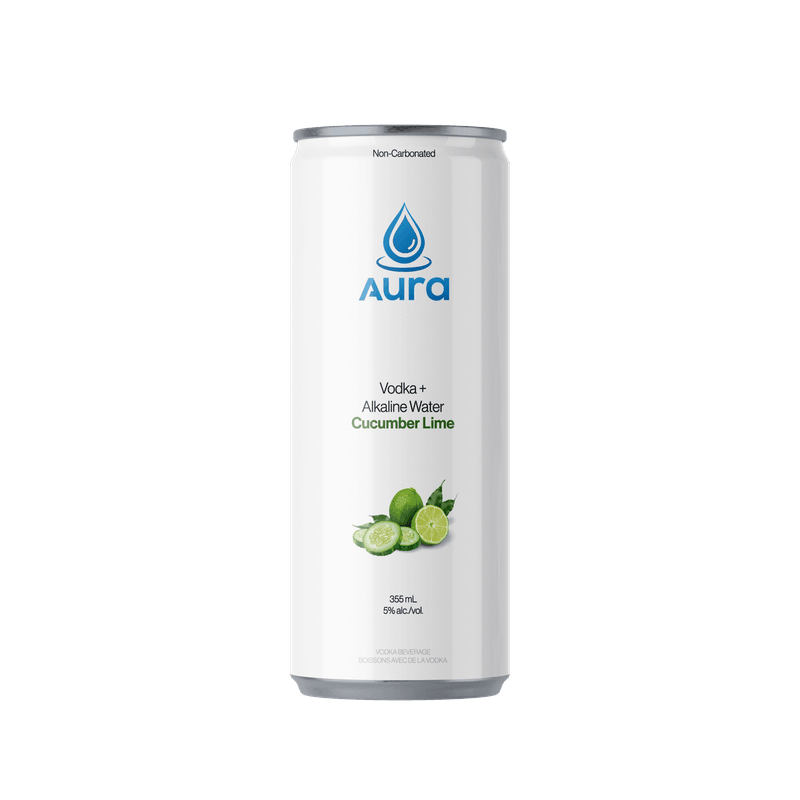
Aura comes in 355mL cans, by the case of 24, in Cucumber Lime, Coconut Pineapple and Mango Peach. For a still drink the can earns its place on the ground the evidence supports — total light exclusion — and the trade-off is the lining, which is why freshness and cool, dark storage deserve your attention.
Pick your flavours from our vodka water cocktails, or read why Aura for the thinking behind the still format. Direct and wholesale ordering delivers to Ontario addresses only — in BC or Alberta, check where to buy, at BC Liquor Stores and licensed private retailers in BC, or AGLC-licensed private retailers in Alberta. Then store the case dark, drink it fresh, and take the empties back for deposit.
Please enjoy Aura responsibly, and only if you are of legal drinking age in your province. This article summarises published research for general interest and is not medical advice.
Sources
- You, X., & O'Keefe, S. F. (2018). Binding of volatile aroma compounds to can linings with different polymeric characteristics. Food Science & Nutrition, 6(1), 54–61. DOI: 10.1002/fsn3.526. onlinelibrary.wiley.com
- Gabriel, P., Dienstbier, M., Fous, K., & Matoulková, D. (2022). Characterization of packaging ability to protect beer from light degradation and introduction of a new Packaging Riboflavin Index. Kvasny Prumysl, 68(6), 679–685. DOI: 10.18832/kp2022.68.679. kvasnyprumysl.eu
- Health Canada, Bureau of Chemical Safety, Food Directorate (2010). Survey of Bisphenol A in Soft Drink and Beer Products from Canadian Markets. Cat. H164-125/2010E-PDF, ISBN 978-1-100-16672-8. canada.ca
- Brewers Retail Inc. (The Beer Store) (2026). Responsible Stewardship 2025: Adapting Sustainability to an Evolving Landscape; limited assurance report by Ernst & Young, 31 March 2026; filed with the Resource Productivity and Recovery Authority. rpra.ca
- Beverage Container Management Board (2025). 2024 Annual Report, Alberta. bcmb.ab.ca