You are two cans in, the night has barely started, and your stomach already feels tight and gassy. Not drunk — just uncomfortably full. Is it the alcohol, the volume, or the bubbles? The honest answer from the carbonation satiety research: bubbles do something real to perceived fullness, the effect is smaller and shorter-lived than most people assume, and the studies contradict each other more than any marketing claim admits.
What carbonation satiety research actually measured
Start with the assumed mechanism: that carbon dioxide slows your stomach down. It mostly doesn't.
Pouderoux and colleagues (Digestive Diseases and Sciences, 1997) gave eight healthy volunteers a radiolabelled meal with carbonated or still water in a crossover design, tracked by gamma camera. Overall gastric emptying — solids, liquids, lag phase — was identical. What changed was where the meal sat: with carbonated water the proximal (upper) stomach held 74 ± 7% of solids versus 56 ± 8%, and 43 ± 5% of liquids versus 27 ± 4% (both P < 0.05). The authors attributed this to proximal distension. Carbonation pushed the meal upward without keeping it there longer — and the upper stomach is where stretch signalling happens.
Why seltzer makes you full: stretch, not slowdown
The cleanest gastric distension study here used no beverage at all. Wang and colleagues (NeuroImage, 2008) inflated a balloon in the stomachs of 18 healthy participants during fMRI. Distension activated sensorimotor cortices and the right insula, adding the left amygdala, insula and precuneus at larger volumes — and the amygdala and insula response tracked reported fullness. Stretch alone, zero calories, produces the sensation.
So why seltzer makes you full isn't mysterious: gas adds volume on top of liquid, the stomach stretches, vagal afferents report it. Two human trials measured the outcome:
- Wakisaka and colleagues (Journal of Nutritional Science and Vitaminology, 2012) tested 19 healthy young women on three fasted mornings: 250 mL of still water, 250 mL of carbonated water, or nothing. Visual-analogue fullness scores were significantly higher after carbonated water, and heart rate rose. The authors called the effect "short-term" — the window was 40 minutes — and electrogastrography found no significant difference in gastric motility.
- Rogers and colleagues (Appetite, 2020) had 51 participants drink 500 mL before snacking freely. Carbonated water decreased hunger and increased fullness versus still water. Their closing line: "Further studies on the effects of carbonation of appetite are warranted."
Where the evidence is genuinely mixed
- Over two weeks, carbonated water did the opposite. Cuomo and colleagues (European Journal of Gastroenterology & Hepatology, 2002) randomised 21 patients with functional dyspepsia and constipation to carbonated or tap water for about 15 days. On a liquid-meal satiety test, calories consumed before maximum satiety rose from 447 ± 146 kcal to 590 ± 245 kcal (P < 0.01) — satiety fell. Acute fullness and sustained satiety are different outcomes, and one intervention moved them opposite ways.
- Drinking less doesn't always mean feeling fuller. Lambert and colleagues (International Journal of Sport Nutrition, 1993) gave eight runners free access to carbonated and non-carbonated carbohydrate drinks during two-hour treadmill runs in the heat. They drank less of the carbonated 6% beverage — yet fullness and thirst ratings did not differ. Behaviour changed while the subjective measure stayed flat.
- One line of work points toward more hunger. Eweis and colleagues (Obesity Research & Clinical Practice, 2017) reported that rats given gaseous beverages for about a year gained weight faster than controls on degassed beverage or tap water, with elevated ghrelin; a parallel test in 20 healthy men found ghrelin rose after carbonated drinks. A rodent study with a small human add-on — but it cuts against the tidy "bubbles fill you up" story.
- Mechanism claims outrun the data. A 2025 analysis in BMJ Nutrition, Prevention & Health traced how CO₂ from carbonated water might raise glucose uptake in red blood cells, then concluded the amount is "so small that it is difficult to expect weight loss effects solely from the CO₂."
Note the sample sizes: 8, 18, 19, 21, 51. Small mechanistic experiments, not large trials, and several are decades old.
Carbonation, drinking pace and alcohol
Pace is where this gets practical, and where it gets misreported. Roberts and Robinson (Journal of Forensic and Legal Medicine, 2007) had 21 fasted subjects drink vodka neat (37.5% v/v), vodka with still water (18.75%) and vodka with carbonated water (18.75%), measuring breath alcohol over four hours. Mean absorption with the carbonated mixer was 4.39 ± 0.45 mg/100 mL/min versus 1.08 ± 0.36 still (P = 0.006).
Read the individual data first: 14 of 21 subjects absorbed faster with the carbonated mixer, but 7 showed no change or a decrease. And the larger, more consistent effect had nothing to do with bubbles — 20 of 21 absorbed the diluted alcohol faster than the concentrated (P < 0.001). Dilution mattered more reliably than carbonation. A still drink is not the "slower" option, and not a safety feature.
What this research does not show
None of it makes any drink healthier, safer or less intoxicating. A can of our vodka water cocktails holds the same alcohol carbonated or not, and comfort is not a health outcome. These studies measure perceived fullness, gastric distribution and absorption in small samples — not health, weight or risk. Nor does any drink prevent bloating: still liquid distends your stomach too, without the gas volume.
What you can do tonight
- Time it. Wakisaka's fullness difference appeared inside a 40-minute window. If your tightness peaks minutes after a drink then fades, that fits gas volume rather than food.
- Pace by the clock, not the can. Carbonation can change how much you drink without changing how full you report feeling (Lambert, 1993), so don't pace by fullness. Use time, and count standard drinks.
- Run your own crossover. Same time, volume and alcohol content — one night carbonated, one night still. Rate fullness at 20 and 40 minutes. An n of 1 beats guessing.
- Alternate with water and eat first. Both are far better established than anything about bubbles.
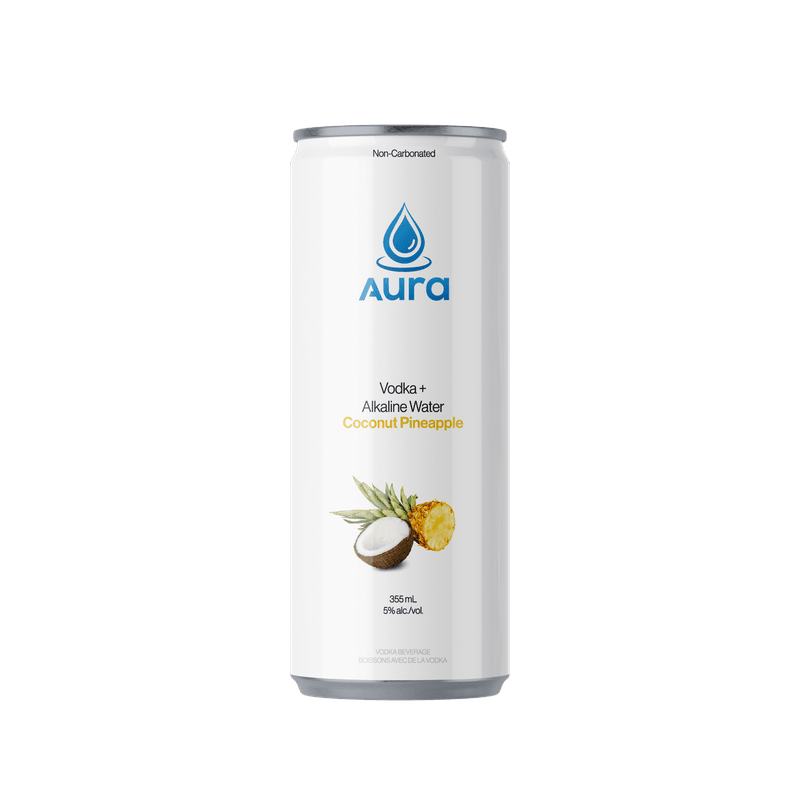
- If gas is the part you dislike, remove the gas. That is the premise behind why Aura: zero carbonation, premium distilled vodka and alkaline water, no added sugar, no artificial sweeteners, no preservatives, gluten-free. Choosing vodka cocktails without carbonation doesn't make the alcohol gentler — it removes CO₂ from the equation so you can tell what was bothering you.
The Canadian context
The Canadian Centre on Substance Use and Addiction's Canada's Guidance on Alcohol and Health (2023) puts 2 standard drinks or less per week in the range where "you are likely to avoid alcohol-related consequences," 3–6 where cancer risk rises, and 7 or more where heart disease and stroke risk rises significantly — advice that applies to still and sparkling drinks identically.
Aura is available across British Columbia, Alberta and Ontario. Our direct and wholesale ordering delivers to Ontario addresses only — in Alberta, find Aura at AGLC-licensed private retailers, and in B.C. at BC Liquor Stores and licensed private retailers.
Curious whether the bubbles were the problem all along? Run the comparison yourself with Cucumber Lime, Coconut Pineapple or Mango Peach — browse our vodka water cocktails, or find your closest case of 355 mL cans at where to buy. Please enjoy responsibly, and only if you are of legal drinking age.
This article summarises published research for general interest and is not medical advice.
Sources
- Pouderoux P, Friedman N, Shirazi P, et al. "Effect of carbonated water on gastric emptying and intragastric meal distribution." Digestive Diseases and Sciences, 1997;42(1):34–39. PMID 9009113. PubMed
- Wang GJ, Tomasi D, Backus W, et al. "Gastric distention activates satiety circuitry in the human brain." NeuroImage, 2008;39(4):1824–1831. PMID 18155924. PubMed
- Wakisaka S, Nagai H, Mura E, et al. "The effects of carbonated water upon gastric and cardiac activities and fullness in healthy young women." Journal of Nutritional Science and Vitaminology (Tokyo), 2012;58(5):333–338. PMID 23327968. PubMed
- Rogers PJ, Ferriday D, Irani B, et al. "Sweet satiation: acute effects of consumption of sweet drinks on appetite for and intake of sweet and non-sweet foods." Appetite, 2020;149:104631. PMID 32057842. PubMed
- Cuomo R, Grasso R, Sarnelli G, et al. "Effects of carbonated water on functional dyspepsia and constipation." European Journal of Gastroenterology & Hepatology, 2002;14(9):991–999. PMID 12352219. PubMed
- Lambert GP, Bleiler TL, Chang RT, et al. "Effects of carbonated and noncarbonated beverages at specific intervals during treadmill running in the heat." International Journal of Sport Nutrition, 1993;3(2):177–193. PMID 8508195. PubMed
- Eweis DS, Abed F, Stiban J. "Carbon dioxide in carbonated beverages induces ghrelin release and increased food consumption in male rats." Obesity Research & Clinical Practice, 2017;11(5):534–543. PMID 28228348. PubMed
- Roberts C, Robinson SP. "Alcohol concentration and carbonation of drinks: the effect on blood alcohol levels." Journal of Forensic and Legal Medicine, 2007;14(7):398–405. PMID 17720590. PubMed
- Takahashi A. "Can carbonated water support weight loss?" BMJ Nutrition, Prevention & Health, 2025;8(1):e001108. PMID 40771535. PubMed
- Canadian Centre on Substance Use and Addiction. Canada's Guidance on Alcohol and Health, 2023. ccsa.ca