If a night of whiskey leaves you wrecked and the same number of vodka drinks leaves you merely tired, you have probably wondered whether the spirit itself is to blame. It is one of the most durable beliefs in drinking culture, and unusually for bar folklore, there is genuine congeners hangover research behind it, including a controlled trial that put bourbon and vodka head to head at a matched dose. The short version: the effect is real, it is smaller than most people assume, and it is swamped by how much you actually drank.
So here is the usable answer before the evidence: switching to a clear spirit is a marginal lever. Drinking less, more slowly, and counting your servings is the large one. If you want the clear-spirit margin anyway, take it, but take it on top of dose control rather than instead of it.
What congeners hangover research actually measures
Congeners are the compounds other than ethanol and water that end up in a finished drink. They arrive from fermentation, from the grain or fruit, from the cask, and from additives during production. The Brown University press release announcing the bourbon trial listed acetone, acetaldehyde, fusel oil, tannins and furfural among them, and quoted lead researcher Damaris Rohsenow making the point that matters most: while these chemicals could be poisonous in large amounts, they occur in very small amounts in alcoholic beverages.
Dark, barrel-aged and heavily flavoured spirits carry more of them. Vodka sits at the other end, rectified close to neutrality, which is precisely why researchers use it as the low-congener comparison arm. That is also why any decent our vodka water cocktails style product starts from a premium vodka base rather than a rougher spirit that needs covering up.
The congener hypothesis, then, is simple: if those trace compounds are mildly toxic, drinks containing more of them should produce worse mornings at the same alcohol dose. That is a testable claim, and it has been tested.
The bourbon-versus-vodka trial: what it actually found
The key study is Rohsenow and colleagues, published in Alcoholism: Clinical and Experimental Research in 2010. Ninety-five healthy heavy drinkers aged 21 to 33 spent an acclimatization night in the lab followed by two drinking nights. On one night they drank to a mean of 0.11 g% breath alcohol concentration on either vodka or bourbon; on the other they got a matched placebo. Beverage type and order were randomized. The researchers ran overnight polysomnography and then assessed self-reported hangover and neurocognitive performance the next morning.
The reported results, in the authors' own summary: after alcohol, participants had more hangover and more decrements on tests requiring both sustained attention and speed. Hangover severity correlated with poorer performance. Alcohol decreased sleep efficiency and REM sleep while increasing wake time and next-day sleepiness. And then the finding that made headlines - no effect of beverage congeners was found except on hangover severity, with people feeling worse after bourbon. There were virtually no sex differences.
The line almost everyone skips
The same paper's conclusion contains a sentence that rarely survives the trip into a lifestyle article: congener content affects only how people feel the next day, so it does not increase risk. Next-morning impairment on attention and reaction-speed tasks was about the same after bourbon as after vodka. People felt worse; they did not perform worse.
That distinction matters enormously if you are thinking about driving, or about a safety-sensitive shift the next morning. A milder subjective hangover is not evidence of a milder impairment. The trial's own headline conclusion was that drinking to this level affects complex cognitive abilities regardless of which bottle it came from.
The companion review by Rohsenow and Howland, published in Current Drug Abuse Reviews the same year, puts the size of the effect in its place. Bourbon, the highest-congener beverage tested, produced more severe hangover ratings than vodka, which has essentially no congeners - but ethanol effects per se had a considerably stronger effect on hangover than did congener content.
How much is dose, and how much is the spirit?
Here is the thing that gets lost. The trial matched the dose. Both arms were driven to the same breath alcohol concentration, which is the only way to isolate a congener effect at all. Your Saturday nights are not matched.
In the wild, a vodka vs whiskey hangover comparison is contaminated by everything the lab controlled for. Whiskey is often poured free-hand, sipped over a longer evening, or ordered as doubles. Vodka more often arrives in a measured highball. People switch drinks, eat differently, and sleep differently across those nights. Almost none of the difference you notice between spirits is a clean congener signal - most of it is dose, pace and sleep.
Note also that 0.11 g% is a heavy-drinking laboratory dose, well past a typical evening. For Canadian context, Canada's Guidance on Alcohol and Health, published by the Canadian Centre on Substance Use and Addiction in 2023, frames consumption as a continuum of risk: 1 to 2 standard drinks per week is low risk, 3 to 6 is moderate, and 7 or more significantly increases risk of heart disease or stroke. It also notes that more than 2 standard drinks on a single occasion is associated with increased risk of harms including injuries and violence. That guidance is about health risk, not hangovers - but it is the number that should be anchoring your evening, not the colour of the spirit.
What the evidence does not support
Being honest about this literature means listing what cuts against it.
- One trial, one population. Ninety-five healthy heavy drinkers aged 21 to 33 is a respectable sample for a polysomnography study, but it is one study in one narrow group. It does not generalise cleanly to light drinkers or older adults.
- The mechanism has not held up well. Methanol is the congener most often blamed. Mackus and colleagues, writing in Alcohol in 2017, studied 36 healthy social drinkers and found urine methanol was significantly higher on hangover days than control days - yet urine methanol concentration did not significantly correlate with overall hangover severity, nor with most individual core symptoms. A congener that tracks drinking but not suffering is a weak explanation.
- The field admits its own limits. The Alcohol Hangover Research Group consensus statement notes that hangover research has been hampered by small sample sizes, inadequate methodologies and arbitrarily chosen tests, along with a lack of well-validated assessment instruments.
- People differ enormously. That same consensus statement records that roughly 25% of heavy drinkers claim they have never had a hangover at all. Whatever you conclude from group averages may simply not describe you.
- Feeling better is not being safer. Worth repeating, because it is the single most misused finding here.
To be direct about our own product: none of this makes Aura healthier, safer, less intoxicating or medically beneficial. The alcohol in the can is the same alcohol. A still drink with no added sugar is a taste and comfort preference, not a health claim, and we are not going to pretend otherwise.
What you can actually do tonight
- Count servings, not drinks. Check the ABV printed on whatever you are holding and work out the standard drinks. A free-poured whisky and a canned cocktail are not interchangeable units.
- Prefer pre-measured formats. A sealed 355 mL can is a portion someone else measured. That removes the single biggest source of accidental dose creep.
- Pace to the clock, not the room. Your body clears alcohol at a fixed rate no matter what you are drinking.
- Protect sleep. The trial found alcohol cut sleep efficiency and REM sleep and raised next-day sleepiness. Those effects correlated with hangover even though they did not explain the performance decline.
- Do not plan around a mild hangover. If you have an early drive or a safety-sensitive shift, the spirit you chose is irrelevant to your impairment.
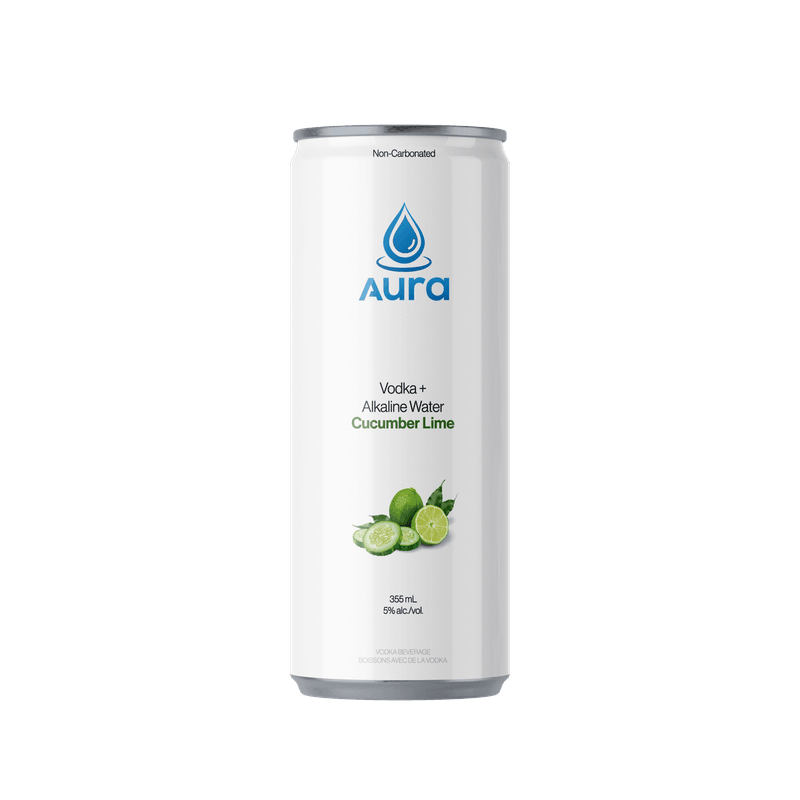
That pre-measured point is most of why Aura is built the way it is. Each can is premium distilled vodka, alkaline water at pH 8.5 or above, and natural flavour - no added sugar, no artificial sweeteners, no preservatives, and gluten-free, in Cucumber Lime, Coconut Pineapple or Mango Peach. It is a still drink with zero carbonation, which is a comfort and flavour choice rather than a hangover one, and it means the serving size is decided before you open it. You can read more about the formulation on why Aura.
Aura is available across British Columbia, Alberta and Ontario in 355 mL cans by the case of 24. Ordering direct or wholesale from us delivers to Ontario addresses only; in Alberta look for AGLC-licensed private retailers, in BC try BC Liquor Stores and licensed private retailers, and check where to buy for the nearest stockist. Please enjoy responsibly, and only if you are of legal drinking age in your province.
This article summarises published research for general interest and is not medical advice.
Sources
- Rohsenow DJ, Howland J, Arnedt JT, Almeida AB, Greece J, Minsky S, Kempler CS, Sales S. Intoxication with bourbon versus vodka: effects on hangover, sleep, and next-day neurocognitive performance in young adults. Alcoholism: Clinical and Experimental Research. 2010;34(3):509-518. PMID 20028364. DOI 10.1111/j.1530-0277.2009.01116.x. pubmed.ncbi.nlm.nih.gov/20028364
- Rohsenow DJ, Howland J. The role of beverage congeners in hangover and other residual effects of alcohol intoxication: a review. Current Drug Abuse Reviews. 2010;3(2):76-79. PMID 20712591. DOI 10.2174/1874473711003020076. pubmed.ncbi.nlm.nih.gov/20712591
- Mackus M, Van de Loo AJAE, Korte-Bouws GAH, Van Neer RHP, Wang X, Nguyen TT, Brookhuis KA, Garssen J, Verster JC. Urine methanol concentration and alcohol hangover severity. Alcohol. 2017;60:1-4 (March 2017). PMID 28262186. DOI 10.1016/j.alcohol.2016.12.004. pubmed.ncbi.nlm.nih.gov/28262186
- Verster JC, et al. The Alcohol Hangover Research Group consensus statement on best practice in alcohol hangover research. Current Drug Abuse Reviews. 2010;3(2):116-126. PMID 20712593. PMCID PMC3827719. pmc.ncbi.nlm.nih.gov/articles/PMC3827719
- Canadian Centre on Substance Use and Addiction. Canada's Guidance on Alcohol and Health. CCSA, 2023. ccsa.ca/canadas-guidance-alcohol-and-health
- Brown University / EurekAlert! press release. Bourbon versus vodka: bourbon hurts more the next day, performance is the same. 18 December 2009. eurekalert.org/news-releases/679771 (press release, cited only for the 37-times congener figure)