If you are launching a canned drink, the hardest early question is not the recipe — it is who actually fills the can. Search contract beverage production Canada and you will get replies from three very different kinds of company, all using the same vocabulary. Sorting them out before you send a spec sheet can save you months and a wasted deposit. Here is what each type of partner actually does, what a production run involves from spec sheet to palletised cans, and the licensing and excise paperwork that has to be in place before anyone books you line time.
Co-packer, contract manufacturer or formulation house?
Formulation house
A formulation or flavour house develops the liquid. You bring a brief — target ABV, sweetness, mouthfeel, allergen and label constraints — and they return bench samples, an ingredient declaration and a specification you either own outright or licence. They do not fill anything. Expect several sample rounds, and get the ownership of the final formula in writing before you pay for the last one.
Co-packer
The co-packer Canada founders usually mean is a filling and packaging operation. You supply the finished formula, and often the cans, ends, film and trays; they run it on their line, seam, date-code, pack and palletise. A co-packer is the fastest route once your formula is locked and your volume fits their can format and line speed. It is also the least forgiving: liquid problems are your problem.
Contract beverage manufacturer
A contract beverage manufacturer is closer to turnkey. It can source raw materials in its own name, hold the production licence, help refine your formula, run quality assurance and release finished, saleable pallets. In alcohol this distinction matters far more than in soft drinks, because it is usually the producer's licence — not yours — that permits the liquid to be legally made, packaged and duty-stamped. Full-service custom drinks manufacturing costs more per case than pure co-packing and removes a lot of first-launch risk.
What a production run actually involves
A run is a sequence of approvals, not a single day of filling. Ask your partner to map their version of this to real dates:
- Spec sheet sign-off: formula, ABV, pH, target fill volume, shelf life, allergen and gluten statements.
- Bench and pilot samples: small-scale liquid you taste and send for analysis before committing.
- Packaging approvals: can and end specs, print proofs, sleeve or litho lead times, carton and pallet configuration.
- Raw material and component receipt: everything must land and be released before the line is scheduled.
- Label and artwork compliance review against Canadian requirements.
- Production: batching, blending, filling and seaming — a still product runs without any carbonation step, which changes both the equipment and the fill parameters.
- In-process QA: fill weights, seam teardowns, ABV verification, microbiological checks, retained samples.
- Coding, packing, palletising, stretch-wrapping — then hold-and-release before the pallets can ship.
Insist on a written certificate of analysis and a retained sample for every batch. If a listing or licensee ever queries a can, that paperwork is the only thing that settles it.
Licensing and excise paperwork for contract beverage production Canada
Alcohol adds a layer that non-alcoholic co-packing does not have. At the federal level, spirits-based ready-to-drink products are made and packaged under an excise licence administered by the Canada Revenue Agency, duty is calculated on the spirits content, and packaged product generally requires excise stamps. Food safety and labelling sit with the Canadian Food Inspection Agency and Health Canada rules, covering standardized container sizes, ABV declaration, allergen statements and the standardized alcohol labelling requirements now phasing in.
Distribution is provincially regulated, and it is where most launch plans slip. Each province controls listings, mark-ups, warehousing and who may sell to licensees, and a valid liquor licence is required for licensee purchasing. Confirm the current rules directly with your provincial liquor authority — AGLC in Alberta, the BC Liquor Distribution Branch in British Columbia, and AGCO and the LCBO in Ontario — and have your producer confirm in writing which licences they hold and which ones remain your responsibility.
Questions to ask before you commit to a run
- Which licences do you hold, and what does my brand still need to obtain?
- Who owns the formula, and can I move it to another producer?
- What is your minimum run, lead time and current schedule availability in writing?
- Can you run a still, non-carbonated product, or is your line built for carbonated fills?
- Who buys and owns the cans, and who carries the loss on damaged or short-filled units?
- What is your overrun and underrun tolerance, and how is it billed?
- What QA documentation, certificates of analysis and traceability records come with each batch?
- How is excise duty handled and invoiced, and who remits it?
- What happens to remaining raw materials and finished stock if we stop working together?
How we do it at Aura
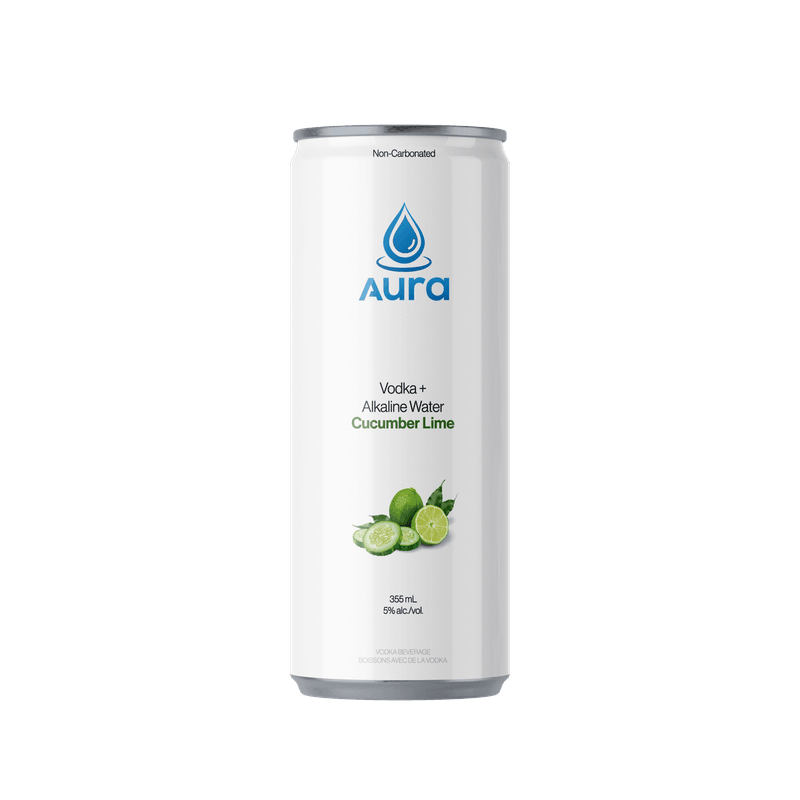
Aura is a canned vodka water: premium distilled vodka, alkaline water at pH 8.5 or higher, and natural flavour, with no added sugar, no artificial sweeteners, no preservatives, and gluten-free. There is zero carbonation — no bubbles means no bloating, which is exactly why our production spec looks different from a seltzer's. You can see the range of our vodka water cocktails in Cucumber Lime, Coconut Pineapple and Mango Peach, or read why Aura built the liquid this way. Cans are 355mL, sold by the case of 24, and available across British Columbia, Alberta and Ontario. Our own direct and wholesale ordering delivers to Ontario addresses only; in BC and Alberta, use where to buy and your provincial channel — AGLC-licensed private retailers in Alberta, BC Liquor Stores and licensed private retailers in BC.
If you are scoping a run and want honest answers on minimums, timelines and what a still-fill spec really requires, talk to people who have already done it. Ask about custom drinks manufacturing or contact our team with your spec sheet and target market, and we will tell you what to ask for rather than guess at numbers. Please enjoy responsibly — Aura is for those of legal drinking age.