
If you've ever had a couple of drinks, then shared a joint, and felt far more out of it than you expected, the science has a name for what happened. "Crossfading" is the slang for using alcohol and cannabis together, and the crossfading research from controlled lab studies points to two reasons the combination hits harder: alcohol can raise the amount of THC that reaches your blood, and the impairments from each substance pile on top of each other. Here's what the studies actually measured, where they disagree, and what to do with that knowledge in Canada, where both are legal for adults.
The short answer: why weed and alcohol together feel stronger
Using weed and alcohol together isn't just "two drinks' worth plus one joint's worth." In several placebo-controlled experiments, people who drank before inhaling cannabis had higher peak blood THC than when they inhaled the same cannabis sober. On top of that pharmacokinetic effect, driving studies show the impairments add up, and on some measures the combination was dramatically worse than either drug alone. Practically, that means your usual cannabis dose is not your usual dose once you've been drinking.
What crossfading research found about THC alcohol interaction
Alcohol raised blood THC in a 2015 vaporizer study
The most detailed measurement comes from Hartman and colleagues, published in Clinical Chemistry in 2015. Thirty-two occasional cannabis users drank either a placebo or a low dose of alcohol (targeting a peak breath alcohol of about 0.065%) 10 minutes before vaporizing placebo, low-dose (2.9%) or high-dose (6.7%) THC cannabis. Nineteen participants completed all six combinations.
Without alcohol, the median peak blood THC was 32.7 μg/L at the low dose and 42.2 μg/L at the high dose. With alcohol, those medians rose to 35.3 and 67.5 μg/L, and the active metabolite 11-OH-THC was also higher. The authors reported these increases as statistically significant and suggested they "possibly explain" the extra impairment seen when the two are combined. Note the wide individual ranges: at the high dose with alcohol, peaks ran from 18.1 to 210 μg/L, so the same session can look very different from one person to the next.
An earlier study linked alcohol to faster, stronger highs
That finding echoes Lukas and Orozco's 2001 study in Drug and Alcohol Dependence. Male volunteers smoked placebo, low or moderate THC cannabis after drinking placebo, 0.35 g/kg or 0.7 g/kg of alcohol on separate days. For many of the dose combinations, participants who had alcohol noticed the cannabis effects sooner, reported more episodes of euphoria and had higher plasma THC than after placebo drinks. The authors proposed that alcohol may increase THC absorption.
Combined use impaired driving more than either alone
Blood levels matter because of what people do next. In an on-road study by Ramaekers, Robbe and O'Hanlon (Human Psychopharmacology, 2000), 18 participants drove in normal traffic after THC (0, 100 or 200 μg/kg), with or without alcohol targeting a blood alcohol concentration of just 0.04%. Each substance alone impaired lane-keeping. Combined, the weaving (standard deviation of lateral position) was equivalent to a BAC of 0.09% and 0.14% at the two THC doses. That's a far larger effect than the 0.04% of alcohol alone would suggest.
A larger simulator study by Downey and colleagues (Accident Analysis & Prevention, 2013) tested 80 recreational users across six double-blind, placebo-controlled sessions, combining 0%, 1.8% or 3% THC cannabis with alcohol to reach 0%, 0.03% or 0.05% BAC. Driving was most impaired in the combined conditions, blood THC was again higher when cannabis came with alcohol, and regular cannabis users had higher plasma THC than non-regular users.
What cuts against the simple story
The evidence is consistent in direction, but it has real limits, and some results point the other way:
- Small samples. Hartman's pharmacokinetic analysis rests on 19 completers and Ramaekers' on 18 drivers. That's normal for dosing studies with blood draws, but it means wide uncertainty.
- The effect isn't always one-directional. A 1992 study by Lukas and colleagues in Neuropsychopharmacology found the reverse interaction: in 15 men who smoked high-dose cannabis 30 minutes after a 0.7 g/kg drink, peak plasma alcohol was 54.80 mg/dL at 105 minutes, versus 78.25 mg/dL at 50 minutes without cannabis. Lower blood alcohol is not the same as less impairment, and the authors only concluded that cannabis "may alter ethanol bioavailability."
- Not every measure stacks. In a follow-up from the Hartman team, Hartman et al. (Journal of Applied Toxicology, 2016) found that among 18 drivers, cannabis was linked to slower driving and longer following distances, and a less-than-additive interaction suggested cannabis reduced alcohol's tendency to make people speed. Driving slower doesn't make anyone safe. It may reflect people trying to make up for impairment they can feel.
- Order and route. In these studies people drank first and then inhaled. They don't tell us much about edibles, about using cannabis before drinking, or about today's high-potency products.
- Lab conditions. Participants were screened, supervised adults on fixed doses. Real-world crossfading often involves more of both, over longer periods.
What the research does not show
None of these studies identify a "safe" combination, a drink that cancels out THC, or a product that makes crossfading less risky. They also don't tell you your personal blood THC on a given night, since individual peaks varied several-fold. And no drink choice changes the basic finding. Alcohol is alcohol, whether it's in a beer, a cocktail or a can of vodka water, and the interaction described above is about the ethanol, not the mixer.
Practical guidance if you're mixing alcohol and cannabis
- Don't drive. No exceptions. Canada's Criminal Code sets a combined limit of 50 mg of alcohol per 100 mL of blood plus 2.5 ng of THC per mL, lower than either the alcohol limit or the 5 ng THC limit alone. In the Hartman data, some participants still had detectable THC (≥1 μg/L) 8.3 hours after a single session. Book the ride home before the first drink.
- If you've been drinking, cut your usual cannabis dose. The studies suggest alcohol can push the same puff higher in your blood. Take less, then wait before deciding on more.
- Be especially careful with edibles. Edibles weren't tested in these studies, and their effects come on slowly. A drink while you're "waiting for it to kick in" can stack on top of a dose you haven't felt yet.
- Count your drinks honestly. Pace yourself, alternate with water or food, and don't treat a light-tasting drink as a weaker one. Hydration helps you feel more comfortable, but it doesn't lower your blood alcohol or THC.
- Know the higher-risk groups. The Lower-Risk Cannabis Use Guidelines (Fischer et al., American Journal of Public Health, 2017), developed with Canadian legalization in mind, advise abstaining from cannabis-impaired driving and say higher-risk groups should avoid cannabis altogether.
- Watch your friends. If someone becomes very confused, can't stay awake or is vomiting repeatedly, don't leave them alone. Call 911 if you're worried.
Where Aura fits in, and where it doesn't
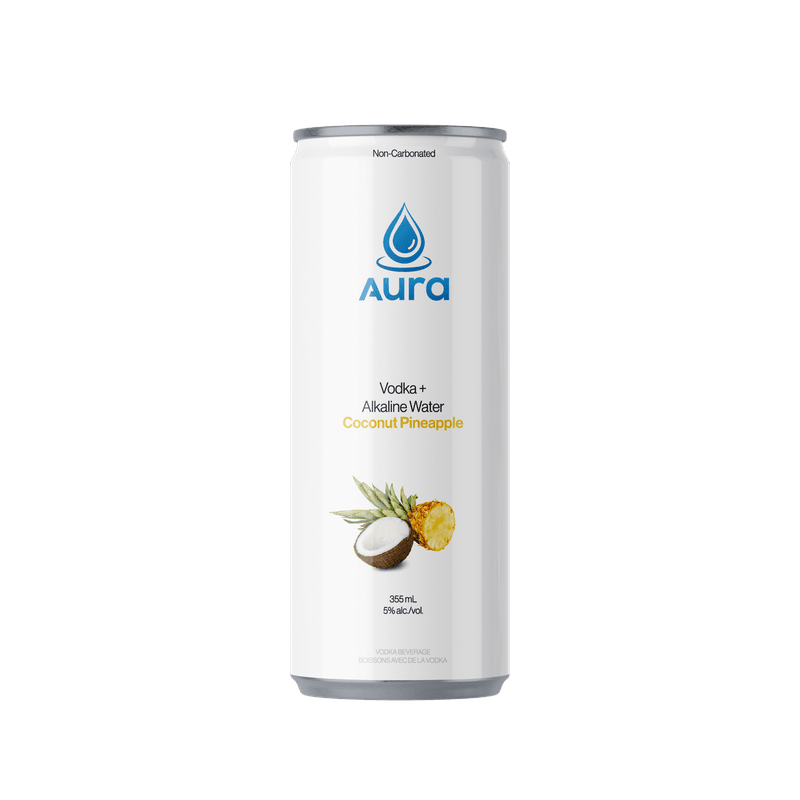
Aura is a still vodka water: premium vodka, alkaline water (pH 8.5+) and natural flavour, with zero carbonation, no added sugar, no artificial sweeteners and no preservatives. Many people choose it because it's a still alternative to seltzers. With no bubbles, there's no bloating. That's a comfort preference, not a safety feature. A can of Aura contains real alcohol, and everything in the crossfading research applies to it exactly as it would to any other drink. You can read more about why Aura is made the way it is.
Aura is available across British Columbia, Alberta and Ontario. Our own direct and wholesale ordering delivers to Ontario addresses only. In Alberta, look for AGLC-licensed private retailers. In BC, check BC Liquor Stores and licensed private retailers. Our where to buy page can help.
This article summarises published research for general interest and is not medical advice. Aura is for adults of legal drinking age in their province. Please enjoy responsibly and never drive impaired.
Explore Aura
If you'd like a drink that keeps things simple, explore our vodka water cocktails in Cucumber Lime, Coconut Pineapple and Mango Peach, sold in cases of 24 × 355 mL cans. Plan your night, pace your drinks, and keep the car keys out of it.
Sources
- Hartman RL, Brown TL, Milavetz G, Spurgin A, Gorelick DA, Gaffney G, Huestis MA. Controlled Cannabis Vaporizer Administration: Blood and Plasma Cannabinoids with and without Alcohol. Clinical Chemistry. 2015;61(6):850-869. PMID: 26019183. doi:10.1373/clinchem.2015.238287. Link
- Lukas SE, Orozco S. Ethanol increases plasma Δ9-tetrahydrocannabinol (THC) levels and subjective effects after marihuana smoking in human volunteers. Drug and Alcohol Dependence. 2001;64:143-149. PMID: 11543984. doi:10.1016/s0376-8716(01)00118-1. Link
- Ramaekers JG, Robbe HW, O'Hanlon JF. Marijuana, alcohol and actual driving performance. Human Psychopharmacology. 2000;15(7):551-558. PMID: 12404625. doi:10.1002/1099-1077(200010)15:7<551::aid-hup236>3.0.co;2-p. Link
- Downey LA, King R, Papafotiou K, Swann P, Ogden E, Boorman M, Stough C. The effects of cannabis and alcohol on simulated driving: Influences of dose and experience. Accident Analysis & Prevention. 2013;50:879-886. PMID: 22871272. doi:10.1016/j.aap.2012.07.016. Link
- Lukas SE, Benedikt R, Mendelson JH, Kouri E, Sholar M, Amass L. Marihuana attenuates the rise in plasma ethanol levels in human subjects. Neuropsychopharmacology. 1992;7(1):77-81. PMID: 1326277. Link
- Hartman RL, Brown TL, Milavetz G, Spurgin A, Pierce RS, Gorelick DA, Gaffney G, Huestis MA. Cannabis effects on driving longitudinal control with and without alcohol. Journal of Applied Toxicology. 2016;36(11):1418-1429. PMID: 26889769. doi:10.1002/jat.3295. Link
- Fischer B, Russell C, Sabioni P, van den Brink W, Le Foll B, Hall W, Rehm J, Room R. Lower-Risk Cannabis Use Guidelines: A Comprehensive Update of Evidence and Recommendations. American Journal of Public Health. 2017;107(8):e1-e12. PMID: 28644037. doi:10.2105/AJPH.2017.303818. Link
- Department of Justice Canada. Impaired driving laws: blood drug concentration limits. Link