You have a flavour idea, a brand name, and no idea who actually makes the liquid. That is the real starting problem, and a custom beverage manufacturing Ontario partner solves roughly half of it — the production half. The other half is licensing, federal excise and label approval, and that stays with you no matter who fills your cans. Below is the order to work in, and the questions to ask before you send anyone a deposit.
What custom beverage manufacturing Ontario actually covers
“Co-packer,” “contract manufacturer” and “private label beverage manufacturing” get used interchangeably, but they describe very different levels of service. Private label usually means you put your brand on an existing recipe. Custom drinks manufacturing means the liquid is developed for you. Confirm which one you are buying in writing, because it determines who owns the formula.
What a production partner can do
- Bench formulation and scale-up from a sample to a full batch
- Ingredient, water treatment and packaging sourcing
- Filling, seaming, coding, labelling and case packing
- QA and lab work: pH, ABV verification, microbiological checks, shelf-life and stability testing
- Short-term warehousing and pallet release to your logistics provider
What they cannot do for you
- Hold your licences on your behalf, or make your brand compliant by association
- Guarantee that a regulator or a provincial liquor board will approve your label or list your product
- Sell or distribute the product into retail or licensee channels
- Own the regulatory relationship — the questions come back to the brand owner
When you shortlist a beverage manufacturer Ontario founders already use, ask for references from brands in your category. A juice line and an alcohol line are not the same operation.
Provincial licensing and federal excise: two clocks running at once
Alcohol production is federally regulated and alcohol distribution in Canada is provincially regulated. Both apply to you at the same time, and neither waits for the other.
- Federally, spirits production and packaging fall under the Excise Act, 2001, administered by the Canada Revenue Agency. Excise duty and excise stamping obligations attach to packaged spirits — confirm with CRA whether your co-packer’s licence covers your product or whether you need your own.
- Provincially in Ontario, manufacturing and sale are overseen by the AGCO, with the LCBO as the route to market for retail and licensee channels.
- Licensee purchasing — a bar, restaurant, venue or caterer buying for resale — requires a valid liquor licence, without exception.
- Rules change. Confirm current requirements directly with your provincial liquor authority: AGCO and the LCBO in Ontario, AGLC in Alberta, and the BC Liquor Distribution Branch in British Columbia.
Water source and formulation decisions
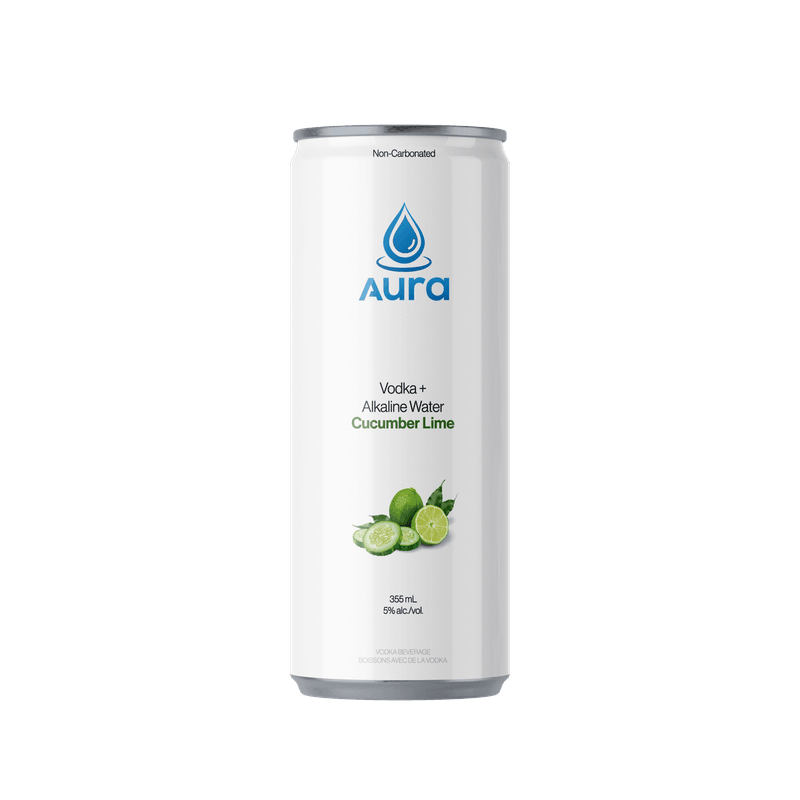
In a vodka water, water is not a filler — it is most of the product. Ask your manufacturer what their source is (municipal supply or well), what treatment train sits in front of the filler, and whether they can hold a mineral and pH specification batch to batch. Carbon filtration, reverse osmosis and controlled remineralisation all change how a finished drink tastes. Aura is built on premium distilled vodka and alkaline water at pH 8.5+, with no added sugar, no artificial sweeteners and no preservatives, and it is gluten-free.
The other decision to make early is still versus carbonated, because it changes the line. Carbonated product needs a carbonator and a counter-pressure filler. Still product fills differently, and the conversation moves to dissolved oxygen, headspace and can integrity instead. Aura is a still drink with zero carbonation — no bubbles means no bloating, which is exactly why we specified a still line rather than a seltzer one. You can taste the result across our vodka water cocktails, and see the reasoning behind the format on why Aura.
Label and packaging approval steps
Artwork is the step most new brands underestimate. Build in time for at least one revision round before you commit to a print run, and never print cans on an unapproved file.
- Confirm mandatory label elements — common name, net quantity, alcohol by volume, responsible party, allergen statements and bilingual requirements — against current CFIA and Health Canada guidance
- Submit artwork for provincial review through the appropriate channel before printing
- Verify can supplier lead times and printing minimums directly with the supplier
- Lock your batch coding and traceability format with the manufacturer
A realistic sequence from idea to first production run
- Define the product: format, ABV, still or carbonated, flavour targets
- Confirm your licensing path with AGCO and CRA before spending on design
- Shortlist manufacturers and confirm capability, ownership of formula and pricing in writing
- Bench samples, then a pilot batch, then stability testing
- Artwork development and regulatory label review
- Packaging procurement against confirmed lead times
- First production run, release testing, and warehousing
- Route to market: listings, licensee sales and distribution
We won’t quote minimums, timelines or pricing here, because real numbers depend on your format and volume — get those from the source. If you are launching a brand or want to bring a canned still cocktail onto your list, talk to us about custom drinks manufacturing or wholesale ordering (direct and wholesale delivery is Ontario addresses only). Outside Ontario, find us through where to buy, or contact our team with your specs. Aura is for those of legal drinking age — please enjoy responsibly.