You wake at 3 a.m. with a mouth like paper, or come off a patio afternoon in Toronto feeling flat and puffy, and somebody offers the four-word explanation: alcohol dehydrates you. If you have ever asked does alcohol dehydrate you and wanted an actual number — how much fluid, at what dose, and whether the water in the glass offsets any of it — the slogan runs out fast. The alcohol hydration research is more specific, more conditional and far more useful than the phrase it gets compressed into.
Short version: alcohol is a diuretic, it does increase urine output, and the size of that effect depends on the grams of ethanol, the concentration of the drink delivering them, and how hydrated you were when you started. At beer-strength dilutions, controlled trials have repeatedly failed to find any difference in urine output between an alcoholic drink and its non-alcoholic twin.
Does alcohol dehydrate you? What the dose-response data actually shows
The cleanest test of dose versus dilution comes from Polhuis and colleagues, published in Nutrients in 2017 (full text). Twenty Dutch men aged 60–75 — 19 completed — drank a fixed 30 g of ethanol on separate occasions, delivered as 5% beer, 13.5% wine, or 35% spirits, each paired against a non-alcoholic counterpart of the same volume. Thirty grams is roughly 2.2 Canadian standard drinks, since Health Canada defines one standard drink as 17.05 mL or 13.45 g of pure alcohol.
Over the four hours after drinking, spirits produced more urine than water (p < 0.001) and wine more than non-alcoholic wine (p < 0.03). Beer produced no more urine than non-alcoholic beer (p > 0.70). By 24 hours none of the three pairs differed at all — every comparison above p = 0.10. Same ethanol dose, three different answers, driven by concentration.
Starting hydration changes the answer too
Hobson and Maughan ran the other half of the experiment in Alcohol and Alcoholism in 2010 (abstract). Twelve men cycled in 35.1 °C heat and 68% humidity until down 1.9% of body mass, then next morning drank 1 L of beer — alcohol-free on two trials, 4% ethanol on the other two.
Starting euhydrated, the alcoholic beer produced 1,279 ± 256 mL of urine over four hours against 1,121 ± 148 mL for the alcohol-free version (P < 0.001). Statistically solid — and worth 158 mL, about two thirds of a cup, off a full litre of beer. Starting dehydrated, the gap narrowed to 261 ± 138 mL versus 174 ± 61 mL and missed significance (P = 0.057). The authors concluded that "the diuretic action of alcohol is blunted when the body is hypohydrated."
The largest trial here is the beverage hydration index study by Maughan and colleagues in the American Journal of Clinical Nutrition in 2016 (PubMed), which gave 72 euhydrated men 1 L of each of 13 drinks and collected urine for four hours. Lager sat in the same statistical group as cola, coffee, tea and orange juice: not different from still water. Only oral rehydration solution (1,038 g), full-fat milk (1,052 g) and skimmed milk (1,049 g) retained more fluid than plain water (1,337 g), all at P < 0.001.
The vasopressin evidence, and where it wobbles
The textbook mechanism: ethanol suppresses arginine vasopressin — antidiuretic hormone — from the posterior pituitary, the kidney stops reclaiming water, urine output climbs. That sentence is the physiology underneath every "alcohol dehydrates you" post online. The most recent controlled test of it is considerably less tidy.
Sailer and colleagues, in the American Journal of Physiology–Renal Physiology in 2020 (PubMed), had ten healthy men complete four interventions in random order: beer alone, beer plus water, beer plus stock (for sodium), or water alone. Fluid volume was matched across all four, and the beer was dosed to reach a blood alcohol concentration of 0.8‰. They tracked copeptin, a stable surrogate for vasopressin, across six time points over 720 minutes.
The primary endpoint — mean copeptin difference 90 minutes in — showed no between-group difference at all (P = 0.4). The deep early suppression the standard story predicts did not separate alcohol from water.
What separated them came later. Total urinary volume was higher across all alcohol interventions than water (P = 0.01), and at the end of the 720-minute window plasma copeptin, plasma sodium and urine osmolality were all significantly higher after alcohol (P = 0.02). The authors read this as suppression that is prolonged rather than deeper, followed by a rebound into water retention. So "alcohol switches off your ADH" flattens a biphasic curve. And here, extra water or sodium alongside the beer did not change any of the alcohol-induced effects — which is not what most people assume about chasing drinks with water.
The caveats, stated plainly
- Small, almost entirely male samples. Twelve men. Ten men. Nineteen older men. Seventy-two men. Women are barely represented, and sex differences in body water and alcohol metabolism are well established.
- Enormous individual variance. Maughan's hydration index values carry standard deviations close to half the mean — 1.54 ± 0.74 for oral rehydration solution. Group averages hide people who respond far more, and far less.
- Short measurement windows. Most of this work stops at four hours. Polhuis's 24-hour data found no differences at all, suggesting the effects that do appear are largely transient.
- Fluid balance is not hangover severity. These studies measured urine volume, osmolality and hormones — not how you feel the next morning. Do not assume one predicts the other.
- Mechanism and outcome disagree. Sailer's group found more urine without the early vasopressin suppression supposed to cause it. An unresolved gap, not a settled story.
Vodka water hydration: where format actually matters
This is the paragraph where a vodka brand is meant to tell you its drink hydrates you. It does not. The dilution evidence supports something narrower: at the same grams of ethanol, a diluted format spreads that alcohol across more water and more time than a shot does, and in controlled trials those formats did not measurably increase urine output over their non-alcoholic equivalents. That is an observation about fluid volume and drinking pace — not a health claim. The ethanol in the can is the same ethanol either way.
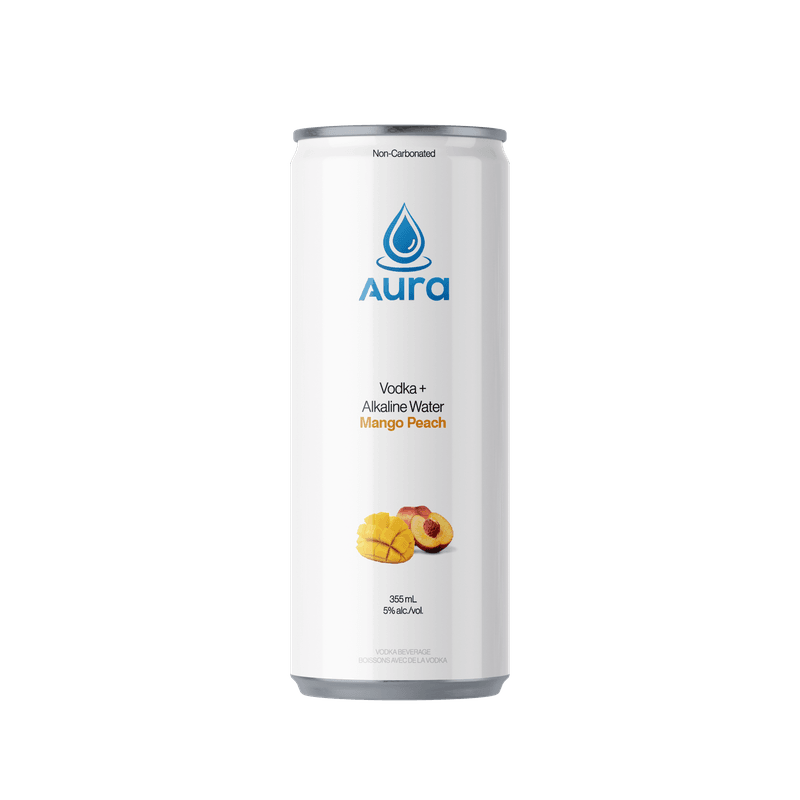
Aura is built on that dilution logic — premium distilled vodka, alkaline water at pH 8.5+ and natural flavour in a 355 mL can, no added sugar, no artificial sweeteners, no preservatives, gluten-free. It is also a still drink: zero carbonation, no bubbles, no fizz — a comfort and taste decision rather than a hydration one. No bubbles means no bloating, but nothing in the research above speaks to carbonation in either direction, and we're not going to pretend otherwise. The reasoning behind the format is in why Aura.
What to actually do tonight
- Count grams of ethanol, not glasses. Serving size × ABV drives the diuresis. A 43 mL shot of 40% spirits and a 341 mL bottle of 5% beer carry the same 13.45 g.
- Take dilution seriously without treating it as a free pass. Thirty grams at 35% moved urine output in Polhuis's trial; the same 30 g at 5% did not.
- Don't treat water-chasing as an antidote. Simultaneous water didn't blunt the alcohol effects in Sailer's trial. Spacing drinks out does more work than the glass beside them.
- If you are genuinely replacing losses — a hot day, a long ride, a shift outdoors — use milk or an oral rehydration solution, which beat water outright. No alcoholic drink at any strength belongs in that job.
- Don't start dehydrated. Hobson and Maughan's blunted diuresis is your body compensating under stress, not a loophole.
- Anchor to the Canadian guidance. The Canadian Centre on Substance Use and Addiction (2023) puts 1–2 standard drinks a week at low risk, 3–6 at moderate risk, and flags more than 2 on one occasion as raising harm risk.
"Hydrating alcoholic drinks" is a category that does not really exist. The honest question is which format lets you drink less alcohol, more slowly — a question about serving size and ABV, not marketing. Aura's Cucumber Lime, Coconut Pineapple and Mango Peach come by the case of 24 across British Columbia, Alberta and Ontario. Our own direct and wholesale ordering delivers to Ontario addresses only; in Alberta, look to AGLC-licensed private retailers, and in BC to BC Liquor Stores and licensed private retailers — where to buy has the current list.
Read the label, count the grams, pace the night, and let water run on its own schedule. If that is the plan you want in a still, no-added-sugar can, browse our vodka water cocktails — and if you're in Ontario, order a case direct. Must be of legal drinking age. Please enjoy responsibly.
This article summarises published research for general interest and is not medical advice.
Sources
- Polhuis KCMM, Wijnen AHC, Sierksma A, Calame W, Tieland M. "The Diuretic Action of Weak and Strong Alcoholic Beverages in Elderly Men: A Randomized Diet-Controlled Crossover Trial." Nutrients, 2017;9(7):660. DOI 10.3390/nu9070660; PMID 28657601. https://pmc.ncbi.nlm.nih.gov/articles/PMC5537780/
- Hobson RM, Maughan RJ. "Hydration Status and the Diuretic Action of a Small Dose of Alcohol." Alcohol and Alcoholism, 2010;45(4):366–373. DOI 10.1093/alcalc/agq029; PMID 20497950. https://academic.oup.com/alcalc/article/45/4/366/155478
- Sailer CO, Refardt J, Bissig S, Bologna K, Imber C, Christ-Crain M. "Effects of alcohol consumption on copeptin levels and sodium-water homeostasis." American Journal of Physiology–Renal Physiology, 2020;318(3):F702–F709. DOI 10.1152/ajprenal.00458.2019; PMID 31961713. https://pubmed.ncbi.nlm.nih.gov/31961713/
- Maughan RJ, Watson P, Cordery PA, Walsh NP, Oliver SJ, Dolci A, Rodriguez-Sanchez N, Galloway SD. "A randomized trial to assess the potential of different beverages to affect hydration status: development of a beverage hydration index." American Journal of Clinical Nutrition, 2016;103(3):717–723. DOI 10.3945/ajcn.115.114769; PMID 26702122. https://pubmed.ncbi.nlm.nih.gov/26702122/
- Canadian Centre on Substance Use and Addiction. "Canada's Guidance on Alcohol and Health: Final Report." CCSA, Ottawa, 2023. https://www.ccsa.ca/en/guidance-tools-resources/substance-use-and-addiction/alcohol/canadas-guidance-alcohol-and-health
- Health Canada. "Low-risk alcohol drinking guidelines" (standard drink definition: 17.05 mL / 13.45 g pure alcohol). Government of Canada. https://www.canada.ca/en/health-canada/services/substance-use/alcohol/low-risk-alcohol-drinking-guidelines.html