You pour a drink while dinner cooks, and twenty minutes later you've worked through half the cheese board before anyone sits down. If you've ever asked yourself "does alcohol make you hungry, or is it just me?", the short answer from controlled lab research is yes: in most feeding studies, people eat more after a drink than after a non-alcoholic one, and they don't eat less later to make up for the calories in the glass. Researchers call this the aperitif effect. Below is what the studies actually measured, where the evidence is weaker than the headlines suggest, and practical ways to keep a pre-dinner drink from turning into a second dinner.
Does alcohol make you hungry? The short answer from the lab
The most useful overview is a 2019 systematic review and meta-analysis in the British Journal of Nutrition by Kwok and colleagues. The authors screened 18,427 papers and included 22 crossover or randomised trials with 701 participants, each comparing an alcohol dose with a non-alcohol condition. Two findings stand out:
- Studies "consistently demonstrated no compensation" for the energy in alcoholic drinks. People did not eat less food to offset what they drank.
- Pooling twelve studies, alcohol increased food energy intake by a weighted mean of 343 kJ (95% CI 161 to 525), about 80 kcal, and total energy intake (food plus drink) by 1,072 kJ (95% CI 820 to 1,323), about 255 kcal, compared with a non-alcoholic comparator.
So alcohol and appetite interact in two ways. The drink adds its own calories, and it nudges food intake up on top of that. That second part is the aperitif effect.
What controlled feeding studies show
Dose seems to matter
A small study by Caton, Ball, Ahern and Hetherington (2004) gave 12 men a lager 30 minutes before lunch on three separate days: no-alcohol, one UK unit (8 g of alcohol) or four units (32 g). After four units, lunch intake was 5,786 ± 991 kJ, compared with 4,928 ± 1,245 kJ after one unit. Participants ate more high-fat, salty foods and rated themselves hungrier for the rest of the day, while fullness ratings didn't change. Dinner intake was similar across conditions, so the extra lunch calories were not made up later. The authors concluded that "above a certain threshold" alcohol appears to stimulate appetite.
Before the meal or with it: both raised intake
Many people assume the timing is the problem. A follow-up by Caton, Bate and Hetherington (2007) tested 11 men who drank 375 mL of red wine either 20 minutes before lunch (aperitif) or split across the meal (co-ingestion). Lunch intake was 6,436 ± 435 kJ in the aperitif condition and 6,254 ± 417 kJ with co-ingestion, against 5,125 ± 262 kJ with no wine (p<0.01). That is roughly a quarter more food either way. The biggest jump was in the starter, which suggests the effect kicks in early in the meal.
It isn't simply that food tastes better
One theory is that a drink makes food more pleasurable. Caton, Marks and Hetherington (2005) tested this with 12 men given a 24 g alcohol drink or a no-alcohol drink before either a bland or a flavourful lunch. Alcohol increased intake with both lunches, but it did not make the food rate as more pleasant. Whatever drives the effect, a flavour boost alone doesn't explain it.
What brain-imaging and lab studies add
The study that gave the phenomenon its popular name is Eiler and colleagues' 2015 paper in Obesity, "The apéritif effect: Alcohol's effects on the brain's response to food aromas in women." Thirty-five non-obese women had fMRI scans on two occasions: once during an intravenous alcohol infusion held at a target breath alcohol level of 50 mg%, and once during a saline infusion. During the scans they smelled food (roast beef, Italian meat sauce) and non-food odours.
- Under alcohol, the hypothalamus, a key appetite-regulating region, responded more strongly to food smells relative to non-food smells (peak effect pFWE = 0.03).
- At an eat-as-much-as-you-like lunch a few hours later, the women ate more after alcohol than after saline: about 587.5 g against 550.5 g, roughly 7% more (p = 0.04).
- Oddly, levels of ghrelin, a hormone usually associated with hunger, fell after alcohol (p<0.001), so the extra eating can't be explained by a ghrelin spike.
Animal research points to a possible mechanism. In Cains and colleagues (2017, Nature Communications), the hypothalamic Agrp neurons that normally fire during starvation became hyperactive when exposed to dietary doses of ethanol in brain slices, and blocking their activity stopped ethanol-induced overeating in mice. That is a mouse result. It suggests a biological route, but it hasn't been shown in people.
The caveats: what this research does not show
- Small, young samples. The feeding trials above used 11 or 12 men each, and Kwok's review notes its findings apply mainly to adults aged 18 to 37. The meta-analysis also reports substantial heterogeneity and signs of small-study effects for some outcomes, both of which can inflate pooled estimates.
- Effect sizes vary widely. The 2007 wine study found roughly 25% more food at lunch. The Eiler fMRI study found about 7%, and the authors suggest the all-female sample may partly explain the smaller increase.
- Some people compensate later. In the 2007 study, the lean, healthy men brought their total intake back down on the days after the lab sessions in every condition. One night out may not translate into lasting weight change for everyone.
- Lab conditions are artificial. Eiler's participants received alcohol intravenously, which bypasses taste and the stomach entirely. Fixed lab menus aren't a Friday night at a restaurant either.
- Mechanisms remain unsettled. The hypothalamus findings are suggestive, Eiler's group acknowledges fMRI limits under alcohol, and the clearest mechanistic evidence comes from mice.
None of this research shows that any particular drink format, flavour or brand avoids the aperitif effect. The effect is linked to alcohol itself.
How to keep a pre-dinner drink from becoming a second dinner
Since drinking and overeating seem to go together in the lab, the most effective changes are the ones you settle before the first sip:
- Keep it to one. In Caton's 2004 study, extra eating showed up after four units, not one. Fewer drinks is the most direct lever. It also lines up with Canada's Guidance on Alcohol and Health (CCSA, 2023), which says people who have two standard drinks or fewer a week are likely to avoid alcohol-related consequences, with risk rising from there.
- Don't drink on an empty stomach right before a meal. In the feeding studies above, the drink came a few hours after the previous meal, right before lunch. Having a planned snack with some protein at your usual time takes the edge off arriving ravenous.
- Plate the starter. The 2007 study found the biggest increase in the first course. Portion out appetisers onto a plate instead of grazing from the bowl, and keep chips and salty snacks off the counter while you drink, since the 2004 study saw people choose more high-fat, salty foods.
- Decide dinner before the drink. Choose your order or plate your portion first. Pre-commitment does the work your judgement might skip after a glass.
- Pace with water. Alternate each drink with a glass of water and sip slowly. A slower pace means less alcohol per hour.
- Count the drink itself. Kwok's review found the calories in the glass add to the meal rather than replace food, so choose drinks without added sugar and count them in your evening.
Where Aura fits
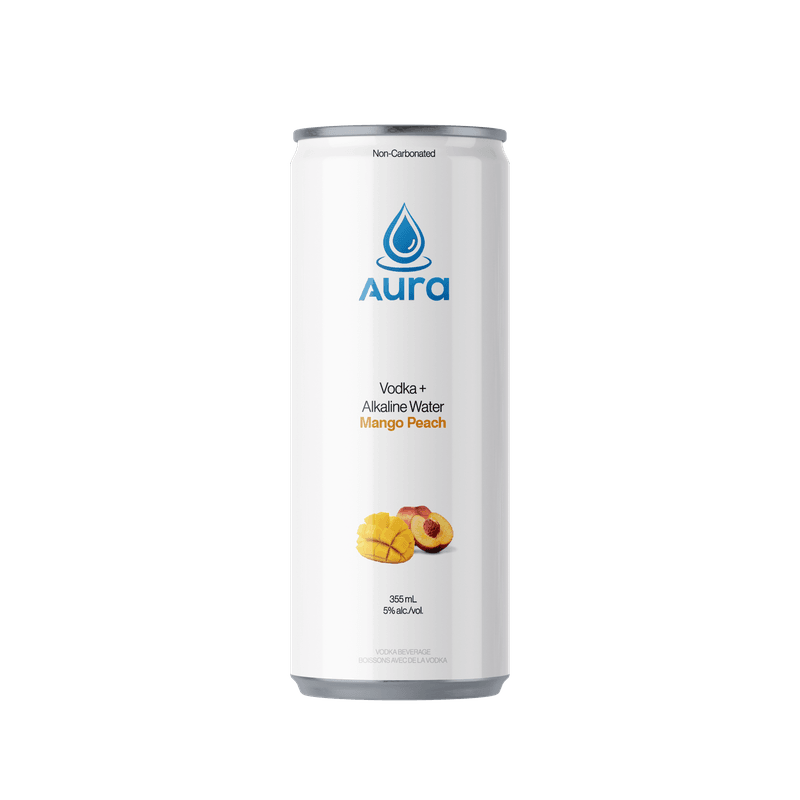
Aura is a still, zero-carbonation vodka water: premium vodka, alkaline water and natural flavour, with no added sugar, no artificial sweeteners and no preservatives. It comes in a measured 355 mL can, which makes "one drink" a clear, countable unit. Because it's still, not a seltzer or vodka soda, it's an easy drink to sip slowly alongside water. To be clear, though, it contains the same alcohol as any other vodka drink. Nothing in the research above suggests Aura, or any other drink, changes the aperitif effect, and we don't claim it does. Learn more about why Aura.
Ready for a simpler pre-dinner pour? Browse our vodka water cocktails in Cucumber Lime, Coconut Pineapple and Mango Peach. Our own direct and wholesale ordering delivers to Ontario addresses only. In British Columbia and Alberta, find Aura through our where to buy page, at BC Liquor Stores and licensed private retailers in BC or AGLC-licensed private retailers in Alberta. Please enjoy responsibly, and only if you are of legal drinking age in your province.
This article summarises published research for general interest and is not medical advice.
Sources
- Kwok A, Dordevic AL, Paton G, Page MJ, Truby H. Effect of alcohol consumption on food energy intake: a systematic review and meta-analysis. British Journal of Nutrition. 2019;121(5):481-495. doi:10.1017/S0007114518003677. PMID 30630543. pubmed.ncbi.nlm.nih.gov/30630543
- Eiler WJ, Džemidžić M, Case KR, Soeurt CM, Armstrong CL, Mattes RD, O'Connor SJ, Harezlak J, Acton AJ, Considine RV, Kareken DA. The apéritif effect: Alcohol's effects on the brain's response to food aromas in women. Obesity. 2015;23(7):1386-1393. doi:10.1002/oby.21109. PMID 26110891; PMCID PMC4493764. pmc.ncbi.nlm.nih.gov/articles/PMC4493764
- Caton SJ, Ball M, Ahern A, Hetherington MM. Dose-dependent effects of alcohol on appetite and food intake. Physiology & Behavior. 2004;81(1):51-58. doi:10.1016/j.physbeh.2003.12.017. PMID 15059684. pubmed.ncbi.nlm.nih.gov/15059684
- Caton SJ, Marks JE, Hetherington MM. Pleasure and alcohol: manipulating pleasantness and the acute effects of alcohol on food intake. Physiology & Behavior. 2005;84(3):371-377. doi:10.1016/j.physbeh.2004.12.013. PMID 15763574. pubmed.ncbi.nlm.nih.gov/15763574
- Caton SJ, Bate L, Hetherington MM. Acute effects of an alcoholic drink on food intake: aperitif versus co-ingestion. Physiology & Behavior. 2007;90(2-3):368-375. doi:10.1016/j.physbeh.2006.09.028. PMID 17107693. pubmed.ncbi.nlm.nih.gov/17107693
- Cains S, Blomeley C, Kollo M, Rácz R, Burdakov D. Agrp neuron activity is required for alcohol-induced overeating. Nature Communications. 2017;8:14014. doi:10.1038/ncomms14014. PMID 28072397; PMCID PMC5234092. nature.com/articles/ncomms14014
- Canadian Centre on Substance Use and Addiction. Canada's Guidance on Alcohol and Health. 2023. ccsa.ca/canadas-guidance-alcohol-and-health