You had two drinks on a hot patio in July and felt like you'd had four. The same two at home in March did nothing. So does altitude affect alcohol, does heat, or is it mostly in your head? The short answer: an empty stomach changes your blood alcohol enormously, altitude changes how your body copes while barely touching your blood alcohol level, and heat changes your behaviour and comfort more than your chemistry.
That distinction matters, because the folklore ("one drink at altitude equals two") sends people looking for the wrong fix.
Does altitude affect alcohol levels in your blood?
The most direct test is old, small and surprisingly clear. In a 1987 study by Collins, Mertens and Higgins in Aviation, Space, and Environmental Medicine, 17 men trained on a seven-task performance battery drank 100-proof vodka mixed with juice at 2.2 mL per kg of body weight, at ground level and at a simulated altitude of 12,500 feet. Breathalyzer peaks averaged 78 mg% at 12,500 feet and 77 mg% at ground level — effectively identical. The authors reported no synergistic interactive effect of alcohol and altitude on breathalyzer readings or on performance scores.
So the claim that thin air multiplies your blood alcohol did not hold up. That is not the same as saying altitude does nothing: in the same study, altitude alone produced performance decrements, and alcohol alone significantly impaired morning performance. Two separate hits to your ability to function still add up, even when the breathalyzer number is unchanged.
A 2024 Thorax study by Trammer and colleagues sharpened the picture. Twenty-three participants slept in a lab and 17 in an altitude chamber set to 2,438 m, with and without alcohol (mean blood alcohol 0.043%). Alcohol plus low pressure dropped mean oxygen saturation to 85.32% — versus 88.07% for altitude alone, 94.97% for alcohol alone and 95.88% for control — and pushed mean heart rate to 87.73 bpm against 63.74 bpm in the control condition (all p<0.0001). Deep sleep fell to 46.50 minutes. The authors concluded the combination "reduced sleep quality, challenged the cardiovascular system and led to extended duration of hypoxaemia."
Together, those studies give the honest version: altitude doesn't meaningfully raise your blood alcohol, but it does stack with alcohol on oxygen saturation, heart rate and sleep. That is why a drink feels heavier in a mountain town, and why a night in the Rockies can cost you more the next morning than the drinking alone would explain.
Drinking in the heat: what a summer patio actually changes
The evidence on heat is thinner than most people assume. A 2024 systematic scoping review in Environmental Health by Morris, Ravanelli and Chaseling pooled just eight studies and 93 participants — all male, average age 27 — at an average dose of 0.68 g/kg (range 0.27–1.2 g/kg), reaching a mean blood alcohol of 0.082 g/dL. Alcohol lowered core temperature in three of the four studies measuring it, and skin blood flow rose in the one study that measured it. Sweating results were inconsistent, increasing in only one of four studies.
The dehydration story is the biggest casualty. In that review, markers of dehydration were generally unchanged except in the one study using the highest dose (1.2 g/kg). A 2010 Alcohol and Alcoholism study by Hobson and Maughan tested it directly: 12 men cycled in hot, humid conditions to dehydrate themselves, then drank either a 4% alcoholic beer or a non-alcoholic one. When they were already dehydrated, urine output did not differ significantly between the two drinks — the diuretic effect was blunted. It appeared only when they started out properly hydrated.
So why does drinking in the heat feel so different?
Mostly for reasons that have nothing to do with your liver.
- You drink faster. A cold drink on a 30°C patio disappears in fifteen minutes, not forty. Same alcohol, half the time, higher peak.
- The symptoms overlap. Flushing, a racing heart, light-headedness and fatigue are heat-strain signs too. You read them as "the alcohol hit me."
- Sun, standing and a skipped lunch usually arrive together, and that last one is the real culprit.
The empty stomach effect is the big one — and it's well documented
If you change one thing, change this. In a 1994 crossover study in the Journal of Forensic Sciences, Jones and Jönsson gave ten healthy men 0.80 g/kg of ethanol either after an overnight fast or immediately after a breakfast of juice, yogurt, two cheese sandwiches, a boiled egg and coffee. Peak blood alcohol was 67 ± 9.5 mg/dL with food, versus 104 ± 16.5 mg/dL fasting (P < 0.001). Total exposure over six hours was 241 ± 34 mg/dL × h with food versus 398 ± 56 mg/dL × h fasting. Every subject felt less intoxicated after eating, and the dose cleared roughly two hours sooner.
That is a difference of more than a third in peak blood alcohol, from the same drinks, from breakfast alone. No altitude or heat effect in this literature comes close.
What to do at your next summer patio session
- Eat before, not during. The Jones and Jönsson effect came from food already in the stomach when drinking started.
- Pace by the clock, not by the can. Heat compresses your natural pace. Set a limit — one drink per hour — and hold it however fast the can empties.
- Count in standard drinks. A standard drink in Canada is 17.05 mL or 13.45 g of pure alcohol — a 1.5 oz shot of 40% spirits. Check the label on whatever you're holding.
- Drink water for thirst. Rehydrating is worth doing on its own merits — just don't treat it as a way to cancel out drinks.
- At altitude, plan for the sleep hit, not the breathalyzer. Stop earlier in the evening rather than assuming a lower ceiling on quantity.
- Never drive on "I feel fine." Blood alcohol keeps climbing after your last drink, and heat symptoms mask the signal you'd normally read.
The caveats: what this research does not show
Being straight about the limits matters more than a tidy conclusion.
- The altitude study was 17 men, one dose, one simulated altitude, in 1987 — the clearest test available, not a definitive one.
- The heat review pooled 93 participants across eight studies, with no female participants at all, about 12 people per study, exposures averaging 70 minutes, and doses low relative to real-world heavy drinking. Its authors flag all of this.
- The Thorax study looked at sleeping participants in a pressure chamber, not people upright on a patio. Applying it to a Kelowna deck is an inference, not a finding.
- Hobson and Maughan used a 4% beer in 12 men. It shows the diuretic effect is blunted when you're already dehydrated; it does not show alcohol is hydrating.
- None of this research is about any particular product. Aura is not healthier, safer or less intoxicating than any other drink. The alcohol in the can is the same alcohol, and a difference in comfort is not a health claim.
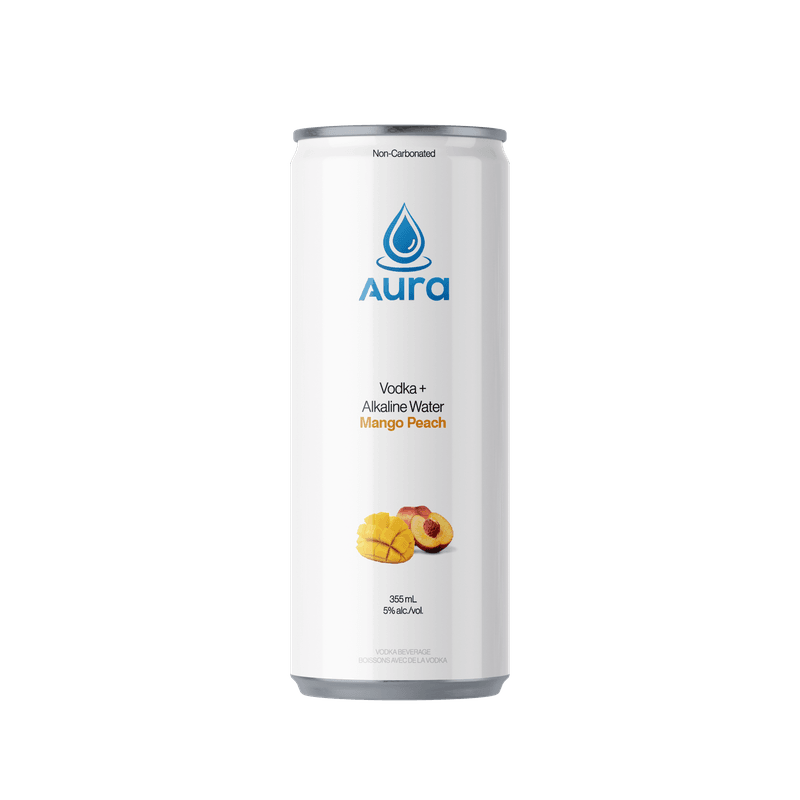
Where our format differs is the bubbles, because there aren't any. Our vodka water cocktails are still, not carbonated: premium distilled vodka, alkaline water and natural flavour in a 355 mL can, with no added sugar, no artificial sweeteners and no preservatives, and gluten-free. If a seltzer feels like too much on a hot day, a still drink is the alternative — a matter of preference, not physiology. The full formulation is on why Aura.
Cucumber Lime, Coconut Pineapple and Mango Peach come by the case of 24, and our direct ordering delivers to Ontario addresses. In Alberta and British Columbia, check where to buy: AGLC-licensed private retailers in Alberta, BC Liquor Stores and licensed private retailers in B.C. Whatever's in your hand this weekend, eat first, pace by the hour, and enjoy responsibly if you're of legal drinking age.
This article summarises published research for general interest and is not medical advice.
Sources
- Collins, W.E., Mertens, H.W., & Higgins, E.A. (1987). Some effects of alcohol and simulated altitude on complex performance scores and breathalyzer readings. Aviation, Space, and Environmental Medicine, 58(4), 328–332. PMID: 3579819. pubmed.ncbi.nlm.nih.gov/3579819
- Trammer, R.A., Rooney, D., Benderoth, S., Wittkowski, M., Wenzel, J., & Elmenhorst, E.M. (2024). Effects of moderate alcohol consumption and hypobaric hypoxia: implications for passengers' sleep, oxygen saturation and heart rate on long-haul flights. Thorax, 79(10), 970–978. doi:10.1136/thorax-2023-220998. PMID: 38830667. pubmed.ncbi.nlm.nih.gov/38830667
- Morris, N.B., Ravanelli, N., & Chaseling, G.K. (2024). The effect of alcohol consumption on human physiological and perceptual responses to heat stress: a systematic scoping review. Environmental Health, 23, 73. doi:10.1186/s12940-024-01113-y. PMID: 39267036; PMCID: PMC11391823. pmc.ncbi.nlm.nih.gov/articles/PMC11391823
- Hobson, R.M., & Maughan, R.J. (2010). Hydration status and the diuretic action of a small dose of alcohol. Alcohol and Alcoholism, 45(4), 366–373. doi:10.1093/alcalc/agq029. PMID: 20497950. doi.org/10.1093/alcalc/agq029
- Jones, A.W., & Jönsson, K.A. (1994). Food-induced lowering of blood-ethanol profiles and increased rate of elimination immediately after a meal. Journal of Forensic Sciences, 39(4), 1084–1093. doi:10.1520/JFS13687J. PMID: 8064267. pubmed.ncbi.nlm.nih.gov/8064267
- Paradis, C., Butt, P., Shield, K., Poole, N., Wells, S., Naimi, T., Sherk, A., & the Low-Risk Alcohol Drinking Guidelines Scientific Expert Panels (2023). Canada's Guidance on Alcohol and Health: Final Report. Ottawa, Ont.: Canadian Centre on Substance Use and Addiction. ISBN 978-1-77871-046-9. ccsa.ca