You have heard the rule a hundred times: one glass of water for every drink and you will wake up fine. So, does drinking water help hangover severity the next morning? The honest answer from the research: less than most people think. Water does address thirst and dry mouth. It does not appear to prevent or shorten a hangover, and it does nothing to lower the amount of alcohol in your blood. The levers that actually move the needle are how much you drink, how fast, and when you stop.
Here is what the trials and surveys found, why "hydrated" and "less intoxicated" are different problems, and what a drinker in Canada can do tonight.
Does drinking water help hangover symptoms? What the studies found
In 2024, a team at Utrecht University led by Marlou Mackus and Joris Verster published a review in the journal Alcohol that gathered every human study they could find on hangover and dehydration (Mackus et al., 2024). Only 13 publications qualified: 10 small experimental studies and 3 surveys. Their conclusion was blunt: "the consumption of water during or directly after the drinking session is not effective in preventing hangovers," and the amount of water consumed on the hangover day "is not significantly related to changes in hangover severity."
The findings behind that verdict show how modest the water effect is:
- Water during the night barely registers. In a survey of 826 Dutch students described in the review, respondents rated how well drinking water prevented their last hangover on a 0-to-10 scale. Water during the drinking session scored a mean of 5.2 (SD 2.4, n = 618) and water before bed scored 5.6 (SD 2.6, n = 502). An earlier survey of 462 students found 55.8% had tried water and rated it a mean 5.8 out of 10. Middle-of-the-road, self-reported scores are not evidence of prevention.
- Drinking more water while hungover did not change the hangover. In a field study of 307 people walking the 15.8 km Samaria Gorge in Crete, 176 arrived hungover and drank a mean 2.7 litres of water during the hike. People with worse hangovers drank more water (r = 0.243, p < 0.001), but the amount of water they drank had no significant relationship with how their hangover changed from start to finish (r = 0.103, p = 0.174 for the during-versus-before difference).
- Measurable dehydration was hard to find. The review also describes a placebo-controlled randomised trial in 214 participants that measured skin water content before drinking and again during the hangover. No significant difference was found, and no correlation with the amount of alcohol consumed, even though participants still reported thirst and dry mouth.
The authors' overall reading is that hangover and dehydration are "two co-occurring but independent consequences of alcohol consumption." Thirst is mild and clears by late morning. The hangover lasts all day.
Symptom relief is not the same as preventing intoxication
The confusion around hydration between drinks comes from mixing up two things. Water can relieve a symptom such as dry mouth. It cannot reduce how intoxicated you are, and intoxication drives the next day.
A 2016 study of 36 social drinkers published in Psychopharmacology found that the concentration of ethanol still in participants' urine at 9:30 the next morning correlated with nausea (r = 0.602, p = 0.008), sleepiness (r = 0.646, p = 0.004) and concentration problems (r = 0.633, p = 0.005) (Van de Loo et al., 2016). The more alcohol still to clear in the morning, the worse people felt. A 2020 review by the same group in the Journal of Clinical Medicine reported that faster ethanol elimination was associated with less severe hangovers, and that higher blood ethanol went with higher inflammatory markers (interleukin-6 and TNF-alpha), which in turn tracked next-day severity (Mackus et al., 2020).
None of that is touched by a glass of water. The Canadian Centre on Substance Use and Addiction (CCSA) notes it takes about two hours for the body to eliminate the alcohol in one standard drink, defined in Canada as 13.45 grams of pure alcohol (Canada's Guidance on Alcohol and Health, 2023). Water does not speed up that clock.
So why does the water rule feel like it works?
Because of displacement, not dilution. If a glass of water takes the place of a drink in a given hour, you drank less alcohol in that hour and your peak blood alcohol is lower. That is a real hangover prevention effect, but it comes from the drink you skipped, not the water you added. The CCSA's own tips reflect this: "for every drink of alcohol, have one non-alcoholic drink" sits alongside "drink slowly." It is pacing advice.
What genuinely reduces next-day severity
- Drink fewer standard drinks. This is the only intervention the evidence consistently supports. Canada's 2023 guidance puts weekly risk at low for 1 to 2 standard drinks, moderate for 3 to 6, and increasingly high at 7 or more, and adds that more than 2 standard drinks on any single occasion raises the risk of harm to yourself and others.
- Slow the pace on purpose. Use a non-alcoholic drink between drinks as a spacer, and use the two-hours-per-standard-drink rule to plan when your last drink should be.
- Count in standard drinks. A pint, a large pour of wine and a double are not one drink each. Read the label.
- Stop earlier. What is left in your system at 9:30 a.m. predicts how you feel, so an earlier last drink means less to clear.
- Do not rely on "cures." A systematic review in the BMJ examined eight double-blind randomised trials covering 340 participants and concluded that "no strong evidence exists to support the effectiveness of conventional or complementary interventions to prevent or treat alcohol hangover" (Pittler, Verster and Ernst, 2005). Three small single trials showed some effect; none was replicated.
Caveats: what this research does not show
- The evidence base is thin. The 2024 review found only 13 relevant publications. Several experimental studies are more than 40 years old with very small samples, and the authors say they "may be underpowered."
- The surveys are self-report. Students recalling their last heavy night are subject to recall bias, and neither survey measured how much water people actually drank.
- Confounders were not controlled. The review flags food, physical activity and sleep as factors the studies did not adequately account for. Sleep in particular could matter a lot, but these studies cannot say how much.
- Most of this work comes from one research group. Independent replication would strengthen the case.
- Water is not useless. It does not fix the hangover, but it treats thirst and is a good pacing tool.
- Nothing here makes any drink safer. The alcohol in a still vodka water is the same alcohol as in a beer or a vodka soda. Format, flavour or the absence of bubbles does not change intoxication or elimination time.
Where a still vodka water fits
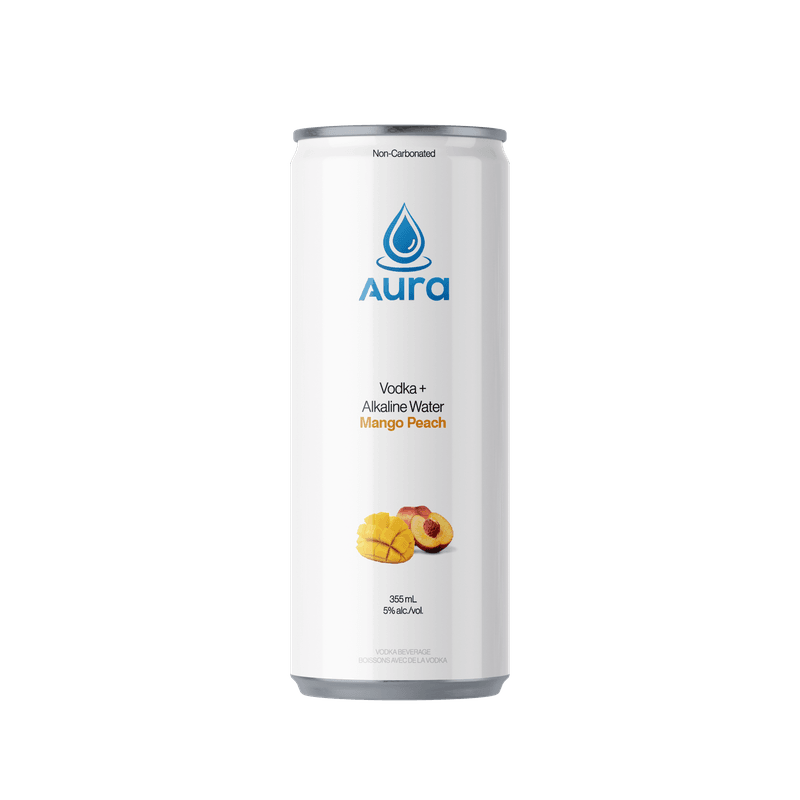
If the takeaway is "fewer drinks, sipped slowly," the format you choose can help you do that without pretending it changes the chemistry. Aura's our vodka water cocktails are still, non-carbonated cans of premium vodka, alkaline water and natural flavour, with no added sugar and no bubbles, in Cucumber Lime, Coconut Pineapple and Mango Peach. A single 355 mL can is a measured serve you can nurse over an hour, and no bubbles means no bloating, which is a comfort point, not a health claim. Read more at why Aura.
Aura is available across British Columbia, Alberta and Ontario. Direct and wholesale ordering from Aura delivers to Ontario addresses only. In Alberta look for AGLC-licensed private retailers, and in BC check BC Liquor Stores and licensed private retailers, or use where to buy to find the nearest option.
Plan your evening in standard drinks, space them out, stop earlier than feels necessary, and keep the water for what it is good at: thirst. Then pick up a case of Aura for the nights you want something light, still and easy to pace. Aura is for adults of legal drinking age in their province. Please enjoy responsibly.
This article summarises published research for general interest and is not medical advice. If you have concerns about your drinking, speak to a health professional.
Sources
- Mackus M, Stock A-K, Garssen J, Scholey A, Verster JC. Alcohol hangover versus dehydration revisited: The effect of drinking water to prevent or alleviate the alcohol hangover. Alcohol. 2024;121:9-18. doi:10.1016/j.alcohol.2024.07.006. https://doi.org/10.1016/j.alcohol.2024.07.006
- Van de Loo AJAE, Mackus M, Korte-Bouws GAH, Brookhuis KA, Garssen J, Verster JC. Urine ethanol concentration and alcohol hangover severity. Psychopharmacology. 2017;234(1):73-77 (published online 2016). doi:10.1007/s00213-016-4437-0. https://pmc.ncbi.nlm.nih.gov/articles/PMC5203841/
- Mackus M, van de Loo AJAE, Garssen J, Kraneveld AD, Scholey A, Verster JC. The Role of Alcohol Metabolism in the Pathology of Alcohol Hangover. Journal of Clinical Medicine. 2020;9(11):3421. doi:10.3390/jcm9113421. https://pmc.ncbi.nlm.nih.gov/articles/PMC7692803/
- Pittler MH, Verster JC, Ernst E. Interventions for preventing or treating alcohol hangover: systematic review of randomised controlled trials. BMJ. 2005;331:1515. PMID 16373736. https://www.ncbi.nlm.nih.gov/books/NBK71351/
- Paradis C, Butt P, Shield K, Poole N, Wells S, Naimi T, Sherk A, et al. Canada's Guidance on Alcohol and Health: Final Report. Canadian Centre on Substance Use and Addiction; January 2023. https://www.ccsa.ca/en/guidance-tools-resources/substance-use-and-addiction/alcohol/canadas-guidance-alcohol-and-health