You are thinking about taking a month off alcohol, and you want a straight answer to one question: does it actually change anything, or does the whole thing wear off by February? The Dry January research outcomes published over the past decade give a reasonably clear answer. Four weeks without alcohol moves measurable markers in the blood, and people who complete the month are still drinking less six months later. The caveats are real too, and most headlines skip them. Here is what the evidence supports, what it does not, and how to run your own month starting today.
What the Dry January research outcomes actually measured
Three lines of published work matter here, and they answer different questions.
- Biological markers. Mehta and colleagues at UCL ran a prospective observational study published in BMJ Open in 2018, comparing 94 people who abstained for one month against 47 who kept drinking.
- Behaviour afterwards. Richard de Visser's team followed Dry January participants at one month and six months, first in Health Psychology (2016) and again in a 2019 cohort published in Alcohol and Alcoholism (2020).
- Whether a proper trial is even possible. Field and colleagues randomised heavy-drinking women to complete or intermittent abstinence in a feasibility trial published in Pilot and Feasibility Studies (2020).
Note what is missing: there is still no large randomised trial of a one-month challenge with long-term follow-up. Everything below is observational or cohort work, which shows association, not cause.
The one month no alcohol study on liver markers, blood pressure and weight
The UCL study is the most cited one month no alcohol study for a reason: it took blood. Participants were moderate-to-heavy drinkers with no known liver disease, averaging 258.2 g of alcohol per week in the abstinence group — several times Canada's higher-risk threshold. After four weeks, the abstinence group showed these median changes from baseline, all at p<0.001:
- Insulin resistance (HOMA score): −25.9% (IQR −48.6% to +0.3%)
- Gamma-GT, the liver enzyme most sensitive to alcohol: −28.6% (IQR −43.5% to −14.4%)
- ALT, another liver enzyme: −14.5% (IQR −28.9% to +6.7%)
- Systolic blood pressure: −6.6%; diastolic: −6.3%
- Weight: −1.5% (IQR −2.9% to −0.4%)
The control group who kept drinking showed no significant change in any of these, and the authors reported that diet, exercise and smoking scores did not account for the differences.
Read the interquartile ranges carefully, because they carry the honest story. The upper bound for insulin resistance and ALT crosses zero, meaning a minority of participants got worse on those markers. And not every change was one to celebrate: HDL cholesterol, the kind usually described as protective, fell 16.7% in the abstinence group. A month off is not a uniform upgrade of every line on a blood panel.
Sleep: what the evidence really says
Better sleep is the most common reason people cite for a drinking break, and it is also where the evidence is indirect. There is no large study measuring sleep architecture before and after a Dry January. What exists is the experimental literature on what alcohol does to sleep in the first place. Ebrahim and colleagues reviewed the studies of healthy volunteers in Alcoholism: Clinical and Experimental Research (2013) and found a consistent pattern at all doses: alcohol shortens the time it takes to fall asleep and consolidates the first half of the night, then disrupts the second half. It delays the first REM period at every dose studied, and reduces total-night REM at moderate and high doses.
So the reasonable claim is a subtraction, not an addition: removing evening alcohol removes a known cause of second-half sleep fragmentation. That is one of the more defensible benefits of a drinking break, but it is inferred from what alcohol does, not measured across a month-long challenge.
What happens months afterwards
This is the finding that surprises people. In the 2016 Health Psychology paper, 857 British adults were followed through Dry January and out to six months. Participation was associated with lower alcohol consumption and greater drink refusal self-efficacy at six months among all respondents — including those who did not make it the whole month, though completers changed more. Critically, very few people reported drinking more afterwards. The feared rebound largely did not appear.
The 2020 follow-up compared 1,192 Dry January participants with 1,549 drinkers who did not attempt it, surveyed in January, February and August 2019. Gains in self-rated health, well-being, drinking control and AUDIT-C intake among completers were not seen in the comparison group.
The caveats, stated plainly
- Self-selection. The 2020 paper found Dry January participants were heavier drinkers, more worried about their intake, of higher socioeconomic status and in poorer well-being than the general population. They are not a random sample of drinkers, so the results may not transfer to you.
- No randomisation. The UCL study assigned people by their own intention, not by chance. Motivation could drive part of the effect.
- Self-report. Drinking amounts and well-being in the cohort studies were self-reported, and people under-report alcohol.
- The trial evidence is tiny. Field's randomised study included 25 women aged 40–60. It was designed to test feasibility, not health outcomes, and concluded only that a full trial is possible.
- Short horizons. Six months is the longest follow-up in this set. Nothing here shows what happens at five years.
To be explicit about what the research does not show: it does not establish that one dry month prevents any disease, and it says nothing about one alcoholic drink being better for you than another. That last point matters to us. Aura contains alcohol, the same as any vodka drink. Nothing about our format makes it healthier, safer or less intoxicating.
How to run your month, and what to do after
Practical steps you can take today:
- Count first. Write down every drink for one normal week before you start. Canada's Guidance on Alcohol and Health (CCSA, 2023) places 1–2 standard drinks per week at low risk, 3–6 at moderate risk, and 7 or more at increasingly high risk. You need your real number to know what you are changing.
- Name the two hard occasions. Most months fail on a specific Friday, not in general. Decide now what you will order and who you will tell.
- Do not treat a stumble as a failure. The six-month improvements in the 2016 study appeared among non-completers too.
- Plan the re-entry. Set your weekly number before the week starts rather than deciding drink by drink. That is the core of mindful drinking, and it is where the six-month effect appears to live.
You are in reasonable company either way: Statistics Canada's 2023 Canadian Community Health Survey found 54% of adults reported no alcohol in the previous seven days, while 15% reported seven or more drinks.
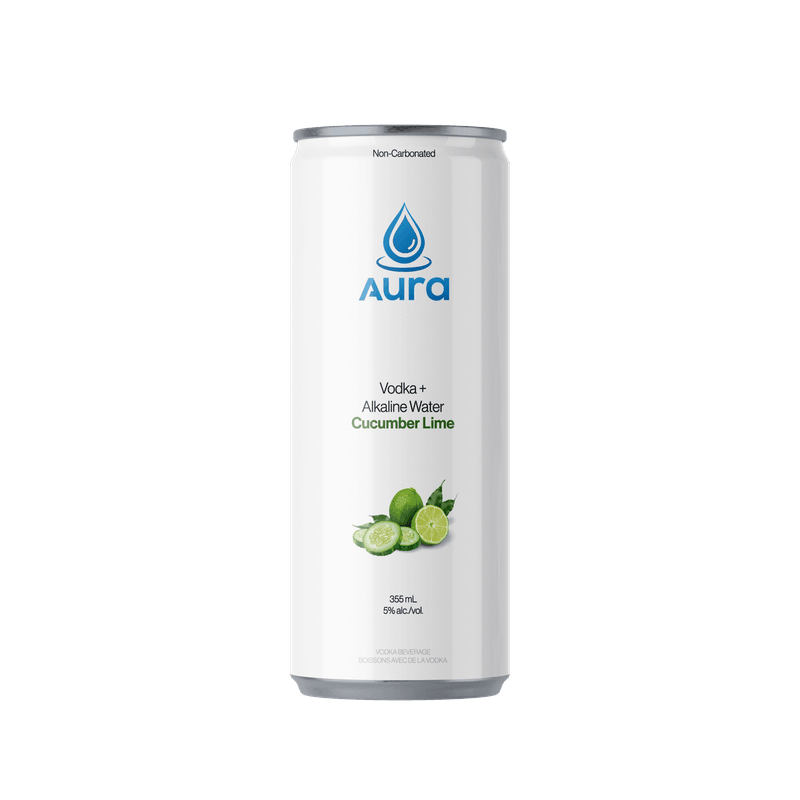
When you do return to drinking, a pre-portioned format makes counting easier — one 355 mL can is one thing to tally, with no free pour to estimate. Aura is a still vodka water: premium vodka, alkaline water and natural flavour, with zero carbonation and no added sugar. That is a taste and format choice, not a health one.
If a considered drink fits your plan after your month, browse our vodka water cocktails in Cucumber Lime, Coconut Pineapple and Mango Peach, read why Aura is made without bubbles, and check where to buy near you. Our own direct and wholesale ordering delivers to Ontario addresses only; in Alberta, look for AGLC-licensed private retailers, and in British Columbia, BC Liquor Stores and licensed private retailers. Please drink responsibly, and only if you are of legal drinking age in your province.
This article summarises published research for general interest and is not medical advice. Speak to a healthcare professional before changing your drinking, particularly if you drink daily or heavily, as sudden cessation can be dangerous.
Sources
- Mehta G, Macdonald S, Cronberg A, et al. Short-term abstinence from alcohol and changes in cardiovascular risk factors, liver function tests and cancer-related growth factors: a prospective observational study. BMJ Open. 2018;8(5):e020673. doi:10.1136/bmjopen-2017-020673. PMID 29730627. Full text
- de Visser RO, Robinson E, Bond R. Voluntary temporary abstinence from alcohol during "Dry January" and subsequent alcohol use. Health Psychology. 2016;35(3):281–289. doi:10.1037/hea0000297. PMID 26690637. Record
- de Visser RO, Piper R. Short- and longer-term benefits of temporary alcohol abstinence during 'Dry January' are not also observed among adult drinkers in the general population: prospective cohort study. Alcohol and Alcoholism. 2020;55(4):433–438. doi:10.1093/alcalc/agaa025. PMID 32391879. Abstract
- Field M, Puddephatt JA, Goodwin L, Owens L, Reaves D, Holmes J. Benefits of temporary alcohol restriction: a feasibility randomized trial. Pilot and Feasibility Studies. 2020;6:9. doi:10.1186/s40814-020-0554-y. PMID 32021698. Full text
- Ebrahim IO, Shapiro CM, Williams AJ, Fenwick PB. Alcohol and sleep I: effects on normal sleep. Alcoholism: Clinical and Experimental Research. 2013;37(4):539–549. doi:10.1111/acer.12006. PMID 23347102. Record
- Canadian Centre on Substance Use and Addiction. More than 6 drinks a week puts your health at risk: New Canada's Guidance on Alcohol and Health. 17 January 2023. CCSA
- Statistics Canada. A snapshot of alcohol consumption levels in Canada: Half of Canadian adults reported not drinking any alcohol in the past seven days, 2023. The Daily, 2 October 2024. Statistics Canada