You told your friend you had two drinks. Based on the evidence, you probably had closer to three. If you pour at home — a rye and ginger, a gin over ice — free pour accuracy research has a consistent and slightly uncomfortable answer: almost nobody pours a standard drink when they believe they are pouring one, and the error runs in one direction. Up.
This is fixable tonight, with a measuring cup you already own. Here is what the studies measured, how far off a typical home pour is, why the glass in your hand changes the size of the mistake, and where a pre-measured can removes the problem.
First: how much is a standard drink?
You cannot estimate something you have not defined, and in Canada the definition is fixed. Canada's Guidance on Alcohol and Health (Canadian Centre on Substance Use and Addiction, 2023) states that "in Canada, a standard drink is 17.05 millilitres or 13.45 grams of pure alcohol," equivalent to:
- A bottle of beer — 12 oz, 341 mL, 5% alcohol
- A bottle of cider — 12 oz, 341 mL, 5% alcohol
- A glass of wine — 5 oz, 142 mL, 12% alcohol
- A shot of spirits — 1.5 oz, 43 mL, 40% alcohol
Look at the wine figure: five ounces — not "a glass." The same guidance sets a continuum of risk, with weekly consumption of 2 standard drinks or less classed as low risk, 3 to 6 as moderate, and 7 or more as increasingly high. Those thresholds only mean something if your standard drink estimation is honest. If every pour runs 30% heavy, your weekly tally is fiction — you are counting six and drinking eight.
What free pour accuracy research actually found
Four independent studies, four different methods, one direction of error:
- Shots off by 26%, mixed drinks by 80%. White and colleagues (Alcoholism: Clinical and Experimental Research, 2003) asked 106 university students to free-pour into cups of varying sizes to represent one standard drink, measured against definitions of 12 oz of beer and 1.25 oz of liquor. Their finding: "In every cup size of every task, students overestimated how much fluid they should pour to create a standard drink." Collapsed across cup sizes, they overpoured shots by 26%, beer by 25%, and mixed drinks by 80%.
- It is not a North American quirk. Zandy and colleagues (ACER, 2013) ran the same paradigm with 105 male undergraduates in Singapore. They overpoured shots by 50% and beer by 100% against Singapore's standard drink definition; pouring alongside a peer cut beer overpouring by roughly 10%.
- Licensed bars miss too. Kerr and colleagues (Drug and Alcohol Review, 2009) purchased and chemically measured 480 drinks from 80 on-premise establishments across 10 Northern California counties. Mean ethanol content was 25.5 mL for wine, 23.4 mL for spirits and 21.7 mL for beer — the paper reports these were "larger than the US standard."
- You cannot see strength. Barnett and colleagues (Psychology of Addictive Behaviors, 2009) analysed mixed drinks collected from 23 campus party events. Concentration ranged from 3.7% to 22.8% — a six-fold spread across drinks that look identical in the cup. The median drink came to 0.97 standard drinks, which tells you nothing about the one in your hand.
Why the shape of the glass changes the error
Wansink and van Ittersum (BMJ, 2005) had 198 students pour a shot's worth of spirits into tall, slender glasses and short, wide ones of identical capacity. Students poured 30% more into the short, wide glass — 59.1 mL versus 45.5 mL (P<0.01). They then tested 86 Philadelphia bartenders averaging 6.3 years of experience: still 20.5% more into short, wide glasses (55.5 mL versus 46.1 mL, P<0.001). Telling them to take their time shrank the gap but did not close it.
The likely mechanism is that we judge liquid by height, not volume. Pechey and colleagues (PLoS ONE, 2015) asked 360 participants to match wine volumes across glass shapes and found the errors tracked relative fullness rather than actual quantity: matching a 250 mL reference, people under-filled a 20%-wider glass by about 32.5 mL, while matching a 125 mL reference into a taller-capacity glass they over-filled by roughly 27.5 mL.
Where this evidence is weaker than the headlines
- The glass-shape literature has a credibility problem. In 2018 a Cornell faculty committee found that Brian Wansink, lead author of the 2005 BMJ study, "committed academic misconduct in his research and scholarship, including misreporting of research data, problematic statistical techniques, failure to properly document and preserve research results, and inappropriate authorship." He has had numerous papers retracted. The 2005 BMJ paper is not among them, but the effect size deserves real scepticism.
- A direct contradiction. Kerr and colleagues, working in real bars rather than a lab, concluded the opposite: "Glass shape does not affect actual drink pours in the US but glass size does in some cases."
- Perception is not pouring. The Pechey team judged photographs on participants' own phones and screens, and stated plainly that "the implications of these results for alcohol consumption are limited by a lack of evidence on how such perceptual biases influence actual pouring or drinking behaviour."
- Small samples, and often not alcohol. Langfield and colleagues (Scientific Reports, 2020) found 72.1 mL less consumed from straight-sided than outward-sloped glasses (95% CI −11.7 to −132.6 mL, p = 0.022) — but with soft drinks, and with samples of 200, 72 and 40. Their own review in Health Psychology Review describes "a paucity of evidence — in particular on measures of consumption."
- Sample bias. Most free-pour studies use university students. They are not a stand-in for Canadian adults generally.
The fair summary: overpouring is robustly replicated across countries and methods. Glass shape is genuinely contested — glass size is the more reliable culprit. Buy smaller glasses before you worry about their silhouette.
What to do about it tonight
- Buy a jigger. A 1.5 oz / 43 mL measure costs a few dollars and settles it permanently.
- Calibrate one glass. Pour 43 mL of water from a measuring cup into your usual glass, note where it sits, and use that glass for spirits. Do the same with 142 mL for wine.
- Measure spirits before the ice and mixer — once the glass is full of ice, your height cue is gone.
- Pick tall and narrow over short and wide when you have the choice — and pick smaller, which the evidence supports more strongly.
- Never top up a partly full glass. You lose the count the moment you do.
- Write the count down as you pour, not at the end of the night.
Canned cocktail calories: arithmetic you can do yourself
Pre-measured formats let you calculate rather than guess. A 355 mL can at 5% ABV holds about 17.8 mL of ethanol — roughly 1.04 Canadian standard drinks. Using CCSA's own ratio of 13.45 g per 17.05 mL, that is about 14 g of alcohol. The Canadian Food Inspection Agency assigns alcohol an energy factor of 7 Cal/g, so the alcohol alone contributes roughly 98 calories. Everything above that floor is sugar and mixers, which is why canned cocktail calories vary so widely between products at the same ABV. Check the ABV on any can you buy and run the same calculation.
Why a pre-measured can removes the guesswork
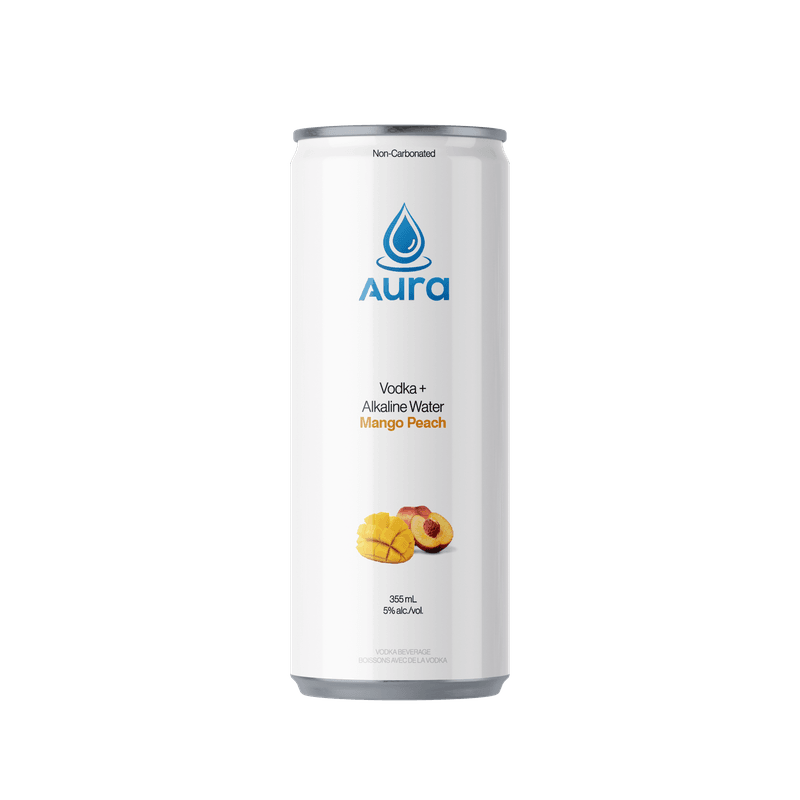
That is the practical argument for a canned format: the measuring already happened, in a facility, to a tolerance no free pour reaches. Our vodka water cocktails are 355 mL cans of premium distilled vodka, alkaline water and natural flavour — Cucumber Lime, Coconut Pineapple and Mango Peach — with no added sugar, no artificial sweeteners and no preservatives, and gluten-free. Aura is a still drink: no carbonation, no bubbles, no fizz, which is exactly why Aura stands apart from the hard seltzer shelf. One can is one countable unit, every time.
To be explicit about what the research does not show: a can is not healthier, safer or less intoxicating than a home pour of the same alcohol content. The ethanol is identical. A pre-measured format changes only your ability to count accurately — a knowledge problem, not a medical one.
Aura is available across British Columbia, Alberta and Ontario. Our own direct and wholesale ordering delivers to Ontario addresses only; in Alberta, find us at AGLC-licensed private retailers, and in British Columbia at BC Liquor Stores and licensed private retailers — use where to buy to find the closest stock.
Ready to stop estimating? Grab a case of 24 from our vodka water cocktails, or check where to buy near you — then count your drinks with a number you can actually trust. Please enjoy responsibly, and only if you are of legal drinking age in your province.
This article summarises published research for general interest and is not medical advice.
Sources
- Canadian Centre on Substance Use and Addiction. Canada's Guidance on Alcohol and Health: Final Report. Ottawa: CCSA, 2023. ccsa.ca
- White AM, Kraus CL, McCracken LA, Swartzwelder HS. "Do college students drink more than they think? Use of a free-pour paradigm to determine how college students define standard drinks." Alcoholism: Clinical and Experimental Research, 2003;27(11):1750–1756. PMID 14634490. pubmed.ncbi.nlm.nih.gov/14634490
- Zandy SL, Pang JS, Ho MH, Matthews DB. "Singaporean college students overpour drinks similar to Western populations: influence of peer presence in a simulated alcohol-pouring task." Alcoholism: Clinical and Experimental Research, 2013;37(11):1963–1970. PMID 23888884. pubmed.ncbi.nlm.nih.gov/23888884
- Kerr WC, Patterson D, Koenen MA, Greenfield TK. "Large drinks are no mistake: glass size, but not shape, affects alcoholic beverage drink pours." Drug and Alcohol Review, 2009;28(4):360–365. PMID 19594789. pmc.ncbi.nlm.nih.gov/articles/PMC2763589
- Barnett NP, Wei J, Czachowski C. "Measured alcohol content in college party mixed drinks." Psychology of Addictive Behaviors, 2009;23(1):152–156. PMID 19290700. pubmed.ncbi.nlm.nih.gov/19290700
- Wansink B, van Ittersum K. "Shape of glass and amount of alcohol poured: comparative study of effect of practice and concentration." BMJ, 2005;331(7531):1512–1514. PMID 16373735. pmc.ncbi.nlm.nih.gov/articles/PMC1322248
- Pechey R, Attwood AS, Couturier D-L, Munafò MR, Scott-Samuel NE, Woods A, Marteau TM. "Does Glass Size and Shape Influence Judgements of the Volume of Wine?" PLoS ONE, 2015;10(12):e0144536. journals.plos.org
- Langfield T, Pechey R, Gilchrist PT, Pilling M, Marteau TM. "Glass shape influences drinking behaviours in three laboratory experiments." Scientific Reports, 2020;10:13362. pmc.ncbi.nlm.nih.gov/articles/PMC7414130
- Langfield T, Pechey R, Pilling MA, Marteau TM. "Glassware design and drinking behaviours: a review of impact and mechanisms using a new typology of drinking behaviours." Health Psychology Review, 2022;16(1):81–103 (published online 2020). PMID 33140699. pmc.ncbi.nlm.nih.gov/articles/PMC8884253
- Cornell University. "Statement of Cornell University Provost Michael I. Kotlikoff," 20 September 2018. statements.cornell.edu
- Canadian Food Inspection Agency. "Elements within the Nutrition Facts table." Government of Canada. inspection.canada.ca