
If you've ever looked down at an empty glass and wondered where the last twenty minutes went, the glass itself may be part of the answer. Research on glass shape drinking speed suggests that a curved glass can make people finish a beer noticeably faster than a straight one, and that bigger wine glasses are linked to more wine being bought. The quick fix is simple: drink from a straight-sided, modest-sized glass, pour a measured amount, and give yourself a visual marker. Here is what the studies found, where they fall short, and how to use them at home in Canada.
The problem: you drink faster than you mean to
Pace slips because we judge how much is left by eye, and the eye is easily fooled. The Canadian Centre on Substance Use and Addiction's 2023 Canada's Guidance on Alcohol and Health says that more than two standard drinks per occasion is associated with an increased risk of harms to self and others. Drinking slower is one practical way to drink less in an evening, and your glass is a small lever you can pull.
Glass shape drinking speed: the Bristol curved vs straight experiment
In 2012, University of Bristol researchers led by Angela Attwood published a randomised lab experiment in PLoS ONE with 159 adult social drinkers (80 men). Each drank alone while watching a nature documentary, given either lager or a soft drink, in either a straight-sided glass or a curved, flute-style glass of the same 12 fl oz capacity, filled either to the top or halfway (6 fl oz).
People drinking a full 12 fl oz of lager drank about 60% slower from the straight glass than the curved one (p = 0.007, effect size d = 0.93). Two details matter:
- The effect appeared only for a full glass; half-filled, shape made no clear difference.
- It did not appear for the soft drink at all.
Why? Asked to mark each glass's halfway point, people misjudged the curved glass far more. In a curved glass much of the volume sits in the wide top, so "half full" is misread. The authors propose that drinkers pace themselves by how much seems left, though the link was tentative: the correlation between someone's halfway-point error and their drinking time was weak and only borderline (r = 0.15, p = 0.059).
Do markings on the glass help?
The Bristol group then tested volume markings in two experiments published in the European Journal of Public Health (Troy et al.). In the first (n = 159), a single halfway mark on a curved glass barely changed anything: 9.98 minutes versus 9.55 minutes to finish 12 fl oz of lager, a difference of 0.42 minutes with a 95% confidence interval from −0.90 to 1.74. In the second (n = 160), quarter, half and three-quarter marks did better: 10.34 minutes versus 9.11, a difference of 1.24 minutes, but the interval (−0.11 to 2.59) still included zero. The authors called this tentative: markings are a low-cost idea, not a proven fix.
Does glass size matter? The Cambridge pub studies
Shape affects pace; size seems to affect how much gets bought. A University of Cambridge team led by Theresa Marteau ran real-world trials in Cambridge, England, swapping the wine glasses every fortnight while keeping the poured portion sizes the same.
In the first, published in BMC Public Health in 2016 (Pechey et al.), daily wine sales were 9.4% higher when wine was served in larger glasses than in standard ones (95% CI 1.9% to 17.5%). The effect was clearer in the bar area (14.4%) than the restaurant (8.2%, with an interval that crossed zero). Whether smaller glasses cut sales was inconclusive.
The team later pooled eight studies from five establishments, run from 2015 to 2018, into a mega-analysis in Addiction (Pilling et al., 2020). The pattern got messier:
- In restaurants, 370 ml glasses were linked to 7.3% more wine sold than 300 ml glasses (95% CI 1.5% to 13.5%).
- Also in restaurants, 250 ml glasses were linked to 9.6% less wine sold, though the interval (−19.0% to 0.7%) just crossed zero.
- Going bigger still, to 450 ml, made no clear difference versus 300 ml.
- In bars, glass size made no clear difference at any size tested.
The authors suggest the restaurant effect may come from free-pouring from bottles and carafes, where a bigger glass invites a bigger "one glass."
What happened when the research moved into homes
The most relevant study for home drinkers may be a UK randomised controlled trial in Addiction (Mantzari et al., 2022). It randomised 260 households that drank at least two bottles of wine a week; 217 completed the study as planned. Households using 290 ml glasses drank on average 253 ml (6.5%) less wine than those using 370 ml glasses over the study periods. But the 95% interval ran from 517 ml less to 10 ml more (p = 0.065), so the result is suggestive rather than conclusive. The authors' own wording was that smaller glasses at home "may reduce consumption."
Caveats: what this drink pacing research does not show
- Small, specific samples. The Bristol experiments each used about 160 people split across several groups, drinking alone in a lab. The authors flagged the missing social setting and a sample of mostly young, heavier drinkers.
- Mixed replication. The single-mark glass study found almost no effect, and the multi-mark result was not statistically clear. The Cambridge size effect held in restaurants but not in bars in the pooled analysis.
- Sales are not consumption. The pub studies measured wine sold, not what each person drank.
- UK settings. None were run in Canada.
- Effects are modest. A glass is a nudge, not an override.
And most importantly: a slower pace changes timing, not what's in the drink. The same amount of alcohol is in the glass or the can whatever shape you pour it into. Nothing here suggests any glass, or any beverage, makes drinking safer or healthier.
How to drink slower at home: a practical checklist
- Choose straight sides. A straight tumbler or highball makes it easier to judge how much is left.
- Go modest on size. Pick a glass that fits one serving, not one that dwarfs it.
- Pour, don't top up. Pour one measured serving, then pause.
- Know your serving. A single can is a fixed, known amount; check the label and count it like any drink.
- Add your own marker. Evidence is weak, but a halfway check-in costs nothing.
- Alternate with water and eat something.
Where Aura fits
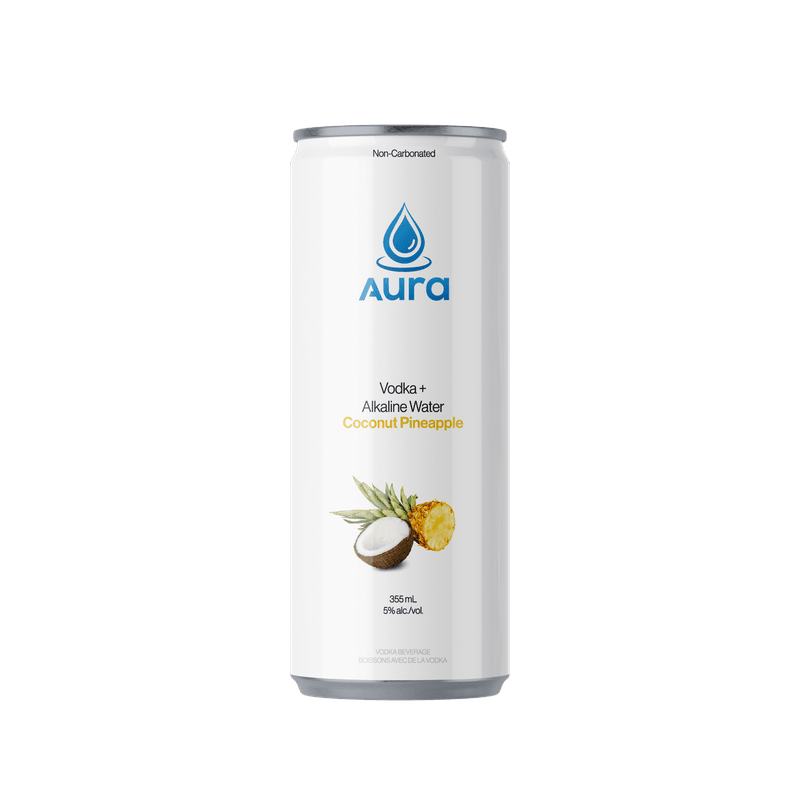
Aura is a still, non-carbonated vodka water: premium vodka, alkaline water and natural flavour in a 355 mL can, with no added sugar and no bubbles. Because it's still, it pours cleanly into a plain straight-sided glass over ice, the shape the research favours for pacing. It contains the same alcohol as any vodka drink of the same strength, so pace and count it the same way. You can read more on why Aura is made the way it is.
The bottom line
The evidence is real but modest: a curved glass sped up lager drinking in one lab study, larger wine glasses were linked to more wine sold in restaurants, and smaller glasses at home pointed toward slightly less drinking. Treat a straight, modest glass and a measured pour as easy defaults, not guarantees.
Planning a slower, more deliberate evening? Explore our vodka water cocktails in Cucumber Lime, Coconut Pineapple and Mango Peach. Aura is available in British Columbia, Alberta and Ontario; our direct ordering delivers to Ontario addresses only, so outside Ontario, find Aura through where to buy at AGLC-licensed retailers in Alberta and BC Liquor Stores or licensed private retailers in BC. Please enjoy responsibly and only if you are of legal drinking age in your province.
This article summarises published research for general interest and is not medical advice.
Sources
- Attwood AS, Scott-Samuel NE, Stothart G, Munafò MR. Glass shape influences consumption rate for alcoholic beverages. PLoS ONE. 2012;7(8):e43007. doi:10.1371/journal.pone.0043007. journals.plos.org
- Troy DM, Attwood AS, Maynard OM, Scott-Samuel NE, Hickman M, Marteau TM, Munafò MR. Effect of glass markings on drinking rate in social alcohol drinkers. European Journal of Public Health. 2017;27(2):352-356. doi:10.1093/eurpub/ckw142. PMC5398342
- Pechey R, Couturier DL, Hollands GJ, Mantzari E, Munafò MR, Marteau TM. Does wine glass size influence sales for on-site consumption? A multiple treatment reversal design. BMC Public Health. 2016;16:390. doi:10.1186/s12889-016-3068-z. PMID 27268112. doi.org
- Pilling M, Clarke N, Pechey R, Hollands GJ, Marteau TM. The effect of wine glass size on volume of wine sold: a mega-analysis of studies in bars and restaurants. Addiction. 2020;115. doi:10.1111/add.14998. University of Cambridge repository
- Mantzari E, Ventsel M, Ferrar J, Pilling MA, Hollands GJ, Marteau TM. Impact of wine bottle and glass sizes on wine consumption at home: a within- and between-households randomized controlled trial. Addiction. 2022;117(12):3037-3048. doi:10.1111/add.16005. University of Bristol research portal
- Canadian Centre on Substance Use and Addiction. Canada's Guidance on Alcohol and Health. 2023. ccsa.ca