
If your heart started racing or fluttering after a big night out, or you have atrial fibrillation (AF) and wonder whether that glass of wine at dinner is a trigger, you are asking the question cardiologists have studied for decades. The short answer: yes, alcohol can set off irregular heart rhythm, the effect can appear within hours, and for people who already have AF, drinking less measurably reduces episodes. This pattern is often called holiday heart syndrome. Below is what the research actually shows, what it does not show, and what you can do about it today.
What is holiday heart syndrome?
The term traces back to a 1978 paper in the American Heart Journal by Ettinger and colleagues, titled "Arrhythmias and the 'Holiday Heart': alcohol-associated cardiac rhythm disorders". The name reflects a timing many people recognise: rhythm trouble that shows up after a celebration, a long weekend or a heavy session, rather than out of nowhere.
The most common rhythm involved is atrial fibrillation, where the upper chambers of the heart beat chaotically instead of in a steady pattern. People describe it as fluttering, pounding, a racing pulse, breathlessness or unusual fatigue. Some feel nothing at all.
Alcohol and AFib: the randomised abstinence trial
Observational studies had long linked heavy drinking with AF, but the strongest evidence that cutting back actually helps came from a randomised trial published in the New England Journal of Medicine in 2020. Voskoboinik and colleagues enrolled 140 adults at six hospitals in Australia. All drank 10 or more standard drinks a week (a standard drink in that trial was about 12 g of alcohol) and all had paroxysmal or persistent AF.
Half were randomly assigned to abstain; half carried on as usual. Over six months:
- The abstinence group cut intake from 16.8 to 2.1 drinks a week (an 87.5% drop). The control group drifted from 16.4 to 13.2 drinks a week.
- AF came back in 37 of 70 people (53%) in the abstinence group versus 51 of 70 (73%) in the control group.
- Time to recurrence was longer with abstinence (hazard ratio 0.55; 95% CI 0.36 to 0.84; P = 0.005).
- Median time spent in AF was 0.5% versus 1.2% (P = 0.01).
The authors concluded that abstinence reduced arrhythmia recurrences in regular drinkers with AF. Note that "abstinence" in practice meant drinking very little, not zero, and AF still returned in about half of that group. Cutting alcohol helped; it was not a cure.
Alcohol heart rhythm effects within hours: the HOLIDAY monitor study
The abstinence trial looked at regular drinkers over months. What about a single evening? A 2021 study in the Annals of Internal Medicine by Marcus and colleagues followed 100 people with paroxysmal AF for four weeks. They wore a continuous ECG monitor and an ankle sensor that detects alcohol through the skin, and pressed a button each time they had a drink.
Comparing each person with themselves at different times, the researchers found:
- One drink in the previous four hours was linked with about twice the odds of an AF episode (odds ratio 2.02; 95% CI 1.38 to 3.17).
- Two or more drinks were linked with about 3.6 times the odds (odds ratio 3.58; 95% CI 1.63 to 7.89).
- Each 0.1% rise in peak inferred blood alcohol concentration was linked with 38% higher odds (odds ratio 1.38).
During the study, 56 of the 100 participants had at least one AF episode. A separate randomised, placebo-controlled trial from the same research group, published in JACC: Clinical Electrophysiology in 2021, gave intravenous alcohol or placebo to 100 patients during AF ablation and reported that a measure of electrical recovery in the pulmonary veins (where AF often starts) shortened by an average of 12 ms with alcohol. The authors described this as a direct mechanistic link between alcohol and immediate pro-arrhythmic effects in the human atria.
What about people who drink occasionally?
This is where honest reading matters. The abstinence trial only included people drinking 10+ drinks a week, so it cannot tell an occasional drinker that cutting back will change their rhythm. The HOLIDAY study only included people who already had AF, and its authors note the findings may not apply to the general population.
For the broader population, the best data are observational. In a pooled analysis of European cohorts in the European Heart Journal, Csengeri and colleagues (2021) followed 107,845 people for a median of 13.9 years; 5,854 developed AF. One drink (12 g) a day was associated with a 16% higher risk of new AF (hazard ratio 1.16; 95% CI 1.11 to 1.22), and the association was similar across beer, wine and spirits. So the type of drink did not appear to matter; the amount of alcohol did.
In Canada, the Canadian Centre on Substance Use and Addiction's 2023 guidance frames risk as a continuum: two standard drinks or fewer a week is where you are likely to avoid alcohol-related consequences, and at seven or more a week "your risk of heart disease or stroke increases significantly." It also notes that more than two standard drinks per occasion is associated with increased risk of harms.
Practical steps if you are worried about holiday heart syndrome
- If you have AF, talk to your doctor about alcohol specifically. The trial evidence is strongest for you, and your care plan (including any blood thinners or rate-control medication) may change the advice.
- Count drinks, not containers. A can, a "glass" or a cocktail can hold more or less than one standard drink. Check the alcohol content on the label and use a standard drink calculator.
- Keep any single occasion small. In the HOLIDAY data, risk rose from one drink to two or more within a four-hour window. Spacing drinks out and stopping at one or two limits peak blood alcohol.
- Log your episodes. If you use a smartwatch or home ECG, note what you drank and when. Patterns you bring to your doctor are more useful than memory.
- Plan alcohol-free days and events. Holidays stack occasions back to back; choosing which ones are dry keeps your weekly total down.
- Know when to get help. Chest pain, fainting, severe shortness of breath or signs of stroke (face drooping, arm weakness, slurred speech) need emergency care: call 911. A racing or irregular pulse that does not settle is worth a same-day medical call.
Caveats: what the alcohol atrial fibrillation research does not show
- Small, specific samples. The abstinence trial had 140 participants, 85% men, average age 62, all from Australian hospitals, followed for six months. It was open-label, so participants knew which group they were in.
- Association is not causation. The European cohort is observational and relied on self-reported drinking. The HOLIDAY authors note that confounding by other things that go along with drinking (late nights, big meals, stress) cannot be excluded.
- No proof for occasional drinkers without AF. No trial here tested whether people who drink lightly and have never had AF benefit from cutting back further.
- Wide uncertainty. Confidence intervals in the HOLIDAY study were broad (two or more drinks: 1.63 to 7.89), so the exact size of the effect is uncertain.
- No drink format is protective. None of these studies suggest any beverage type, mixer or format lowers the rhythm risk of alcohol. Beer, wine and spirits behaved similarly in the large cohort.
Where Aura fits, honestly
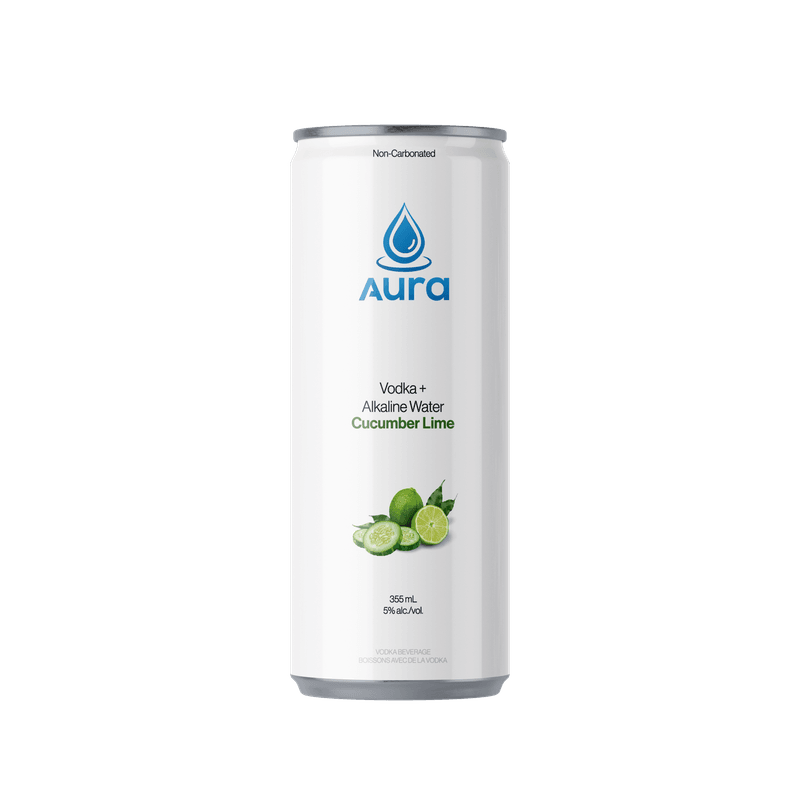
Aura is a still vodka water: premium vodka, alkaline water and natural flavour, with no carbonation, no added sugar and no artificial sweeteners. Being still rather than a seltzer is about comfort and taste, not your heart. The same alcohol is in the can either way, and nothing about Aura changes the research above. If you have AF or have been told to avoid alcohol, the right choice is to follow that advice. If you do drink, a single 355 mL can makes it easy to know exactly what you have had: check the label, count it, and stop when you planned to. You can read more about why Aura is made the way it is.
Curious about the flavours? Explore our vodka water cocktails in Cucumber Lime, Coconut Pineapple and Mango Peach. Aura is available across British Columbia, Alberta and Ontario; our direct ordering delivers to Ontario addresses only, so in BC or Alberta, find a nearby retailer on our where to buy page. Please enjoy responsibly, only if you are of legal drinking age in your province, and never drink and drive.
This article summarises published research for general interest and is not medical advice. Speak with your doctor about your own heart health.
Sources
- Voskoboinik A, Kalman JM, De Silva A, Nicholls T, Costello B, Nanayakkara S, et al. Alcohol Abstinence in Drinkers with Atrial Fibrillation. New England Journal of Medicine. 2020;382(1):20-28. doi:10.1056/NEJMoa1817591. PMID: 31893513. pubmed.ncbi.nlm.nih.gov/31893513
- Marcus GM, Vittinghoff E, Whitman IR, et al. Acute Consumption of Alcohol and Discrete Atrial Fibrillation Events. Annals of Internal Medicine. 2021;174(11):1503-1509. doi:10.7326/M21-0228. PMID: 34461028. pubmed.ncbi.nlm.nih.gov/34461028
- Marcus GM, Dukes JW, Vittinghoff E, et al. A Randomized, Double-Blind, Placebo-Controlled Trial of Intravenous Alcohol to Assess Changes in Atrial Electrophysiology. JACC: Clinical Electrophysiology. 2021;7(5):662-670. doi:10.1016/j.jacep.2020.11.026. PMID: 33516710. pubmed.ncbi.nlm.nih.gov/33516710
- Csengeri D, Sprünker NA, Di Castelnuovo A, Niiranen T, Vishram-Nielsen JKK, Costanzo S, et al. Alcohol consumption, cardiac biomarkers, and risk of atrial fibrillation and adverse outcomes. European Heart Journal. 2021;42(12):1170-1177. doi:10.1093/eurheartj/ehaa953. doi.org/10.1093/eurheartj/ehaa953
- Ettinger PO, Wu CF, De La Cruz C Jr, Weisse AB, Ahmed SS, Regan TJ. Arrhythmias and the "Holiday Heart": alcohol-associated cardiac rhythm disorders. American Heart Journal. 1978;95(5):555-562. doi:10.1016/0002-8703(78)90296-x. PMID: 636996. pubmed.ncbi.nlm.nih.gov/636996
- Canadian Centre on Substance Use and Addiction. Canada's Guidance on Alcohol and Health. 2023. ccsa.ca