You've had a couple of drinks, you own a personal breathalyzer, and it reads below the limit. Can you drive? The short answer is no, not on the strength of that number alone. To see why, it helps to understand how breathalyzers work. They measure alcohol in your breath, not your blood. Then they convert that reading with an average ratio that doesn't hold for every person, and the result can be thrown off by alcohol still sitting in your mouth. Here is the science, the research, and what to do in Canada tonight.
How breathalyzers work: from blood to breath
When you drink, alcohol is absorbed into your bloodstream. As blood passes through the lungs, some of that alcohol moves into the air in the tiny air sacs (alveoli). Deep-lung air at the end of a long, steady exhale carries alcohol that tracks your blood level. Every breath device measures it, then reports a breath-alcohol figure or an estimated blood-alcohol concentration (BAC).
The two main ways of detecting the alcohol work differently:
- Fuel cell (electrochemical) sensors oxidise the ethanol in the breath sample on a catalytic electrode. That produces a small electric current, and the current rises with the amount of alcohol. In a 1985 laboratory evaluation of an electrochemical device, published in Clinica Chimica Acta, A.W. Jones found breath readings closely matched blood levels (correlation coefficient 0.98). Jones still recommended calibrating it at 2,300:1 rather than 2,100:1 for unbiased blood estimates (Jones, 1985).
- Infrared (IR) spectroscopy shines infrared light through a chamber holding the breath sample. Ethanol absorbs specific wavelengths, so the drop in light shows how much alcohol is present. Large desktop evidential instruments used at police stations, such as the Intoxilyzer 5000S and 8000 used in the ratio studies below, are infrared.
Many cheap consumer gadgets use simpler semiconductor sensors instead. Either way, the sensor type alone doesn't guarantee accuracy. What matters is how a device performs against a reference instrument.
The 2100:1 breath alcohol ratio and why it varies
To turn a breath reading into a blood estimate, many devices assume a fixed breath alcohol ratio: the alcohol in 2,100 mL of deep-lung breath roughly equals the alcohol in 1 mL of blood. That 2100:1 figure is a convention, not a constant of nature. Back in 1978, Jones reported in the Journal of Studies on Alcohol that the blood:breath ratio "varies from person to person and within one person over time" (Jones, 1978).
Two larger studies quantify the variation:
- 799 drivers in Sweden. Jones and Andersson compared infrared breath tests with blood drawn on average 30 minutes later. After adjusting for alcohol metabolised in between, the mean ratio was 2,407 ± 213, and the 95% limits of agreement ran from 1,981 to 2,833. Most people had ratios above 2,100. Even so, 34 individuals (4.3%) fell below 2,100:1 after correction, and 156 (19.6%) did without correction (Jones & Andersson, 1996).
- 100 volunteers in a controlled drinking study. Jones and Cowan reported a mean ratio of 2,382 ± 119 once alcohol absorption was complete. The ratio didn't differ significantly by gender or among the three ethnic groups studied. It was, however, lower in people with higher breath and body temperatures, and it dropped with longer exhalation times (P < 0.001). In this post-absorptive state, none of the 100 subjects had a ratio below 2,100:1 (Jones & Cowan, 2020).
In practice, 2100:1 usually slightly under-states blood alcohol, but it's an average applied to an individual. Body temperature, breathing pattern and whether you're still absorbing your last drink all shift it. A single reading is an estimate with a margin, not a precise measurement.
Mouth alcohol: the false-high problem
Mouth alcohol is ethanol still sitting in your mouth and throat from a drink you just finished, or from mouthwash or breath spray. Breath devices assume they're sampling deep-lung air. Alcohol vapour in the mouth gets added on top and can push the reading well above your true BAC.
- In a German controlled trial with the Alcomat analyzer, volunteers who had no alcohol in their blood rinsed their mouths with 40 mL of whiskey for 30 seconds. They produced readings equivalent to blood levels of up to 0.26% (Urban et al., 1991).
- A study from Innsbruck had volunteers rinse with beer, wine, spirits, and alcohol-containing sweets. It found that dentures didn't prolong residual mouth alcohol. But it also found that in individual cases, the 15-minute waiting period required in Austria proved too short (Katzgraber et al., 1995).
That's why evidential testing uses a waiting period before sampling. For a personal device it cuts both ways: a reading right after a sip can be falsely high, and a well-timed one can still be misleadingly low, as the next section shows.
Personal breathalyzer accuracy: what the studies found
Two independent studies tested consumer devices against police-grade equipment:
- Oxford, UK (2014). Three public-market breathalysers were tested on 208 adults in licensed venues against a police breathalyser; 38 (18%) were at or over the UK limit. A digital multi-use device detected 89.5% of them. One single-use device detected 94.7% but flagged many people who were under the limit. The other single-use device had a sensitivity of just 26.3%, which the authors described as "false reassurance for approximately three people in four who are over the limit" (Ashdown et al., 2014).
- Philadelphia, US (2021). Twenty healthy moderate drinkers were dosed to a target peak BAC of 0.10%, and six smartphone-paired devices were compared with a police-grade device and blood tests. All seven breath devices, including the police unit, underestimated BAC by more than 0.01%. Two consumer devices failed to detect drivers over the limit more than 50% of the time (Delgado et al., 2021).
Caveats: what this research does and does not show
- The samples are small. The US study had 20 people, with only 10 per device. The UK study had 38 people over the limit, so its confidence intervals are wide (for example, 75.4% to 99.1% for one device).
- Both tested specific models that may since have changed. Neither tells you how your device performs.
- The ratio studies report averages and ranges; they can't predict any one person's ratio.
- The mouth-alcohol studies are older German-language papers with limited published detail.
- Nothing here shows that any drink, brand, or mixer changes how much alcohol reaches your blood or your breath.
Why a personal reading is not a licence to drive in Canada
Under the Criminal Code, it's an offence to have a BAC of 80 mg or more per 100 mL of blood. Police can also demand a roadside breath sample from any lawfully stopped driver, without suspecting that you've been drinking (Justice Canada). Provinces go further. In Ontario, a BAC between 0.05 and 0.079 is the "warn range," and a first occurrence brings a 7-day licence suspension, an education course, and a $250 penalty. Drivers aged 21 or under, or holding a G1, G2, M1 or M2 licence, must have zero alcohol in their system (Government of Ontario).
Put it together: your device may read low, your personal ratio may differ from 2100:1, your BAC may still be rising, and provincial penalties start below the criminal limit. A "safe" number on a consumer gadget isn't certainty you can stake a licence or a life on.
What to do tonight
- Decide how you're getting home before your first drink: a designated driver, transit, a taxi or rideshare, or staying over.
- If you've had any alcohol and you hold a G1/G2 licence or are 21 or under, don't drive. Full stop.
- Treat a personal breathalyzer as a reason not to drive, never as permission.
- Wait at least 15 minutes after drinking, eating, smoking, or using mouthwash before any test, so mouth alcohol doesn't distort it.
- Unsure the next morning? Leave the car. Only time clears alcohol.
Where Aura fits
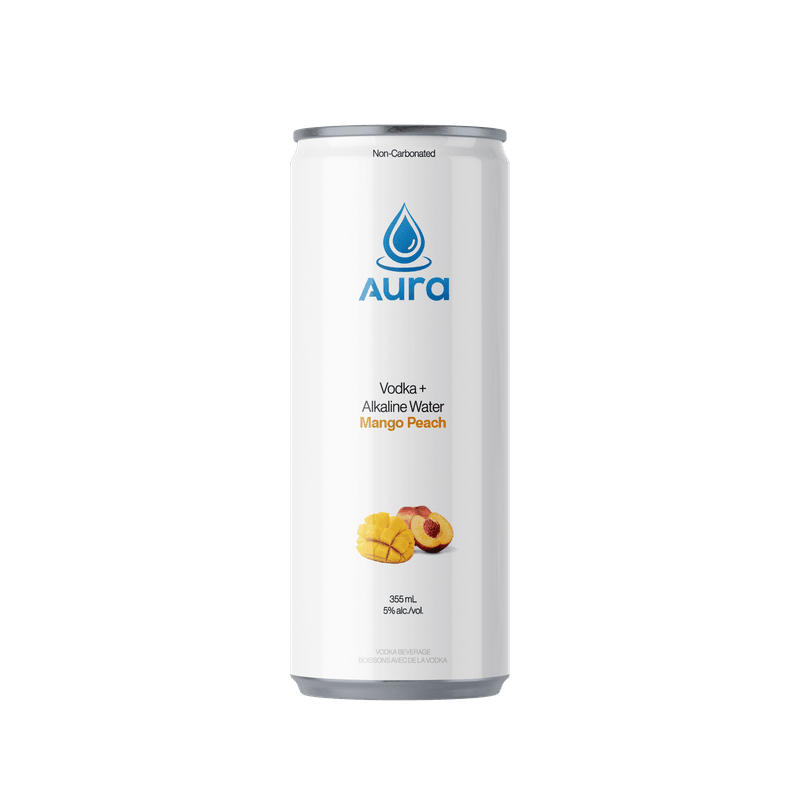
Aura is a still, zero-carbonation vodka water made with premium vodka, alkaline water and natural flavour, with no added sugar. To be clear: a can of Aura contains real alcohol and registers on a breathalyzer exactly like any drink with the same amount of alcohol. Nothing about the recipe makes you less impaired or changes a breath test. Explore our vodka water cocktails, read why Aura, or see where to buy. Aura is sold in British Columbia, Alberta and Ontario. Our own direct ordering delivers to Ontario addresses only. Elsewhere, look for Aura at BC Liquor Stores and licensed private retailers in BC, or at AGLC-licensed private retailers in Alberta.
Plan the ride before the first pour, then enjoy Cucumber Lime, Coconut Pineapple or Mango Peach the way it's meant to be enjoyed: on the patio, not behind the wheel. Please enjoy responsibly, and only if you're of legal drinking age in your province.
This article summarises published research for general interest and is not medical or legal advice.
Sources
- Ashdown HF, Fleming S, Spencer EA, Thompson MJ, Stevens RJ. Diagnostic accuracy study of three alcohol breathalysers marketed for sale to the public. BMJ Open. 2014;4(12):e005811. doi:10.1136/bmjopen-2014-005811. PMID: 25526794. pubmed.ncbi.nlm.nih.gov/25526794
- Delgado MK, Shofer F, Wetherill R, Curtis B, Hemmons J, Spencer E, Branas C, Wiebe DJ, Kranzler HR. Accuracy of consumer-marketed smartphone-paired alcohol breath testing devices: a laboratory validation study. Alcoholism: Clinical and Experimental Research. 2021;45(5):1091-1099. doi:10.1111/acer.14597. PMID: 33966283. pubmed.ncbi.nlm.nih.gov/33966283
- Jones AW, Cowan JM. Reflections on variability in the blood-breath ratio of ethanol and its importance when evidential breath-alcohol instruments are used in law enforcement. Forensic Sciences Research. 2020;5(4):300-308. doi:10.1080/20961790.2020.1780720. PMID: 33457048. pubmed.ncbi.nlm.nih.gov/33457048
- Jones AW, Andersson L. Variability of the blood/breath alcohol ratio in drinking drivers. Journal of Forensic Sciences. 1996;41(6):916-921. PMID: 8914280. pubmed.ncbi.nlm.nih.gov/8914280
- Jones AW. Electrochemical measurement of breath-alcohol concentration: precision and accuracy in relation to blood levels. Clinica Chimica Acta. 1985;146(2-3):175-183. doi:10.1016/0009-8981(85)90056-7. PMID: 3987047. pubmed.ncbi.nlm.nih.gov/3987047
- Jones AW. Variability of the blood:breath alcohol ratio in vivo. Journal of Studies on Alcohol. 1978;39(11):1931-1939. doi:10.15288/jsa.1978.39.1931. PMID: 739773. pubmed.ncbi.nlm.nih.gov/739773
- Urban R, Wolf M, Eidam J, Kleemann WJ, Schroeder G, Tröger HD. [The "Alcomat" breath alcohol analyzer in a controlled drinking trial]. Blutalkohol. 1991;28(5):304-311. PMID: 1953995. pubmed.ncbi.nlm.nih.gov/1953995
- Katzgraber F, Rabl W, Stainer M, Wehinger G. [Dental prosthesis: residual alcohol content?]. Blutalkohol. 1995;32(5):274-278. PMID: 7576430. pubmed.ncbi.nlm.nih.gov/7576430
- Department of Justice Canada. Impaired Driving Laws. justice.gc.ca/eng/cj-jp/sidl-rlcfa
- Government of Ontario. Impaired driving. ontario.ca/page/impaired-driving