If you've ever forced down a glass of water you didn't want because an app said you were "behind," this one's for you. How much water should I drink each day? The short answer from the research: there is no single number. For most healthy adults in a temperate place like most of Canada, drinking when you're thirsty, having water with meals and drinking more when it's hot or you're active covers it. You don't have to hit an exact eight glasses, and the water in your food and other drinks counts toward your total.
Here's where the eight-glass rule came from, what the largest study of real daily water use found, and how to judge your own hydration needs.
Where the 8 glasses of water myth came from
In 2002, Dartmouth physiologist Heinz Valtin went looking for the science behind "drink at least eight 8-oz glasses of water a day." His review in the American Journal of Physiology reported plainly that "no scientific studies were found in support of 8 x 8." Instead, surveys of food and fluid intake across thousands of adults suggested that such large amounts weren't needed by healthy people.
As for how the rule started, Valtin suggested in Dartmouth's 2002 release on the paper that it may trace back to a Food and Nutrition Board recommendation of about "1 milliliter of water for each calorie of food." That works out to roughly 64 to 80 ounces a day. But the very next sentence of that recommendation said "most of this quantity is contained in prepared foods," and that part seems to have been forgotten. This origin story is Valtin's best reconstruction rather than a documented fact, and he invited readers to send him any evidence he had missed.
Valtin's conclusion also had clear limits. It applies to healthy adults in a temperate climate who aren't very active. He stressed that higher fluid intakes are advisable for some medical conditions, such as kidney stones, and during hard physical work, hot weather and long flights.
What doubly labelled water studies found about daily water intake research
Most older water guidelines relied on people's own reports of what they drank, and those reports are often inaccurate. In 2022 a large international team published a more objective measurement in Science. Yamada and colleagues measured water turnover (the total water moving through the body each day, both in and out) in 5,604 people aged 8 days to 96 years. They used isotope tracking from the International Atomic Energy Agency's doubly labelled water database: participants drink a small dose of water tagged with deuterium, and researchers track how quickly it leaves the body.
The headline numbers
- Averages vary by sex and age. Water turnover peaked in early adulthood at an average of about 4.3 litres a day for men and 3.4 litres for women, then fell to roughly 3.1 and 2.8 litres a day for people over 70.
- The range is huge. The authors note the low end for adults is about 1 to 1.5 litres a day and the upper end about 6 litres, with outliers near 10.
- Context matters. The study's model predicts 3.2 litres a day for a non-athletic 70 kg, 20-year-old man in a mild climate (10°C, 50% humidity) and 2.7 litres for a 60 kg woman in the same setting. An athletic man in hot, humid conditions at altitude came out at 7.3 litres.
- Heat, activity and pregnancy all push it up. In 72 people measured in both seasons, turnover was higher in summer (average 29°C) than spring (18°C), with P<0.001. In 63 women it rose by about 670 mL a day in the third trimester and by about 260 mL a day while breastfeeding.
The authors concluded that "one size does not fit all" for drinking guidelines and that the eight-glass suggestion "is not backed by objective evidence."
Turnover is not the same as what you drink
This is the part most headlines skipped. Water turnover is not a drinking target. According to the paper, about 10% of turnover is metabolic water your body makes when it burns food, and a few more percent come from breathing and skin. Food and drinks together supply roughly 85%. So the 3.2-litre example above does not mean 3.2 litres of drinks.
So how much water should I drink? Food and other drinks count
The Dietary Reference Intakes for water, a joint U.S.–Canadian report whose sponsors included Health Canada, set an "adequate intake" for total water. In its 2004 announcement, the National Academies said adequately hydrated women take in about 2.7 litres of total water a day and men about 3.7 litres. Roughly 80% comes from beverages and about 20% from food. The panel said "we don't offer any rule of thumb based on how many glasses of water people should drink each day," that most people can meet their needs by letting thirst guide them, and that caffeinated drinks contribute to hydration much like non-caffeinated ones.
A 2016 randomized trial in the American Journal of Clinical Nutrition tested how well different drinks are retained. Maughan and colleagues gave 72 healthy men 1 litre of one of 13 beverages over 30 minutes and measured urine over the next 4 hours. Urine output after cola, diet cola, hot tea, iced tea, coffee, lager, orange juice, sparkling water and a sports drink was not different from still water. Milk and an oral rehydration solution were retained better: about 1,040 to 1,050 g of urine versus 1,337 g after water, P<0.001.
A practical plan you can use today
- Let thirst lead. If you're healthy, thirst is a reliable signal. Drink when you're thirsty, and keep water nearby so it's easy to act on.
- Anchor water to meals. A glass with each meal and one with snacks covers a good share of most people's beverage intake without counting.
- Count your food. Soups, fruit, vegetables, yogurt and cooked grains are mostly water. A produce-heavy day needs fewer drinks.
- Count your coffee, tea and milk. They hydrate too.
- Scale up for heat, sweat and pregnancy. A summer heatwave, a hockey game or a long hike calls for more. So do pregnancy and breastfeeding.
- Glance at your urine. Pale yellow, at regular intervals, generally means you're doing fine. Consistently dark urine suggests you should drink more.
- Don't overdo it. Forcing down water you don't want isn't necessary for most people.
Caveats: what this research does not show
- Turnover isn't a requirement. Yamada and colleagues did not measure hydration status, so their averages describe what people used, not what they should drink. They also state that no study has yet properly measured how much water comes from food. Survey estimates range from 20% to 50%, and those surveys are likely inaccurate.
- The 8x8 origin is a hypothesis. Valtin's account of the misread recommendation is plausible but unproven, and proving an absence of evidence is hard, as he acknowledged.
- The beverage trial was narrow. Maughan's study tested only euhydrated, fasted men over 4 hours. It says nothing about women, older adults, long-term effects or larger amounts of alcohol.
- Some people need different advice. People with kidney, heart or other conditions, and anyone told to limit or increase fluids, should follow their clinician's guidance.
Where alcohol fits in, honestly
Valtin wrote that mild alcoholic drinks like beer, in moderation, may count toward fluid intake only "to a lesser extent." In Maughan's trial, a single litre of lager wasn't different from water over 4 hours. But that's a narrow lab finding, not a reason to drink for hydration. Alcohol is never a hydration strategy, and that includes ours.
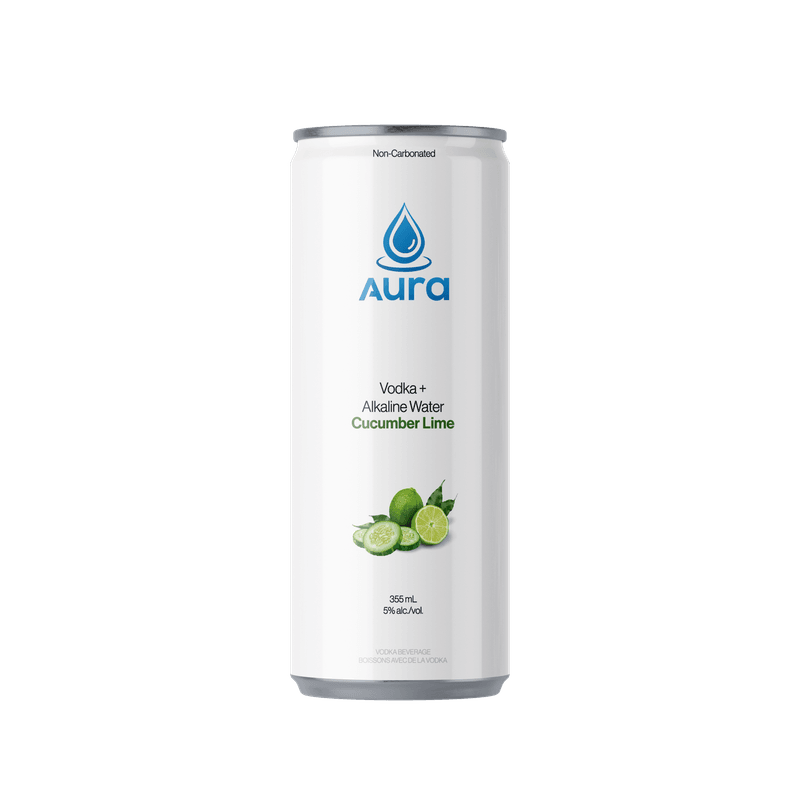
Aura is a canned vodka water: premium vodka, alkaline water (pH 8.5+) and natural flavour, with no added sugar and zero carbonation. It's a still drink, so no bubbles means no bloating, and it's a different experience from a fizzy seltzer. But the alkaline water doesn't make it hydrating or healthier, and the alcohol is the same as in any other drink. Enjoy it alongside plain water, not instead of it. Learn more about why Aura is made the way it is.
The bottom line
The eight-glass rule was never based on evidence. The best data, from more than 5,600 people measured with isotopes, shows that daily water needs vary widely with body size, age, activity and climate, and that food and everyday drinks count. Drink to thirst, add more for heat and exercise, and stop counting glasses.
When you want something to sip on a Canadian patio or at a cottage dinner, explore our vodka water cocktails in Cucumber Lime, Coconut Pineapple and Mango Peach. Aura is sold across British Columbia, Alberta and Ontario. Our own online ordering delivers to Ontario addresses, and in BC and Alberta you can find Aura through local retailers on our where to buy page. Please enjoy responsibly, and only if you're of legal drinking age in your province.
This article summarises published research for general interest and is not medical advice.
Sources
- Valtin H. "Drink at least eight glasses of water a day." Really? Is there scientific evidence for "8 x 8"? American Journal of Physiology – Regulatory, Integrative and Comparative Physiology. 2002;283(5):R993–R1004. doi:10.1152/ajpregu.00365.2002. PMID: 12376390. pubmed.ncbi.nlm.nih.gov/12376390
- Dartmouth Medical School. News release on Valtin's "8 x 8" review, August 8, 2002. geiselmed.dartmouth.edu
- Yamada Y, Zhang X, Henderson MET, et al.; IAEA DLW Database Consortium. Variation in human water turnover associated with environmental and lifestyle factors. Science. 2022;378(6622):909–915. doi:10.1126/science.abm8668. PMID: 36423296; PMCID: PMC9764345. pmc.ncbi.nlm.nih.gov/articles/PMC9764345
- Maughan RJ, Watson P, Cordery PA, Walsh NP, Oliver SJ, Dolci A, Rodriguez-Sanchez N, Galloway SD. A randomized trial to assess the potential of different beverages to affect hydration status: development of a beverage hydration index. American Journal of Clinical Nutrition. 2016;103(3):717–723. doi:10.3945/ajcn.115.114769. PMID: 26702122. pubmed.ncbi.nlm.nih.gov/26702122
- National Academies of Sciences, Engineering, and Medicine. Report sets dietary intake levels for water, salt, and potassium to maintain health and reduce chronic disease risk (news release on the Dietary Reference Intakes for Water, Potassium, Sodium, Chloride, and Sulfate), 2004. nationalacademies.org