"Drink responsibly" never says how many drinks, over how long, or when to stop. If you want to know how to pace drinks, you need numbers you can count. The short answer: count standard drinks, space them out, eat first, and don't trust how you feel to tell you when you've had enough.
Why "drinking responsibly" fails as advice
"Drinking responsibly" leaves every decision to in-the-moment judgment, which is exactly what alcohol impairs.
In a national sample of 76,882 incoming first-year students from 258 U.S. colleges, Nguyen and colleagues (2011) found that "limit drinking" strategies generally declined over the data collection period, while intent to get drunk and peak blood alcohol concentration rose right after school started. Good intentions faded just when the setting changed.
How to pace drinks: start with the standard drink
You can't pace something you aren't counting. Canada's Guidance on Alcohol and Health (CCSA, 2023) defines a Canadian standard drink as 17.05 mL, or 13.45 g, of pure alcohol. That equals a 341 mL bottle of 5% beer or cider, a 142 mL glass of 12% wine, or a 43 mL shot of 40% spirits.
To count any can, bottle or glass, use this formula:
- Standard drinks = volume (mL) × alcohol % ÷ 17.05
- Example: a 355 mL can at 5% alcohol is 355 × 0.05 ÷ 17.05 ≈ 1.04 standard drinks.
- Use the percentage on the label. Large pours can quietly turn one "drink" into two.
Next, set a limit before you start drinking. The CCSA guidance says that "consuming more than 2 standard drinks per occasion is associated with a significant increased risk of harms to self and others." It also says that 2 or fewer standard drinks per week is the level where you are likely to avoid alcohol-related consequences.
The blood alcohol curve over an evening
Your body absorbs alcohol quickly and clears it slowly, which gives the blood alcohol curve its shape: a rise, a peak and a long decline.
The rise lasts longer than you'd expect
In a laboratory study of healthy men who drank on an empty stomach, Jones, Jönsson and Neri (1991) found that peak blood alcohol arrived within 45 minutes for 77% of subjects (N = 152) and within 75 minutes for 97%. When subjects drank 0.80 g/kg of alcohol over 30 minutes, their blood alcohol kept climbing after they stopped, by an average of 33 mg/100 mL, and peaked within 60 minutes of the last sip in 92% of trials. Takeaway: wait before deciding on another drink.
The decline is slow and varies from person to person
A review of the elimination research by Jones (2010) puts the normal range of alcohol clearance from blood at 10 to 35 mg/100 mL per hour. The review suggests 15 mg/100 mL per hour as a good population average for moderate drinkers. The rate tended to be 10 to 15 after drinking on an empty stomach and 15 to 20 in people who had eaten. The popular "one drink per hour" rule is a rough average; your rate could be slower.
For context, Canada's Criminal Code sets the prohibited blood alcohol concentration for driving at 80 mg of alcohol per 100 mL of blood. Provinces and territories add their own rules. Never plan to drive after drinking, whatever the math says.
Food flattens the curve
In a crossover study of ten healthy men given the same dose (0.80 g/kg), Jones and Jönsson (1994) measured an average peak of 67 mg/100 mL when the subjects drank after breakfast, compared with 104 mg/100 mL after an overnight fast (P < 0.001). With food, the body also cleared the dose about two hours faster. Eat a real meal before your first drink.
Standard drinks per hour vs. how people actually self-regulate
Most people don't count standard drinks per hour; they go by feel, which is a noisy guide.
- Subjective intoxication tracks alcohol levels only loosely. Richards, Turrisi and Russell (2024) followed 222 heavy-drinking young adults for six days, using phone check-ins every 30 minutes and wearable alcohol sensors. Feeling drunk was moderately linked to estimated blood alcohol (standardized βs = 0.5–0.6), but the link "varied widely between persons and across days." Feeling drunker also predicted more consequences, even at the same alcohol level (IRRs = 1.29–1.70).
- Estimating your own level can be learned, but not by everyone. In their review, Aston and Liguori (2013) report that moderate drinkers successfully learned to estimate their blood alcohol, while dependent drinkers could not, most likely because of tolerance. Real-world studies gave mixed results.
So use an external count, not just feel:
- Set your number and finish time before you go out.
- Eat first, and keep a standard-drink tally on your phone.
- Space drinks at least an hour apart, plus a buffer.
- Have a non-alcoholic drink between alcoholic ones, and don't top up unfinished glasses.
- Treat "I feel fine" as unreliable, especially with high tolerance.
What the research does not show: caveats
- Small, narrow lab samples. The blood alcohol curve studies above tested healthy men, often fasting and in the morning. The food study had ten participants. Women, older adults and real evenings may differ.
- Pacing strategies have modest proven effects. A systematic review of 94 studies (Cox et al., 2024) found that overall use of protective strategies was consistently associated with less heavy drinking. However, a critical review (Pearson, 2013) noted that 80% of 62 reports used only cross-sectional data, which can't show cause and effect. A meta-analysis of 15 randomized trials (Van Nhat et al., 2026) found that interventions increased use of the strategies (g = 0.23) but did not change how much people drank (g = −0.05, p = 0.162), with only a small drop in drinking frequency (g = −0.09).
- Mostly U.S. students. Much of the behavioural research comes from American university samples, not adults in Canada.
- No formula makes drinking safe. Pacing lowers your peak; it doesn't remove risk.
Where Aura fits, and where it doesn't
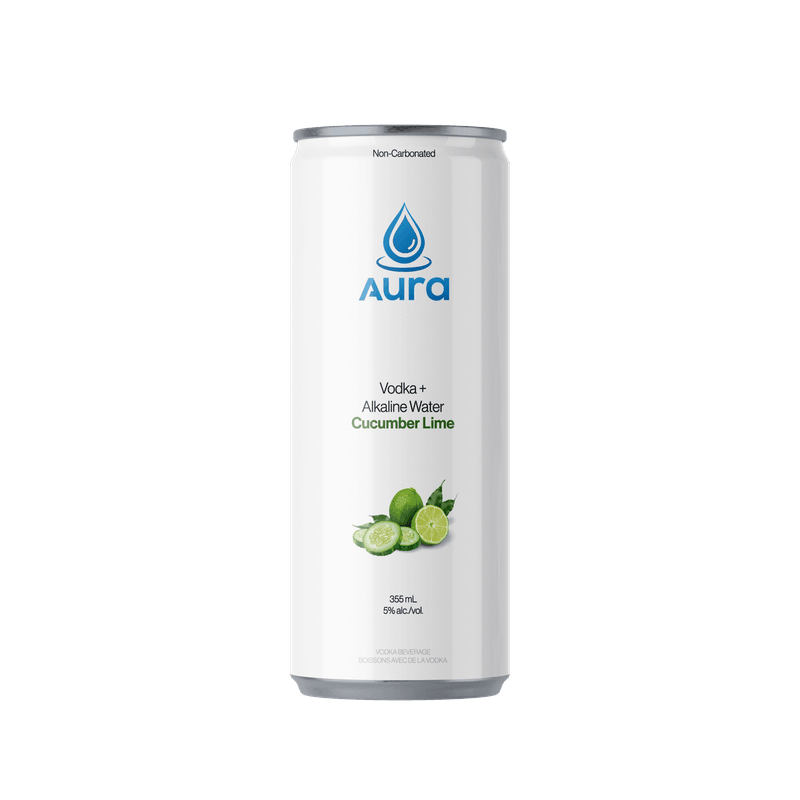
Aura is a still vodka water: premium vodka, alkaline water and natural flavour, with no carbonation, no added sugar and no artificial sweeteners. No bubbles means no bloating, which is a comfort preference, not a pacing tool or safety feature. The alcohol is the same alcohol, so count each can from the label percentage, exactly as above. Learn more about why Aura or browse our vodka water cocktails.
Ready to plan your next evening with a number in mind? Aura's direct and wholesale ordering delivers to Ontario addresses only. In Alberta, look for Aura at AGLC-licensed private retailers; in British Columbia, at BC Liquor Stores and licensed private retailers. See where to buy. Please enjoy responsibly, and only if you are of legal drinking age in your province.
This article summarises published research for general interest and is not medical advice.
Sources
- Paradis C, Butt P, Shield K, Poole N, Wells S, Naimi T, Sherk A, & the Low-Risk Alcohol Drinking Guidelines Scientific Expert Panels. Canada's Guidance on Alcohol and Health: Final Report. Canadian Centre on Substance Use and Addiction, 2023. ISBN 978-1-77871-046-9. CCSA
- Jones AW, Jönsson KA, Neri A. Peak blood-ethanol concentration and the time of its occurrence after rapid drinking on an empty stomach. Journal of Forensic Sciences, 1991;36(2):376–385. PMID 2066719. PubMed
- Jones AW, Jönsson KA. Food-induced lowering of blood-ethanol profiles and increased rate of elimination immediately after a meal. Journal of Forensic Sciences, 1994;39(4):1084–1093. PMID 8064267. PubMed
- Jones AW. Evidence-based survey of the elimination rates of ethanol from blood with applications in forensic casework. Forensic Science International, 2010;200(1–3):1–20. doi:10.1016/j.forsciint.2010.02.021. PMID 20304569. PubMed
- Aston ER, Liguori A. Self-estimation of blood alcohol concentration: a review. Addictive Behaviors, 2013;38(4):1944–1951. doi:10.1016/j.addbeh.2012.12.017. PMID 23380489. PubMed
- Richards VL, Turrisi RJ, Russell MA. Subjective intoxication predicts alcohol-related consequences at equivalent alcohol concentrations in young adults using ecological momentary assessment and alcohol sensors. Psychology of Addictive Behaviors, 2024;38(3):334–346. doi:10.1037/adb0000993. PMID 38271080. PubMed
- Nguyen N, Walters ST, Wyatt TM, DeJong W. Use and correlates of protective drinking behaviors during the transition to college: analysis of a national sample. Addictive Behaviors, 2011;36(10):1008–1014. doi:10.1016/j.addbeh.2011.06.002. PMID 21719203. PubMed
- Pearson MR. Use of alcohol protective behavioral strategies among college students: a critical review. Clinical Psychology Review, 2013;33(8):1025–1040. doi:10.1016/j.cpr.2013.08.006. PMID 24036089. PubMed
- Cox MJ, DiBello AM, Jones EP, et al. A systematic review of the associations between protective behavioral strategies and heavy alcohol consumption and consequences among young adults. Psychology of Addictive Behaviors, 2024;38(4):488–506. doi:10.1037/adb0001002. PMID 38573700. PubMed
- Van Nhat T, Uthis P, Jantarapakdee R, Krongtham P. The effectiveness of protective behavioral strategies for reducing alcohol use and alcohol-related harms among adults: a systematic review and meta-analysis of randomized controlled trials. Psychiatry Research, 2026;365:117430. doi:10.1016/j.psychres.2026.117430. PMID 42685511. PubMed
- Department of Justice Canada. Impaired Driving Laws. justice.gc.ca