You are reading a label that says "alkaline" and you want a straight answer: is vodka acidic or alkaline? Here it is. Plain, unflavoured vodka sits close to neutral, roughly pH 6 to 7, because distillation leaves most of the acids behind in the still. But what ends up in your glass is almost never plain vodka. Add lime, cranberry or cola and the drink can fall below pH 3. The spirit is not the variable. The mixer is.
Is vodka acidic or alkaline? What the vodka pH numbers say
The pH entry in The Oxford Companion to Spirits & Cocktails, by Doug Frost, states that "a well-made, neutral spirit will have a pH in the 6 to 7 range," while a barrel-aged spirit "will generally fall somewhere around 4.5." Pure ethanol is listed there as very slightly alkaline at pH 7.33. Frost names the two things that nudge a bottle off neutral: the water used to cut the spirit to bottling strength, which can push it slightly alkaline, and added citric acid, which pushes it the other way.
So if you have searched vodka pH or pH vodka hoping for one clean number, the honest answer is a narrow band, not a single value.
Why distillation leaves the spirit close to neutral
Fermentation is an acidic business. Wash, wine and beer carry organic acids such as malic, lactic and tartaric acid, and those acids are non-volatile, so when the wash is distilled they largely stay behind while the ethanol and water come over.
Canada's standard reinforces the point. Under SOR/2019-217, registered 17 June 2019, vodka here must be a distillate from potatoes, cereal grain or other agricultural material, treated with charcoal or other means so that it is "without distinctive character, aroma or taste." A spirit stripped of character has also been stripped of most of the compounds, acids included, that would move its pH.
The mixer moves the pH far more than the spirit does
De Paiva and colleagues, in the International Journal of Dentistry in 2026, measured the pH of ready-to-drink alcoholic beverages and exposed 60 bovine enamel blocks (n = 10 per group) to them:
- Jack Daniel's & Coca-Cola: pH 2.35
- Coca-Cola (positive control): pH 2.57
- Schweppes Vodka Citrus: pH 2.73
- Skol Beats Senses: pH 2.87
- Ice Smirnoff: pH 3.04
- Mineral water (negative control): pH 7.54
Every drink fell below pH 5.5, the threshold the authors cite for enamel demineralisation. Ice Smirnoff, Skol Beats Senses and the Schweppes vodka mix produced roughly 72% microhardness loss against 65% for the whiskey and cola, and Ice Smirnoff showed the greatest surface loss at 6.36 µm. Look at the gap: the base spirit in two of those products sits near pH 6 to 7 alone, yet the finished drink measured under 3. Citric acid and juice concentrate did that, not the vodka.
Titratable acidity matters more than the pH number
Tenuta and colleagues showed something counterintuitive in Brazilian Oral Research in 2015. Eight volunteers held 15 mL of a drink for 10 seconds, then spat. Cola had the lower pH (2.5 ± 0.05) but low titratable acidity (0.57 ± 0.04 mmol OH- to reach pH 5.5), and salivary pH returned to baseline in 30 seconds. Orange juice had a higher pH (3.5 ± 0.04) but far greater titratable acidity (3.17 ± 0.06 mmol OH-), and saliva took 90 seconds. The drink with the better pH number kept the mouth acidic three times longer.
pH tells you how strong the acid is at that moment; titratable acidity tells you how much acid there is to neutralise. A label quoting only pH quotes the less informative half.
Still, sparkling, and where the acid really comes from
Carbonation does lower pH, because dissolved CO2 forms carbonic acid, but that effect is easy to overstate. Marchan and colleagues, in Open Journal of Stomatology in 2021, measured still and sparkling waters in Trinidad. Plain carbonated mineral water came in at pH 4.35, titratable acidity 0.01 mmol/L. The flavoured waters, still and sparkling alike, measured pH 1.70 to 2.64 with titratable acidity up to 0.08 mmol/L. The citric acid, malic acid and juice concentrate on those labels were doing far more work than the bubbles.
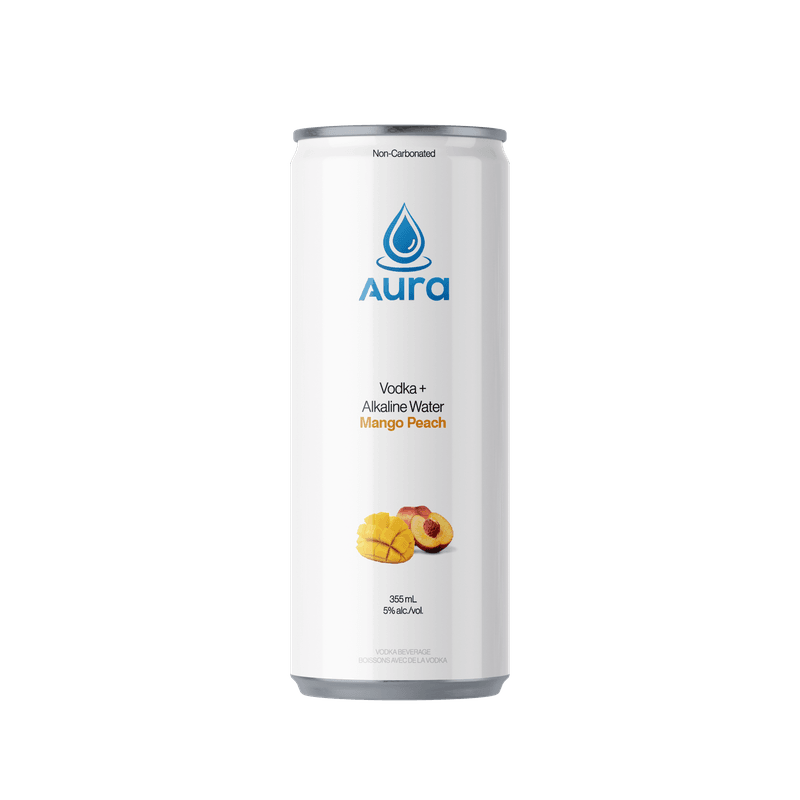
That cuts against a lazy marketing line. Aura is a still drink with zero carbonation, but that is not a licence to claim a pH advantage we have not measured in a lab. Read the flavour ingredients, not the bubbles.
How to read a pH or "alkaline" claim on a drinks label
Five checks:
- Ingredient or finished drink? "Made with alkaline water, pH 8.5+" specifies the water going in, not the sealed can after alcohol and flavour are added.
- Ask for titratable acidity too. Per Tenuta et al., that predicts how long your mouth stays acidic. Almost nobody publishes it, which itself tells you something.
- Read the ingredients before the marketing. Citric acid, malic acid and juice concentrate move the finished pH further than the spirit or the water ever will.
- Be sceptical of "alkaline vodka" as a category. A neutral spirit is near pH 7 by construction; bottling with slightly alkaline water is a small shift, not a different kind of product.
- Treat pH as chemistry, not health. No pH figure changes how much alcohol is in the can.
That last one is what we hold ourselves to: see what goes into our vodka water cocktails and the reasoning behind why Aura, with no health claim attached to a pH number.
What this research does not show
- The enamel work is in vitro. De Paiva et al. used bovine enamel under continuous immersion and note that in the mouth "enamel is protected by several mechanisms absent in continuous immersion models," making their results "an upper-bound estimate." No still vodka water was tested.
- The salivary study is small. Eight volunteers, no alcohol tested, a hold-and-spit protocol rather than normal drinking.
- The water survey carries a flag its own authors raise. Marchan et al. note their pH readings ran lower than other investigators have reported, and it is a single-market survey with no clinical outcomes.
- The best-known alkaline water finding is a lab result. Koufman and Johnston reported in the Annals of Otology, Rhinology & Laryngology in 2012 that artesian water at pH 8.8 irreversibly inactivated human pepsin — explicitly in vitro, not a trial in people, and involving no alcohol.
- Broader alkaline claims do not survive review. Fenton and Huang screened 8,278 citations and 252 abstracts for BMJ Open in 2016 and found one eligible study and no randomised trials. That cohort showed no association between dietary acid load and bladder cancer (RR 1.15, 95% CI 0.86 to 1.55, p = 0.38). They also record a dietary change raising urine pH by 1.02 units while blood pH moved 0.014 units, noting that "urine pH does not provide a measurement of systemic pH." Promoting alkaline diet or alkaline water for cancer prevention or treatment, they conclude, "is not justified."
To be explicit: none of this means a still drink is healthier, safer or less intoxicating than a carbonated one. The alcohol is the same either way, and mouthfeel is not a health outcome.
The practical takeaway
Canada's Guidance on Alcohol and Health (CCSA, 2023) sets out a continuum of risk: 1 to 2 standard drinks a week is low risk, 3 to 6 moderate, with risk rising sharply at 7 or more. Aura is for people of legal drinking age; drink responsibly and never drive after drinking.
For a still, no-added-sugar, gluten-free vodka water in Cucumber Lime, Coconut Pineapple or Mango Peach, browse our vodka water cocktails. Direct and wholesale ordering delivers to Ontario addresses only; in BC or Alberta, check where to buy for BC Liquor Stores and licensed private retailers, or AGLC-licensed retailers in Alberta.
This article summarises published research for general interest and is not medical or dental advice.
Sources
- Frost, D. "pH." In Wondrich, D. (ed.), The Oxford Companion to Spirits & Cocktails, Oxford University Press. Link
- Government of Canada. Regulations Amending the Food and Drug Regulations (Vodka), SOR/2019-217, 17 June 2019. Canada Gazette II, 153(13). Link
- de Paiva, M.A.A., et al. "Analysis of the Surface Morphology of Dental Enamel Exposed to Ready-to-Drink Alcoholic Beverages." International Journal of Dentistry, 2026, art. 9930736. doi:10.1155/ijod/9930736. Link
- Tenuta, L.M.A., Fernandez, C.E., Brandao, A.C.S., Cury, J.A. "Titratable acidity of beverages influences salivary pH recovery." Brazilian Oral Research, 29(1), 2015, art. 0032. PMID 25715032. Link
- Marchan, S., Hector, T., Bascombe, K. "The pH and Titratable Acidity of Still and Sparkling Flavored Waters." Open Journal of Stomatology, 11, 2021, 148-158. doi:10.4236/ojst.2021.113012. Link
- Koufman, J.A., Johnston, N. "Potential Benefits of pH 8.8 Alkaline Drinking Water as an Adjunct in the Treatment of Reflux Disease." Annals of Otology, Rhinology & Laryngology, 121(7), 2012, 431-434. PMID 22844861. Link
- Fenton, T.R., Huang, T. "Systematic review of the association between dietary acid load, alkaline water and cancer." BMJ Open, 6(6), 2016, e010438. PMID 27297008. Link
- Canadian Centre on Substance Use and Addiction. Canada's Guidance on Alcohol and Health: Final Report, CCSA, 2023. Link