Maybe you've noticed that two drinks hit harder in the days before your period, or that a glass of wine feels different mid-cycle. It's a common question, so we read the controlled lab research on menstrual cycle alcohol effects. Here is the short answer. In the best-designed studies, the phase of your cycle does not reliably change your blood alcohol level or how fast you clear alcohol. There is some evidence that how alcohol feels can shift, especially in the late luteal (premenstrual) phase. That makes your own body and your own pattern the most useful guide. Below is what the studies found, why they disagree, and what you can do with that today.
The menstrual cycle alcohol question: what are we actually asking?
When people ask about their period and drinking, they usually mean one of two things:
- Pharmacokinetics: does the same drink produce a higher blood alcohol concentration (BAC), or stay in your system longer, at certain points in the cycle?
- Subjective and behavioural effects: at the same BAC, do you feel more intoxicated, enjoy it more or less, or perform worse on balance and coordination?
The research gives different answers to these two questions, which explains much of the confusion online.
Blood alcohol across the cycle: mostly no difference
The strongest pharmacokinetic studies give the same answer: cycle phase barely moves the numbers.
Mumenthaler and colleagues, 1999
In a within-subjects study published in Alcoholism: Clinical and Experimental Research, Mumenthaler et al. (1999) gave 24 women 0.67 g/kg of ethanol once during the menstrual phase and once during the luteal phase. They measured breath alcohol at 20 or more time points. Blood tests confirmed ovulation, and women with anovulatory cycles were excluded. Estradiol and progesterone differed significantly between the two test days. Even so, the authors reported "no significant differences between menstrual and luteal phases for any of the pharmacokinetic variables," and hormone levels did not correlate with any pharmacokinetic measure.
Dettling and colleagues, 2010
A German forensic team led by Dettling et al. (2010, Alcohol) tested 14 women in the follicular and luteal phases, aiming for a peak BAC of about 0.08 g%. Their main analysis covered the 10 women with a normal luteal rise in progesterone. Average hourly elimination was about 0.0194 g%/h in the follicular phase and 0.0193 g%/h in the luteal phase, which is not a significant difference. They also found no phase differences in peak BAC, absorption rate, time to peak or distribution volume. Absolute progesterone level did not correlate with elimination rate.
What does drive BAC differences
Body composition matters more than cycle phase. In a small 1983 study, Sutker et al. found that seven women reached significantly higher peak BACs than nine men (p < 0.01) on the same weight-adjusted dose. The authors attributed the gap to differences in body water. After correcting for body water, they found no sex difference in how much alcohol was metabolised. Your size, body water, how much you've eaten and how fast you drink will move your BAC far more than the calendar.
Hormones and alcohol: subjective effects are where it gets mixed
The question of hormones and alcohol gets more interesting when researchers measure how drinking feels.
Holdstock and de Wit, 2000: no phase effect
In Psychopharmacology, Holdstock and de Wit (2000) tested 16 healthy women at four phases: early follicular, late follicular, mid-luteal and late luteal. Each session started with three 0.2 g/kg doses, after which the women could choose up to three more. Alcohol produced its usual euphoria and stimulant-like feelings and impaired eye movements and psychomotor performance. However, the "effects of ethanol did not vary according to menstrual cycle phase," and the amount women chose to drink did not vary either.
Evans and Levin, 2011: some luteal-phase differences
A larger study gives a more nuanced picture. Evans and Levin (2011, Drug and Alcohol Dependence) ran a double-blind, placebo-controlled study with 45 women. Twenty-four of them had a father with a history of alcoholism. Each woman received placebo, 0.25 g/kg or 0.75 g/kg of alcohol in both the mid-follicular and late luteal phases, with ovulation confirmed by urine kits. Their findings:
- Before any drinking, negative mood was higher in the luteal phase, and vigour, arousal and friendliness scores were lower.
- Alcohol raised "drug liking" and "good drug effect" ratings more in the luteal phase.
- Most performance impairment did not differ by phase, but balance impairment was greater in the luteal phase.
- BAC showed only a trend toward being higher in the luteal phase after the 0.75 g/kg dose (p < 0.07), mostly in women with a family history of alcoholism. That falls short of conventional statistical significance.
The authors also summarised earlier work. One study found greater eye-movement effects in the late luteal phase only among women with premenstrual dysphoric disorder (PMDD). Another, also by Mumenthaler's group, found no phase differences in flight-simulator performance.
Why the results on alcohol effects, women and the cycle are mixed
The research on alcohol effects, women and the cycle is inconsistent for several reasons.
- Small samples. The studies above had 9 to 45 participants. Small studies can miss modest effects, and they can also produce chance findings.
- Different phase definitions. Some studies compared menstrual and luteal phases, others follicular and luteal, and one used four phases. If the effect is concentrated in a few late-luteal days, a study that tests mid-luteal could miss it.
- Verifying the phase. Evans and Levin note that early studies often relied on self-reported cycle days without hormone confirmation. The better studies used blood or urine tests, and Dettling's team analysed only women with a confirmed progesterone rise.
- Who is studied. Effects seem to show up in subgroups, such as women with PMDD or a family history of alcoholism, and may get washed out in averages.
- One cycle, one day. Most designs test each phase once, in one cycle, so normal day-to-day variation is hard to separate from a true phase effect.
- Low lab doses. Lab doses are modest and closely controlled. They don't reflect a night out, an empty stomach or poor sleep.
What the research does NOT show
- It does not show that you get "drunker" or reach a higher BAC from the same drinks before your period. The best pharmacokinetic studies found no significant difference.
- It does not show that any phase is a "safe" time to drink more.
- It does not show that any type of drink, mixer or brand changes how your hormones interact with alcohol, including ours.
Practical guidance you can use today
- Track it. Use a cycle app or notes for two or three cycles to log when you drink, how much, and how you felt. Your own pattern beats any population average.
- Plan around mood. If premenstrual days bring lower mood, Evans and Levin's data suggest alcohol may feel more rewarding then. That is worth being aware of so it doesn't turn into drinking more than you planned.
- Watch balance and coordination in the late luteal phase, especially if you're walking home or on stairs. Never drive after drinking.
- Control what you can: eat beforehand, pace yourself, alternate with water and count your standard drinks.
- Talk to a clinician if you have severe premenstrual symptoms or suspect PMDD, or if you're on medication that may interact with alcohol.
- Know the Canadian guidance. The Canadian Centre on Substance Use and Addiction published Canada's Guidance on Alcohol and Health in January 2023. It's a good reference for weekly limits wherever you live in Canada.
Where Aura fits, honestly
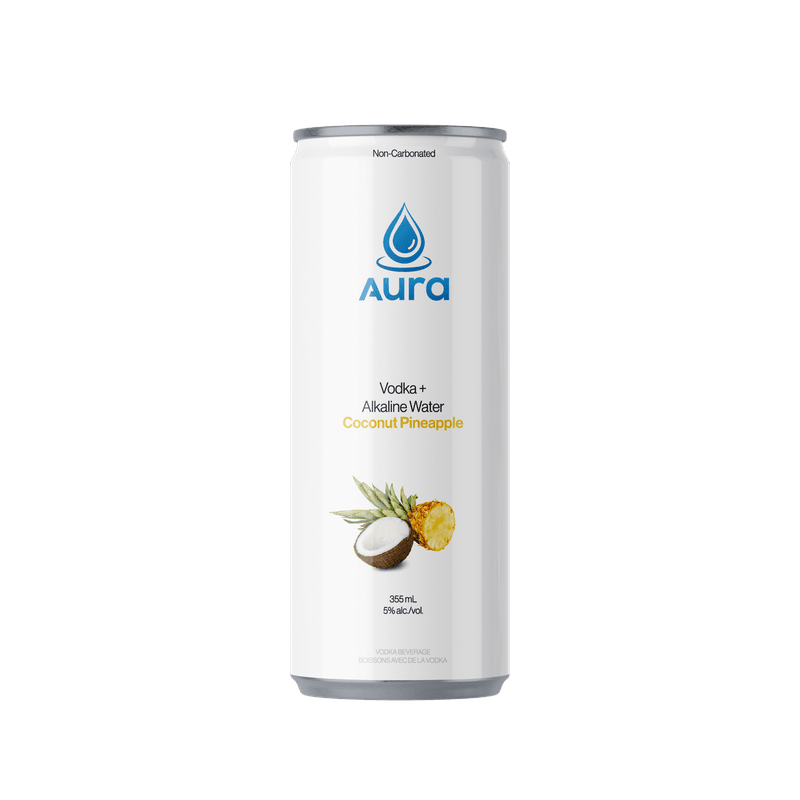
A 355mL can of Aura has the same alcohol whatever day of your cycle it is. Nothing in it changes how your body absorbs or processes ethanol, and we don't claim otherwise. What we can offer is a simple, predictable drink. Aura is premium vodka with alkaline water (pH 8.5+) and natural flavour, with no added sugar, no artificial sweeteners and no preservatives, and it's gluten-free. It's also completely still, with zero carbonation. If carbonated drinks leave you feeling bloated on days you already feel bloated, a still drink is an alternative to a seltzer. That's a matter of comfort, not a health benefit. Read more about why Aura is still, or browse our vodka water cocktails in Cucumber Lime, Coconut Pineapple and Mango Peach.
Whatever you're drinking, please enjoy responsibly and only if you're of legal drinking age in your province.
This article summarises published research for general interest and is not medical advice.
Want to try Aura? It's available across British Columbia, Alberta and Ontario. Ontario readers can order cases of 24 directly for delivery to an Ontario address. In BC and Alberta, find Aura at BC Liquor Stores and licensed private retailers in BC, or at AGLC-licensed private retailers in Alberta. Use our where to buy page to find a store near you.
Sources
- Mumenthaler MS, Taylor JL, O'Hara R, Fisch HU, Yesavage JA. Effects of menstrual cycle and female sex steroids on ethanol pharmacokinetics. Alcoholism: Clinical and Experimental Research. 1999;23(2):250-255. PMID: 10069553. https://pubmed.ncbi.nlm.nih.gov/10069553/
- Dettling A, Preiss A, Skopp G, Haffner HT. The influence of the luteal and follicular phases on major pharmacokinetic parameters of blood and breath alcohol kinetics in women. Alcohol. 2010;44(4):315-321. doi:10.1016/j.alcohol.2010.02.006. PMID: 20570083. https://pubmed.ncbi.nlm.nih.gov/20570083/
- Holdstock L, de Wit H. Effects of ethanol at four phases of the menstrual cycle. Psychopharmacology. 2000;150(4):374-382. doi:10.1007/s002130000461. PMID: 10958078. https://pubmed.ncbi.nlm.nih.gov/10958078/
- Evans SM, Levin FR. Response to alcohol in women: role of the menstrual cycle and a family history of alcoholism. Drug and Alcohol Dependence. 2011;114(1):18-30. doi:10.1016/j.drugalcdep.2010.09.001. PMID: 20888148; PMCID: PMC3017640. https://pmc.ncbi.nlm.nih.gov/articles/PMC3017640/
- Sutker PB, Tabakoff B, Goist KC Jr, Randall CL. Acute alcohol intoxication, mood states and alcohol metabolism in women and men. Pharmacology Biochemistry and Behavior. 1983;18(Suppl 1):349-354. doi:10.1016/0091-3057(83)90198-3. PMID: 6634848. https://pubmed.ncbi.nlm.nih.gov/6634848/
- Canadian Centre on Substance Use and Addiction. Canada's Guidance on Alcohol and Health: Final Report. CCSA; January 2023. https://ccsa.ca/canadas-guidance-alcohol-and-health-final-report