You've probably seen a headline saying a litre of water holds hundreds of thousands of plastic particles. You likely want to know two things: is it true, and should you change what you drink? The short answer: researchers have repeatedly found microplastics in bottled water. The counts depend heavily on how they were measured. And the effects on human health are still largely unknown. In Canada there are a few sensible steps you can take today. Drink treated tap water where it's available, carry it in glass or stainless steel, and be careful with any single number in a headline. Here's what the bottled water research actually says.
What studies found about microplastics in bottled water
2018: hundreds of particles per litre
One of the first large surveys, by Sherri Mason, Victoria Welch and Joseph Neratko, was published in Frontiers in Chemistry in 2018. It tested 259 bottles from 11 brands, bought in 19 locations across nine countries. About 93% of bottles showed synthetic polymer contamination above the lab's background level. Particles larger than 100 µm averaged about 10.4 per litre. Counting smaller particles down to about 6.5 µm raised the average to roughly 325 per litre, and one bottle exceeded 10,000. Polypropylene was the most common polymer among the chemically confirmed larger particles (54%). The authors suggested that packaging, especially caps, and the bottling process were likely sources.
2024: a nanoplastics study pushes the count far higher
In January 2024, a team including Naixin Qian, Beizhan Yan and Wei Min published a nanoplastics study in PNAS. Its method could chemically identify individual particles smaller than 100 nanometres. Using bottled water as a test case, they estimated about 240,000 (± 130,000) plastic particles per litre. Roughly 90% of those were nanoplastics. The authors note this is orders of magnitude more than earlier reports of microplastics in bottled water.
2025: a Canadian review of the evidence
At Concordia University in Montreal, Sarah Sajedi, Chunjiang An and Zhi Chen reviewed more than 140 studies in the Journal of Hazardous Materials. According to the university's September 2025 release, the review estimates that people take in roughly 39,000 to 52,000 microplastic particles a year. It also estimates that people who drink bottled water regularly take in about 90,000 more particles a year than people who mostly drink tap water. These are estimates built from other studies, not new measurements.
Why the numbers differ so much: measurement methods
The gap between 325 and 240,000 particles per litre doesn't mean bottled water suddenly got worse. It mostly shows that the two studies could see very different size ranges.
- Stain and count (Mason, 2018): Samples were filtered and stained with Nile Red, a dye that makes plastics glow under blue light. Particles were then counted under a microscope. Only some particles over 100 µm were chemically confirmed with infrared spectroscopy (FTIR). Smaller particles were counted by fluorescence alone. Anything below about 6.5 µm was invisible. The authors also say their small-particle counts are probably underestimates.
- Single-particle chemical imaging (Qian, 2024): Stimulated Raman scattering (SRS) microscopy, combined with an automated matching algorithm, identifies the plastic type of each particle down to the nanoscale. That opens up a size range earlier studies couldn't measure.
Comparing studies is hard even with the same method. When the World Health Organization briefed reporters on its 2019 drinking-water report, its experts said the report reviewed just nine drinking-water studies. Those studies used methods so different that comparing their particle counts was unreliable. The Concordia team describes a similar trade-off. Some tools detect tiny particles but can't identify their chemistry. Others identify chemistry but miss the smallest particles. And the best tools are expensive.
When you read about the next study, check four things:
- What was the smallest particle size it could detect?
- Were the particles chemically confirmed as plastic, or only stained?
- Did the lab run blank controls to rule out contamination from air, gloves and equipment?
- How many brands, lots and bottles were tested?
What is known, and not known, about health effects
This is where headlines often go further than the science.
WHO (2019). Bruce Gordon, WHO's coordinator for water, sanitation and hygiene, said: "our assessment of the risk is that it is low." WHO technical expert Jennifer de France added that the conclusion rests on "a limited evidence base." Gordon said there was "very little information" on whether nanoplastics get into body tissues. WHO did not recommend routine monitoring. It called for more research and less plastic pollution instead.
Health Canada and Environment and Climate Change Canada (2020). The federal Science Assessment of Plastic Pollution found that the current literature does not identify a human health concern. It also said there are "insufficient data to allow for a robust evaluation" of risks from swallowed microplastics. Animal studies at high doses found effects such as liver inflammation and changes in gut bacteria. The assessment says those findings can't be linked to everyday exposure.
The NEJM plaque study (2024). Raffaele Marfella and colleagues studied 304 patients having surgery to remove plaque from the carotid artery, and 257 completed follow-up. They reported in the New England Journal of Medicine that polyethylene was found in the removed plaque of 58.4% of patients. Over an average of about 34 months, those patients had a higher risk of heart attack, stroke or death from any cause (hazard ratio 4.53; 95% CI 2.00 to 10.27; P<0.001). The authors state plainly that "our results do not prove causality." They also note that lab contamination couldn't be firmly ruled out, and that they did not analyse drinking water or food exposure.
Caveats: what this research does not show
- No study here shows that drinking bottled water causes disease in people.
- The particle counts from 2018 and 2024 can't be compared directly, because the methods covered different size ranges.
- Large counts of nanoplastics don't tell us how many particles the body absorbs, or what dose would cause harm.
- The NEJM finding is one observational study in a specific surgical group. It doesn't tie the plastic to any drink, and it hasn't yet been confirmed by other cohorts.
- Results varied a lot between brands, lots and individual bottles. Some lots in the 2018 study were tested with only a few bottles.
- The 90,000-particle figure comes from a review that estimated exposure from many different studies. It is not a direct measurement.
Practical steps to cut plastic in drinks today
- Use tap water where it's safe. The federal assessment says drinking-water treatment is expected to remove a large share of microplastic particles. WHO also noted higher counts in bottled water than in tap water, while cautioning that the data were limited.
- Carry a refillable glass or stainless steel bottle instead of buying single-use plastic bottles every day. Keep single-use bottles for when you really need them.
- Don't panic over one number. Use the four questions above to judge new studies.
- Look for updates from Health Canada and WHO. They review this evidence as it builds up.
Where Aura fits, honestly
We get asked about plastic in drinks, so here's a straight answer. Aura comes in aluminum cans, not plastic bottles. But aluminum cans generally have a thin inner coating. We haven't seen published research measuring microplastics in canned ready-to-drink cocktails, so we don't claim Aura is microplastic-free, safer or healthier. It's also an alcoholic drink, and that matters far more than anything in this article.
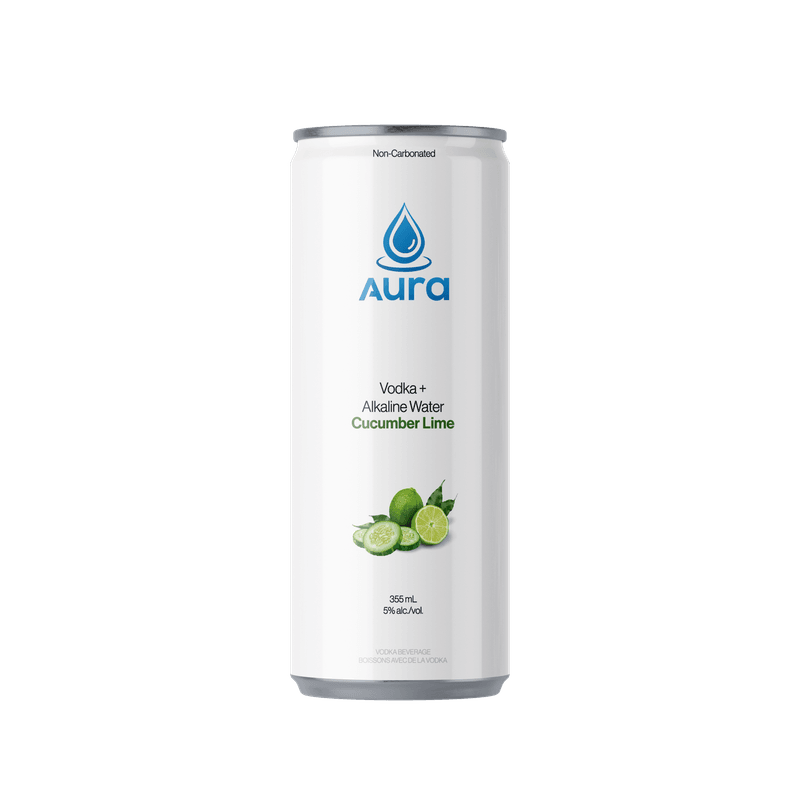
Here's what we can say. Aura is a still vodka water made with premium vodka, alkaline water (pH 8.5+) and natural flavour. It has zero carbonation: unlike a seltzer or vodka soda, there are no bubbles, so no bloating. It contains no added sugar, no artificial sweeteners and no preservatives, and it's gluten-free. Read more about why Aura, or browse our vodka water cocktails in Cucumber Lime, Coconut Pineapple and Mango Peach.
Ready to try a still alternative? Aura is sold in 24-can cases of 355mL cans across British Columbia, Alberta and Ontario. Our direct and wholesale ordering delivers to Ontario addresses only. In Alberta, look for AGLC-licensed private retailers. In BC, try BC Liquor Stores and licensed private retailers. Find your nearest shop on our where to buy page. Please enjoy responsibly, and only if you are of legal drinking age in your province.
This article summarises published research for general interest and is not medical advice.
Sources
- Mason SA, Welch VG, Neratko J. Synthetic Polymer Contamination in Bottled Water. Frontiers in Chemistry. 2018;6:407. doi:10.3389/fchem.2018.00407. Link
- Qian N, Gao X, Lang X, Deng H, Bratu TM, Chen Q, Stapleton P, Yan B, Min W. Rapid single-particle chemical imaging of nanoplastics by SRS microscopy. Proceedings of the National Academy of Sciences of the USA. 2024;121(3):e2300582121. doi:10.1073/pnas.2300582121. PMID 38190543. Link
- Sajedi S, An C, Chen Z. Unveiling the hidden chronic health risks of nano- and microplastics in single-use plastic water bottles: A review. Journal of Hazardous Materials. 2025;495:138948. doi:10.1016/j.jhazmat.2025.138948. Summarised in Concordia University news release, September 2025. Link
- Marfella R, Prattichizzo F, Sardu C, Fulgenzi G, Graciotti L, et al. Microplastics and Nanoplastics in Atheromas and Cardiovascular Events. New England Journal of Medicine. 2024;390(10):900-910. doi:10.1056/NEJMoa2309822. PMID 38446676. Link
- Environment and Climate Change Canada; Health Canada. Science Assessment of Plastic Pollution. Government of Canada. October 2020. Link
- World Health Organization. Microplastics in drinking-water: media briefing transcript. 20 August 2019. Link