If you have read that Scotland "put a floor under the price of a drink" and wondered whether it worked, or whether Canada does anything similar, here is the short answer. Minimum unit pricing (MUP) in Scotland was followed by a modest drop in alcohol sales and a meaningful drop in deaths caused wholly by alcohol, according to the published evaluations. And Canadian provinces already set minimum prices on alcohol, with at least one province tying those floors to how strong a drink is. Below is what the evidence shows, what it does not show, and how to use the same arithmetic when you shop.
What minimum unit pricing actually is
Minimum unit pricing sets a legal floor price based on how much alcohol a product contains, not on what kind of drink it is. Since May 1, 2018, every alcoholic drink sold in Scotland has had a minimum price of £0.50 per unit, where a UK unit is 8 grams of alcohol (about 10 mL of pure alcohol). In April 2024, the Scottish Parliament voted to keep the policy and raise the floor from 50p to 65p per unit, according to the Scottish Government.
A flat tax raises prices everywhere. A per-unit floor mostly affects the cheapest, strongest products, such as large bottles of high-strength cider or budget spirits, because those are the only products that were selling below the floor. Drinks already priced above it do not change.
Scotland MUP results: what the evaluations found
Scotland built an independent evaluation into the law, led by Public Health Scotland, and several peer-reviewed studies were published alongside it.
Sales and purchases fell, mostly among the heaviest buyers
- Population sales: Public Health Scotland's final report, published June 27, 2023, concluded that MUP "led to a 3% reduction in alcohol consumption at a population level, as measured by retail sales" (Public Health Scotland, 2023).
- Household shopping data: O'Donnell and colleagues, writing in the BMJ in 2019, used barcode-level data on shop (off-trade) purchases from 5,325 Scottish households, with English households as controls. They found the price paid rose by 0.64p per gram of alcohol and weekly purchases fell by 9.5 g of alcohol per adult per household.
- Did it last? A follow-up by Anderson and colleagues in The Lancet Public Health (2021) drew on a panel of 35,242 British households and 1.24 million alcohol purchases. By the first half of 2020, prices in Scotland were still 7.6% higher than in northern England and purchases were 7.7% lower. Wales, which brought in the same 50p floor in March 2020, showed similar results. The authors report that the drops were "largely restricted to households that bought the most alcohol". Households that bought little alcohol, including low-income households, did not end up spending more.
Deaths fell clearly; the drop in hospital stays was smaller and less certain
The main health study is Wyper and colleagues in The Lancet (2023). It compared Scotland with England, which had no MUP, using data from January 2012 to December 2020. MUP was associated with a 13.4% reduction in deaths wholly attributable to alcohol (95% CI −18.4 to −8.3; p=0.0004). Hospitalisations fell by 4.1%, but that result was not statistically significant (95% CI −8.3 to 0.3; p=0.064). The gains came mainly from chronic conditions, especially alcoholic liver disease, and were concentrated in the four most socioeconomically deprived tenths of the population.
A systematic review by Maharaj and colleagues in BMJ Open (2023) pooled 22 studies (6 natural experiments, 16 modelling studies) from countries including Canada, Scotland and Wales. Real-world studies mostly showed acute alcohol-related admissions falling by 2–9%, with chronic admissions falling 4–9% a year after a lag of two to three years. The reviewers judged the causal link "moderate-to-strong", not certain.
The caveats: what the research does not show
- It is observational. These studies compare Scotland with England over time. They do not randomise anyone, and other differences between the two countries could affect the results.
- Hospitalisations were not significant. The 4.1% figure is often quoted next to the 13.4% one, but its confidence interval includes no change at all.
- Dependent drinkers saw little benefit. Public Health Scotland found "limited evidence of any reduction in consumption" among people with alcohol dependence. It also found some evidence that dependent drinkers on low incomes put alcohol ahead of food. A price floor is not a treatment.
- COVID overlaps the data. The Lancet study's follow-up ran to December 2020, so the pandemic falls inside its observation window. Anderson and colleagues report that their purchase results were not affected by the March 2020 lockdown.
- Industry effects were mixed. Public Health Scotland found "no clear evidence of substantial negative impacts" on Scotland's drinks industry as a whole, though effects varied by product and retailer.
Alcohol price in Canada: provinces already use minimum prices
If you are comparing alcohol price Canada-wide, note that Canada has no national minimum unit price. Alcohol pricing policy is mostly set by the provinces, and several already use minimum prices. Canadian researchers have produced some of the strongest evidence on what they do.
British Columbia
Stockwell and colleagues, in Addiction (2012), analysed BC Liquor Distribution Branch price and sales data from 1989 to 2010. A 10% increase in minimum prices was associated with a 3.4% drop in consumption of all alcoholic drinks (p=0.007), including 6.8% for spirits and 8.9% for wine. When one product's minimum price rose 10%, its consumption fell 16.1% compared with other drinks, which suggests people switched products.
Saskatchewan: pricing by strength
Saskatchewan's experience is the most direct Canadian evidence on pricing by strength. A study in the American Journal of Public Health (2012) looked at the province's new and higher minimum prices. A 10% increase in minimum prices was associated with an 8.43% drop in consumption of all drinks combined. For higher-strength beer (over 6.5% ABV), the same 10% increase was associated with a 22.0% drop, against 8.17% for lower-strength beer. Neighbouring Alberta showed no change over the same period. The authors conclude that prices that reflect alcohol content "can shift consumption toward lower alcohol content beverage types."
How Canada scores overall
The most recent Canadian Alcohol Policy Evaluation, published in the Canadian Journal of Public Health, scored provinces and territories against best-practice policy. The average was 37%, and no jurisdiction reached 50%. Pricing and taxation, one of the most effective policy areas, scored just 29%. The tools exist in Canada but are used unevenly.
How to use per-unit thinking when you shop today
You do not need a law to compare drinks the way MUP does. The arithmetic is simple:
- Work out the pure alcohol: container size (mL) × ABV. For example, a 355 mL can at 5% ABV holds about 17.75 mL of pure alcohol, roughly 1.8 UK units.
- Compare price per unit of alcohol, not per can. A "cheap" high-strength tall can can cost less per unit than a lighter drink, and that per-unit gap is exactly what minimum unit pricing targets.
- Count what you pour, not the number of containers. A single strong can may hold the alcohol of two lighter drinks.
- Check the label every time. Strength varies widely among ready-to-drink products, even within one brand's range.
Making a price comparison does not make any drink "healthier". Alcohol is alcohol, whatever the price or format.
Where Aura fits
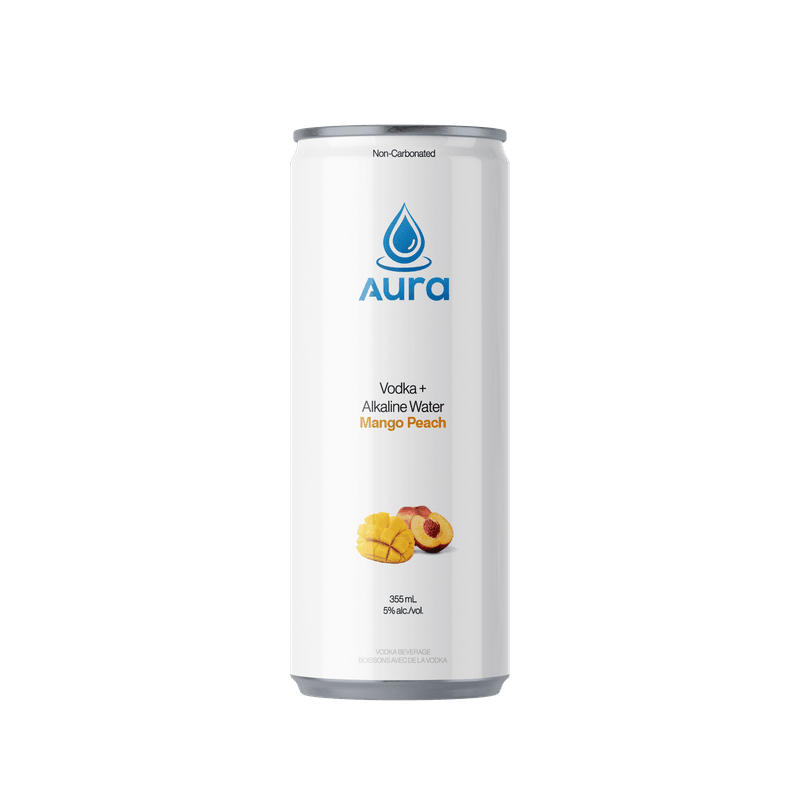
Aura is a still canned vodka water: premium distilled vodka, alkaline water (pH 8.5+) and natural flavour, with zero carbonation. It has no added sugar, no artificial sweeteners and no preservatives, and it is gluten-free. Many hard seltzers are fizzy; Aura is the still alternative, and our core promise is simple: no bubbles means no bloating. That is a comfort and taste choice, not a health claim. The alcohol in an Aura can is the same alcohol as in any other drink, and nothing in the research above suggests one beverage format is safer or less intoxicating than another. Read more about why Aura is made the way it is, or browse our vodka water cocktails in Cucumber Lime, Coconut Pineapple and Mango Peach (355 mL cans, by the case of 24).
Bottom line
The evidence from Scotland suggests minimum unit pricing modestly reduced sales and was associated with fewer deaths from alcohol, mostly among heavier drinkers and in deprived areas. The weaker points are that hospital admissions did not fall significantly, dependent drinkers saw little change, and the studies are observational. Canada's own research, from BC and Saskatchewan, points the same way, and the national scorecard shows provinces could do more.
Ready to try Aura? Ordering directly from us delivers to Ontario addresses only. In British Columbia or Alberta, use our where to buy page and your provincial channels: BC Liquor Stores and licensed private retailers in BC, or AGLC-licensed private retailers in Alberta. Please enjoy responsibly, and only if you are of legal drinking age in your province.
This article summarises published research for general interest and is not medical advice.
Sources
- Wyper GMA, Mackay DF, Fraser C, Lewsey J, Robinson M, Beeston C, Giles L. Evaluating the impact of alcohol minimum unit pricing on deaths and hospitalisations in Scotland: a controlled interrupted time series study. The Lancet. 2023;401:1361–1370. doi:10.1016/S0140-6736(23)00497-X. PMID 36963415. Link
- O'Donnell A, Anderson P, Jané-Llopis E, Manthey J, Kaner E, Rehm J. Immediate impact of minimum unit pricing on alcohol purchases in Scotland: controlled interrupted time series analysis for 2015-18. BMJ. 2019;366:l5274. doi:10.1136/bmj.l5274. PMID 31554617. Link
- Anderson P, O'Donnell A, Kaner E, Llopis EJ, Manthey J, Rehm J. Impact of minimum unit pricing on alcohol purchases in Scotland and Wales: controlled interrupted time series analyses. The Lancet Public Health. 2021;6:e557–e565. doi:10.1016/S2468-2667(21)00052-9. PMID 34058125. Link
- Maharaj T, Angus C, Fitzgerald N, Allen K, Stewart S, MacHale S, Ryan JD. Impact of minimum unit pricing on alcohol-related hospital outcomes: systematic review. BMJ Open. 2023;13:e065220. doi:10.1136/bmjopen-2022-065220. PMID 36737089. Link
- Public Health Scotland. Evaluating the impact of Minimum Unit Pricing for alcohol in Scotland: final report (news release, June 27, 2023). Link
- Scottish Government. Minimum unit pricing (policy page). Link
- Stockwell T, Auld MC, Zhao J, Martin G. Does minimum pricing reduce alcohol consumption? The experience of a Canadian province. Addiction. 2012;107:912–920. doi:10.1111/j.1360-0443.2011.03763.x. PMID 22168350. Link
- Stockwell T, Zhao J, Giesbrecht N, Macdonald S, Thomas G, Wettlaufer A. The raising of minimum alcohol prices in Saskatchewan, Canada: impacts on consumption and implications for public health. American Journal of Public Health. 2012;102(12):e103–e110. doi:10.2105/AJPH.2012.301094. PMID 23078488. Link
- Priore I, Vishnevsky N, Farkouh EK, et al. Provincial and territorial results and recommendations from the Canadian Alcohol Policy Evaluation project: Room for improvement. Canadian Journal of Public Health. 2026;117:113–124. doi:10.17269/s41997-025-01061-1. PMID 40506630. Link