If you're trying to drink less, the fridge at your local store can be confusing. One can says "0.0%", another says "non-alcoholic" but lists 0.5%, and a third says "low alcohol" without saying how low. This guide to non alcoholic drinks Canada answers three questions: what the 0.5% ABV figure actually means under Canadian rules, whether switching to no- and low-alcohol options really cuts how much people drink overall, and how to read the number on a can in about ten seconds.
Non alcoholic drinks Canada: what the labels legally mean
Many shoppers assume 0.5% ABV is Canada's legal line for "non-alcoholic". It isn't. Federal food labelling sets several different thresholds, and 0.5% is only one of them. According to the Canadian Food Inspection Agency's labelling requirements for alcoholic beverages (last modified March 2026):
- Under 0.05%: "the term 'non-alcoholic' or 'alcohol-free' may be used to describe a product whose alcohol level has been reduced to a level less than 0.05%."
- More than 0.5%: beverages "are usually exempt from carrying a Nutrition Facts table". That makes 0.5% a labelling line. It is not a definition of "non-alcoholic".
- Under 1.1%: "Low alcohol" is an acceptable claim, and "dealcoholized" means the alcohol content has been reduced to less than 1.1%.
- 1.1% and up: "All alcoholic beverages containing 1.1% or more alcohol by volume must declare the percentage by volume."
So what does 0.5% ABV mean?
If you're wondering what 0.5% ABV means in practice, the short answer is this: half of one percent of the liquid is pure alcohol. The industry often uses 0.5% as shorthand for non-alcoholic beer and wine, but under the CFIA wording above, the words "non-alcoholic" and "alcohol-free" go with products reduced below 0.05%. That's ten times lower. A can that says both "0.5%" and "non-alcoholic" deserves a closer look at the fine print.
Sales rules are a separate matter. Health Canada notes on its page about ethanol in non-alcoholic fermented beverages that "provinces and territories oversee control, distribution and sale of alcoholic beverages in their own jurisdictions" and "may have added requirements." Whether a low-alcohol product sits on a grocery shelf or behind a liquor counter depends on where you live, so check your provincial liquor authority. The same page is a useful reminder that fermented drinks such as kombucha "are not made to be alcoholic" but can still contain some ethanol.
How to read ABV claims on a can
You can read any can the same way. Here's the checklist:
- Find the percentage, not the adjective. "Light", "low" and "lower alcohol" are relative terms. The number is what counts. The CFIA's "light" thresholds vary by category (for example, 4% or less for cider and 9% or less for wine), so a "light" drink can still hold a meaningful amount of alcohol.
- Multiply by the can size. Millilitres × ABV ÷ 100 = millilitres of pure alcohol.
- Convert to standard drinks. Health Canada's low-risk drinking page states: "In Canada, a standard drink is 17.05 millilitres or 13.45 grams of pure alcohol." Divide your result by 17.05.
- Treat "0.0%" and "under 0.05%" as essentially alcohol-free. Treat 0.5% as very low but not zero. That matters if you're pregnant, in recovery, taking certain medications, or driving under a zero-tolerance rule. When in doubt, ask a health professional.
Worked examples: a 355 mL can at 0.5% has about 1.8 mL of alcohol, roughly 0.1 of a standard drink. A 355 mL can at 5% has about 17.75 mL, slightly more than one standard drink. Health Canada lists a 341 mL beer at 5% as one standard drink. The same maths applies to low alcohol canned drinks, spirit-based coolers and vodka waters, including our vodka water cocktails. The number on the can tells you what you're drinking.
Why count? The CCSA's Canada's Guidance on Alcohol and Health (2023) describes a continuum: 2 standard drinks or less per week means you're "likely to avoid alcohol-related consequences". At 3–6 per week, the risk of several types of cancer increases. At 7 or more, the risk of heart disease or stroke "increases significantly". It also notes that more than 2 standard drinks per occasion is associated with an increased risk of harms, and it advises: "Count your standard drinks."
Do alcohol free alternatives actually reduce total drinking?
This is the question that matters most, and the honest answer is "sometimes, based on limited evidence."
Evidence that substitution happens
The strongest consumer-level data comes from Spain. Anderson and Kokole analysed household purchase records in Adicciones (2024). Among 1,791 households (9.1% of the panel) that newly bought one of eleven branded zero-alcohol beers, purchases of all grams of alcohol fell by 5.5% after their first zero-alcohol purchase. The drop came largely from swapping each litre of higher-strength beer (above 3.5% ABV) for 0.75 litres of the same brand's 0.0% beer. In a smaller group of 337 households that had never bought that brand's regular beer, alcohol purchases fell by 14%, mostly because they bought less wine and spirits.
A 2021 scoping review by the same group in Nutrients screened publications from 2010 to early 2021 and included seventy. Two publications, both from Great Britain, suggested that no- and low-alcohol beer sales "replaced rather than added to" sales of higher-strength beers.
People also say they use these drinks deliberately. In a British population survey published in BMJ Public Health (Buss et al., 2025), the share of people at increased risk from drinking who used alcohol-free or low-alcohol drinks in attempts to cut down rose from 35.0% in October 2020 to 43.9% in August 2024.
Caveats: what the research does not show
- Purchases are not consumption. The Spanish studies track what households bought, not what individuals drank. They are observational, so they can't prove the switch caused the reduction.
- The overall picture is thin. The 2021 scoping review concluded that the evidence for a health benefit "is very limited" and "could be considered inadequate to inform policy." It also found that three papers reported consumer confusion about no- and low-alcohol labelling.
- Clear substitution is rare at the population level. A British forecasting study in Addiction (Wilson et al., 2025) projected that no/lo products would make up only about 2.3% of off-trade and 1.0% of on-trade alcohol sales volume by December 2025. It also estimated that just 1.8% of households were both increasing no/lo purchases and decreasing alcoholic purchases.
- Who drinks them matters. In a survey of 7,691 British adults in Drug and Alcohol Review (Perman-Howe et al., 2024), 31.3% had ever tried no/lo drinks and 9.8% drank them weekly. Use was more common among increasing-risk drinkers (adjusted OR 3.96) and more advantaged social groups. The authors warn this pattern may sustain or widen health inequalities.
- None of this is Canadian data. The research comes from Spain and Great Britain. Canadian prices, taxes and retail rules differ, so the results may not transfer directly.
- Using these drinks is no guarantee of drinking less. Using a 0.0% drink to replace a drink is different from having one alongside your usual drinks.
A practical plan you can use this week
- Decide your weekly number first, using the CCSA continuum, then plan which occasions will be alcohol-free.
- Alternate: follow each alcoholic drink with a 0.0% drink or water. The research that supports substitution describes swapping drinks, not adding them.
- Read every can using the millilitres × ABV ÷ 17.05 formula, and keep a running tally.
- Choose drinks with a clearly stated percentage over vague "light" or "low" claims.
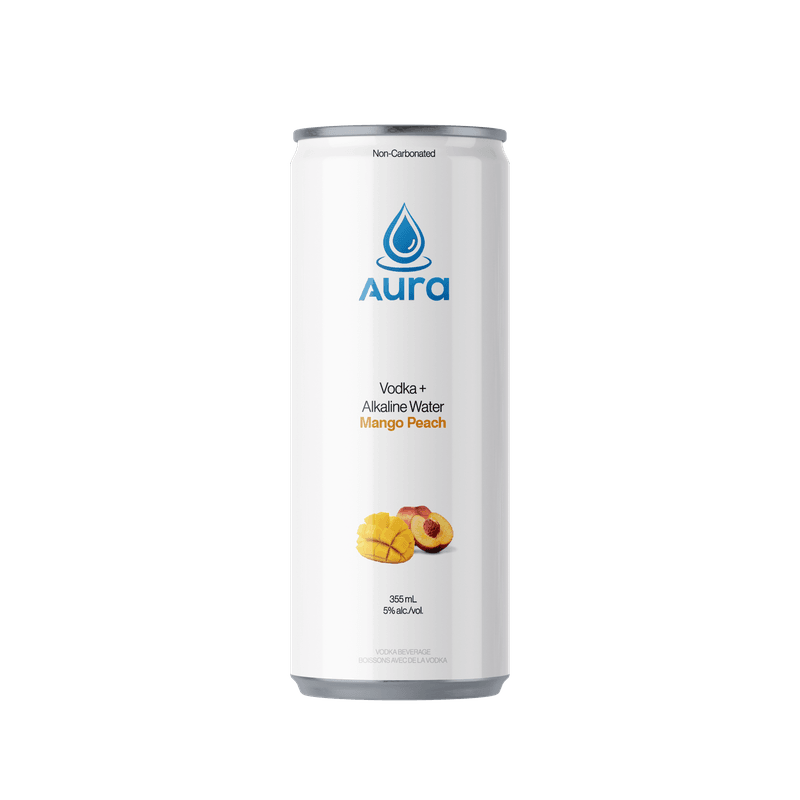
When you do choose to drink alcohol, choose deliberately. Aura is a vodka water, not a non-alcoholic drink. It's a still, non-carbonated blend of premium vodka, alkaline water and natural flavour, with no added sugar. The alcohol in it counts toward your total just like any other drink, and nothing about it makes that alcohol safer. Learn more about why Aura is made the way it is.
Ready to plan your next occasion? Aura comes in Cucumber Lime, Coconut Pineapple and Mango Peach. It's available across British Columbia, Alberta and Ontario, and our direct ordering delivers to Ontario addresses only. In Alberta, look for AGLC-licensed private retailers. In BC, try BC Liquor Stores and licensed private retailers. Everywhere, start with where to buy. Please enjoy responsibly, and only if you are of legal drinking age in your province.
This article summarises published research and government guidance for general interest. It is not medical advice.
Sources
- Canadian Food Inspection Agency. "Labelling requirements for alcoholic beverages." Government of Canada, modified 2026-03-24. inspection.canada.ca
- Health Canada. "Ethanol in non-alcoholic fermented beverages." Government of Canada, 2020. canada.ca
- Health Canada. "Low-risk alcohol drinking guidelines." Government of Canada, modified 2025-03-25. canada.ca
- Canadian Centre on Substance Use and Addiction. "Canada's Guidance on Alcohol and Health." CCSA, 2023. ccsa.ca
- Anderson P, Kokole D. "Substitution of higher-strength beers with zero-alcohol beers: Interrupted time series analyses of Spanish household purchase data, 2017-2022." Adicciones. 2024;36(3):299-316. doi:10.20882/adicciones.1866. PMID: 36975074. Link
- Anderson P, Kokole D, Llopis EJ. "Production, Consumption, and Potential Public Health Impact of Low- and No-Alcohol Products: Results of a Scoping Review." Nutrients. 2021;13:3153. doi:10.3390/nu13093153. PMID: 34579030. Link
- Buss V, Kale D, Oldham M, Shahab L, Stevely A, Kersbergen I, Brown J. "Trends in use of alcohol-free or low alcohol drinks in attempts to reduce alcohol consumption in Great Britain, 2020-2024: a population-based study." BMJ Public Health. 2025;3(2):e002775. doi:10.1136/bmjph-2025-002775. PMID: 41001235. Link
- Wilson LB, Stevely AK, Kersbergen I, McGrane E, Moore EC, Pryce RE, Brown J, Holmes J. "Current and future trends in the consumption, sale and purchasing of alcohol-free and low-alcohol products in Great Britain, 2014 to 2023." Addiction. 2025;120(8):1655-1665. doi:10.1111/add.70041. PMID: 40116140. Link
- Perman-Howe PR, Holmes J, Brown J, Kersbergen I. "Characteristics of consumers of alcohol-free and low-alcohol drinks in Great Britain: A cross-sectional study." Drug and Alcohol Review. 2024;43(7):1686-1697. doi:10.1111/dar.13930. PMID: 39169566. Link