You meant to have two drinks at the team social. Somehow you're on your fourth, and you can't say when it happened. That's peer pressure drinking, though usually nobody is pressuring anyone. The research suggests a quieter cause: we copy the drinking of the people around us, sip by sip, mostly without noticing. Below is what the experiments found, why people drink more in groups, where the evidence runs out, and a pacing plan you can use at your next party or work event in Canada.
Peer pressure drinking is mostly mimicry, not arm-twisting
Most social drinking research uses a simple setup. A volunteer sits in a "bar lab," a room built to look like a real bar, with someone they think is another participant. That person is actually a confederate working for the researchers and has been told to drink heavily, lightly or not at all. The researchers then record how much the real participant drinks.
This approach dates back decades, to Caudill and Marlatt's 1975 modelling study in the Journal of Consulting and Clinical Psychology. Later work has kept finding the same pattern:
- The effect holds in real bars, not just labs. In two field experiments run in actual bars, Larsen and colleagues found that participants drank more when their drinking partner ordered alcohol than when the partner ordered non-alcoholic drinks. Study 1 had 79 participants and Study 2 had 60. Men and women imitated to a similar degree, and so did same-sex and mixed-sex pairs (Larsen et al., 2012).
- It happens with friends, and people don't notice it. Dallas and colleagues brought 46 pairs of real friends and partners, aged 19 to 60, into a bar lab. One person in each pair was secretly told to drink only alcohol or only soft drinks. The partners of alcohol drinkers chose significantly more alcoholic drinks, a large effect (χ²(2) = 15.8, p < 0.001, Cramér's V = 0.59). About 81% of those influenced said their partner hadn't affected their drinking (Dallas et al., 2014).
- It works at the level of single sips. When researchers coded each sip during a 30-minute conversation, participants tended to take a sip soon after their partner did. That was true even when the drinks weren't alcoholic, but imitation was more likely when both people were drinking alcohol (Larsen et al., 2010).
This sip-level drinking mimicry explains why groups speed you up. A table of six people drinks at six different speeds, and if you take your cue from each of them, you'll be lifting your glass more often than you would on your own.
Why people drink more in groups: the "fitting in" motive
Why would we copy someone's drinking? One answer is ingratiation, meaning the wish to be liked. Robinson and colleagues at the University of Liverpool tested this in two experiments (Robinson et al., 2016). In Study 1, 80 participants drank with a heavy-drinking or light-drinking confederate. Some were told they would later be judged by that person, and some were told they wouldn't. Among those expecting to be judged, people paired with the heavy drinker drank about three times as much as those paired with the light drinker, by the study's measure (means of 74.7 vs. 23.4, p < .001). Among those who didn't expect judgement, the gap was smaller and not statistically significant (55.4 vs. 42.8). In Study 2 (N = 149), copying was strongest when participants weren't sure the confederate had accepted them.
That fits work events closely. You're with colleagues or a new manager, you're keen to make a good impression, and you may not know where you stand with them. Those are the conditions in which the research found the strongest copying.
Personality may also matter. At Dalhousie University in Halifax, Nogueira-Arjona, Stewart and colleagues followed 149 college students and their same-sex "drinking buddies" for 30 days. On days they drank together, each student's drinking tracked their buddy's, and the match was closer for more extraverted students (Nogueira-Arjona et al., 2019). An older barroom study of 202 heavy social drinkers found that people with a high need for social approval were especially likely to follow a model's drinking. Copying worked in both directions: drinking also fell when the model drank lightly (Caudill & Kong, 2001).
How to pace yourself at parties and work events
The research shows that copying is automatic and that the cue is whatever the person beside you is drinking. Rather than counting on willpower, change the cues.
Before you go
- Set a number in standard drinks. Canada's Guidance on Alcohol and Health says that if you're going to drink, you shouldn't exceed 2 drinks on any day. It also describes 1 to 2 standard drinks per week as low risk. A standard drink is 341 mL of 5% beer, cooler, cider or ready-to-drink, 142 mL of 12% wine, or 43 mL of 40% spirits. Read the alcohol content on any can, because the number of standard drinks depends on it.
- Eat first, and plan when you'll leave before you arrive.
At the event
- Pick a slow person to copy. Copying can lower drinking as well as raise it (Caudill & Kong, 2001). Spend time near the people drinking slowly, or the ones drinking water.
- Use an "every other" rule. Switch to water or a non-alcoholic drink after each alcoholic one. You'll still have a glass in your hand and still be sipping along with everyone, but there will be less alcohol in it.
- Don't join group rounds. Rounds tie your pace to whoever drinks fastest. Buying your own drinks lets you go at your own speed.
- Put the drink down between sips. The sip study suggests imitation happens in the moment. If the drink is on the table, you're less likely to lift it each time someone else lifts theirs.
- Keep a short line ready. "I'm pacing myself tonight" works fine. In the ingratiation study, copying was weaker when people felt accepted, and most colleagues care far more that you're there than about what's in your glass.
The caveats: what this research does and doesn't show
- Small samples. Most experiments here had somewhere between 46 pairs and about 150 people. That's normal for lab work, but it makes the size of each effect less precise.
- Narrow populations. Many studies used young adults or university students in the Netherlands or the UK. One stress study tested only young men. In that study (N = 106), participants drank substantially more alongside an alcohol-drinking confederate whether or not they had been stressed (Larsen et al., 2013). So the effect was robust, but only within that group. We found little experimental work on mid-career professionals at office parties specifically.
- Short, staged sessions. Bar-lab sessions run tens of minutes with one partner, not a whole evening with a crowd. The claim that groups multiply the effect is our inference from the dyad and sip studies. It hasn't been tested directly in these papers.
- Correlation in the real-world data. The Dalhousie diary study shows that friends drink similar amounts. Because it relies on self-reports, it can't prove that one friend caused the other's drinking, and people who drink alike may simply spend time together.
- Volume is not health. These studies measure how much people drink. None of them tests whether a particular drink makes you less intoxicated or less harmed. Pacing spreads alcohol over time but doesn't change the total.
Where Aura fits, honestly
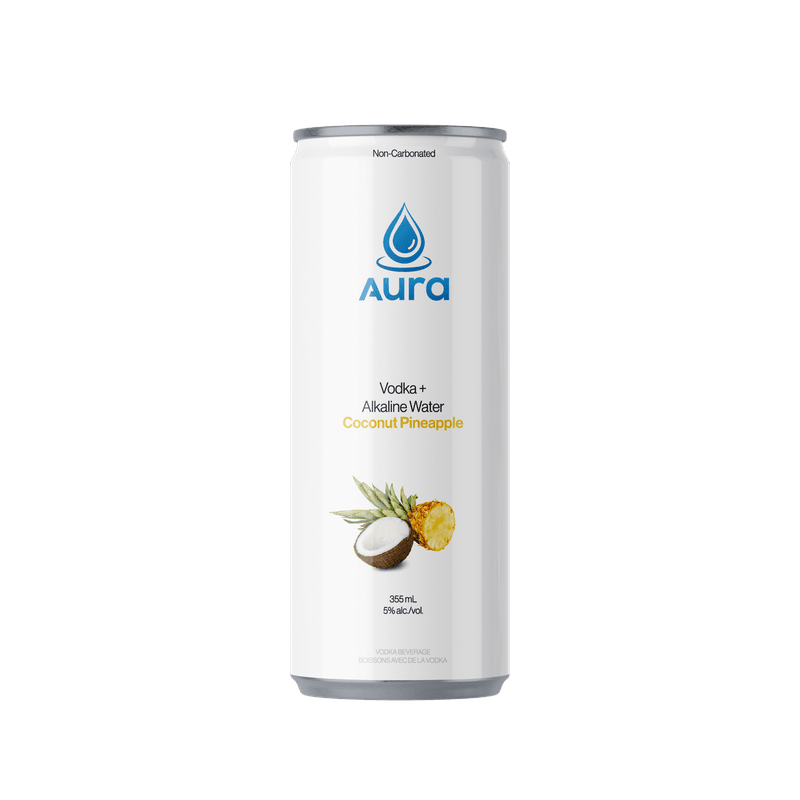
Our vodka water cocktails are still, with zero carbonation. They're made from premium vodka, alkaline water and natural flavour, with no added sugar, no artificial sweeteners and no preservatives, and they're gluten-free. Some people find a still drink easier to sip slowly than a fizzy seltzer or vodka soda, and the absence of bubbles means no bloating. That's a comfort preference, not a health claim. A can of Aura contains real alcohol, just like any other drink with the same alcohol content. Pacing, water and your own limit are what matter. Read more about why Aura is made this way.
Planning your next get-together? Pick up Cucumber Lime, Coconut Pineapple or Mango Peach in 24-can cases. In British Columbia and Alberta, find us through where to buy at BC Liquor Stores, licensed private retailers and AGLC-licensed retailers. Ontario readers can also order from us directly for delivery to an Ontario address. Set your number, eat first, and keep a glass of water close. Please enjoy responsibly, and only if you are of legal drinking age in your province.
This article summarises published research for general interest and is not medical advice.
Sources
- Larsen H, Overbeek G, Granic I, Engels RCME. The strong effect of other people's drinking: two experimental observational studies in a real bar. American Journal on Addictions. 2012;21(2):168-175. doi:10.1111/j.1521-0391.2011.00200.x. PMID 22332861. PubMed
- Dallas R, Field M, Jones A, Christiansen P, Rose A, Robinson E. Influenced but unaware: social influence on alcohol drinking among social acquaintances. Alcoholism: Clinical and Experimental Research. 2014;38(5):1448-1453. doi:10.1111/acer.12375. PMID 24588229. PubMed
- Larsen H, Engels RCME, Souren PM, Granic I, Overbeek G. Peer influence in a micro-perspective: imitation of alcoholic and non-alcoholic beverages. Addictive Behaviors. 2010;35(1):49-52. doi:10.1016/j.addbeh.2009.08.002. PMID 19733978. PubMed
- Robinson E, Oldham M, Sharps M, Cunliffe A, Scott J, Clark E, Piercy K, Field M. Social imitation of alcohol consumption and ingratiation motives in young adults. Psychology of Addictive Behaviors. 2016;30(4):442-449. doi:10.1037/adb0000150. PMID 27322802. PubMed
- Nogueira-Arjona R, Shannon T, Kehayes IL, Sherry SB, Keough MT, Stewart SH. Drinking to keep pace: a study of the moderating influence of extraversion on alcohol consumption similarity in drinking buddy dyads. Addictive Behaviors. 2019;92:69-75. doi:10.1016/j.addbeh.2018.12.023. PMID 30597333. PubMed
- Caudill BD, Kong FH. Social approval and facilitation in predicting modeling effects in alcohol consumption. Journal of Substance Abuse. 2001;13(4):425-441. doi:10.1016/s0899-3289(01)00099-2. PMID 11775074. PubMed
- Larsen H, Engels RCME, Granic I, Huizink AC. Does stress increase imitation of drinking behavior? An experimental study in a (semi-)naturalistic context. Alcoholism: Clinical and Experimental Research. 2013;37(3):477-483. doi:10.1111/j.1530-0277.2012.01942.x. PMID 23025584. PubMed
- Caudill BD, Marlatt GA. Modeling influences in social drinking: an experimental analogue. Journal of Consulting and Clinical Psychology. 1975;43(3):405-415. doi:10.1037/h0076689. PMID 1159130. PubMed
- Canadian Centre on Substance Use and Addiction. Canada's Guidance on Alcohol and Health (public summary poster). CCSA, commissioned by Health Canada; 2023. ccsa.ca