You are standing in front of forty cans in a Canadian liquor store, and most of them shout the same three words: crisp, clean, light. But "premium" is not a regulated term — nothing legally stops a bottom-shelf product from printing it. So how do you separate premium ready to drink cocktails from a mass-market hard seltzer in nicer packaging? Judge the can on six things you can verify while standing there: base spirit, water, sweetener load, carbonation, honest ABV and can size.
First, the label tells you less than you assume
Most shoppers assume an ingredient list is mandatory. It is not. The Canadian Food Inspection Agency's labelling requirements for alcoholic beverages exempt standardized beverages — beer, wine, rum and others with a prescribed compositional standard — from showing an ingredient list, and Nutrition Facts tables are generally not required above 0.5% alcohol.
The one lever worth knowing: that Nutrition Facts exemption is lost the moment a product makes a nutrient content claim. Advertise "only 1 g of sugar" or "100 calories" and the can must carry a Nutrition Facts table. A brand that brags about sugar has to show its numbers; one that says nothing may stay silent.
Two things are always mandatory: any beverage at 1.1% alcohol by volume or more must declare its strength on the principal display panel ("X % alc./vol.") in English and French, and allergen, gluten and added-sulphite declarations apply to every alcoholic beverage. ABV and gluten status are always verifiable; sugar and ingredients often are not.
A six-point test for premium ready to drink cocktails
1. The base spirit: named, or hidden?
A premium RTD names its alcohol — vodka, tequila, gin — not just the flavour. Many mass seltzers use a cheaper fermented sugar or malt base, which surfaces as a vague common name rather than a spirit. CFIA rules require an unstandardized beverage to carry a common name that accurately describes it, so read that line. If "vodka" appears nowhere, you are not holding a canned vodka cocktail.
2. The water, because it is most of the can
At 5% ABV, roughly 95% of the can is water and flavour — the ingredient that gets the least marketing attention. Premium producers name the source and treatment. Aura is built on alkaline water at pH 8.5+ because of how it carries flavour; we make no health claim for that water, and be sceptical of any brand that does.
3. Sweetener load, and the claim trap
Ask in order: added sugar, artificial sweeteners, or neither? If the can makes a sugar or calorie claim, read the Nutrition Facts table it is now obliged to print. If it makes none, check the brand's website and treat silence as information. Aura uses no added sugar, no artificial sweeteners and no preservatives, and is gluten-free — but verify that for every can, ours included.
4. Carbonation: a formulation choice, not a health feature
Nearly every hard seltzer is carbonated. A still RTD is a deliberate and much rarer decision, about texture and preference: plenty of drinkers simply do not want bubbles, especially in the heat or with food. Aura is a still canned vodka cocktail with zero carbonation — the whole contrast with a seltzer. What carbonation is not is a health variable; see below.
5. Honest ABV: do the arithmetic yourself
A Canadian standard drink is 17.05 mL, or 13.45 g, of pure ethanol, per the Canadian Institute for Substance Use Research at the University of Victoria. Multiply volume by ABV, divide by 17.05:
- 355 mL at 5% = 17.75 mL ethanol ≈ 1.04 standard drinks
- 355 mL at 7% = 24.85 mL ≈ 1.46 standard drinks
- 473 mL at 7% = 33.1 mL ≈ 1.94 standard drinks — nearly two, in one can
Canada's Guidance on Alcohol and Health (Canadian Centre on Substance Use and Addiction, 2023) states that more than two standard drinks on one occasion is associated with increased risk of harms, and places 3–6 drinks a week in the band where cancer risk rises. One tall 7% can is close to a whole occasion by that measure.
6. Can size and format
Format is serving control disguised as packaging. A 355 mL can at 5% is about one standard drink, so counting cans and counting drinks become the same act. A 473 mL tall can at 7% breaks that. Aura ships 355 mL cans by the case of 24.
What Canadians are actually buying
If you are shopping for ready to drink cocktails Canada-wide, the market data explains the crowded shelf. Statistics Canada reported on 5 March 2026 that in 2024/2025 ciders and coolers were the only alcohol category to grow, up 4.8% to $2.4 billion, while beer, wine and spirits all fell. Per-capita consumption averaged 8.0 standard drinks a week, down from 9.7 a decade ago. Canadians are drinking less and choosing cans more, which is why "premium" is applied so freely.
What the research supports, and what it does not
On carbonation, the most-cited controlled study is small. Roberts and Robinson (2007), in the Journal of Forensic and Legal Medicine, had 21 subjects (12 male, 9 female) drink, after an overnight fast, neat vodka at 37.5% ABV, vodka diluted with still water to 18.75%, and vodka diluted with carbonated water to 18.75%. Fourteen of 21 absorbed alcohol faster with the carbonated mixer; seven showed no change or a decrease (p = 0.006). More consistent, and cutting against a bubbles-are-the-villain story: 20 of 21 absorbed the diluted drink faster than the neat spirit (p < 0.001). Dilution — the defining feature of every RTD — mattered more than carbonation.
The limits matter: 21 fasted people drinking in five minutes under breathalyser measurement. It says nothing about bloating, hangover or health, and a still drink contains exactly the same alcohol as a carbonated one at equal ABV and volume. No formulation choice makes a drink healthier or less intoxicating.
The marketing also shifts perception more than it should. Forbes, Vanderlee and Hobin (2025), in Alcohol and Alcoholism, ran an online randomized experiment with 4,689 Canadian drinkers aged 18–64 using hard seltzer containers. Calorie and sugar claims — the most prevalent nutrient claims on RTDs in Canada — made products more appealing, and participants trying to lose weight had higher odds of perceiving reduced health risk from a claim-only container (adjusted OR 1.31, 95% CI 1.14–1.50). The design was cross-sectional, non-probability sampled and online rather than in-store. Treat it as a caution about your own reasoning: "no sugar" is a formulation fact, not a health fact.
Labels alone also do less than you would hope. Schoueri-Mychasiw and colleagues (2020) added standard-drink, guideline and cancer-warning labels in real Yukon liquor stores (2,049 participants). Label recall rose sharply (adjusted OR 5.69, 95% CI 3.02–10.71), but effects on estimating standard drinks accurately (AOR 1.06, 95% CI 0.59–1.93) and on drinking within guidelines (AOR 1.04, 95% CI 0.75–1.46) were negligible — both intervals cross 1. The study was cut short by industry interference and used generic labels.
Where Aura lands
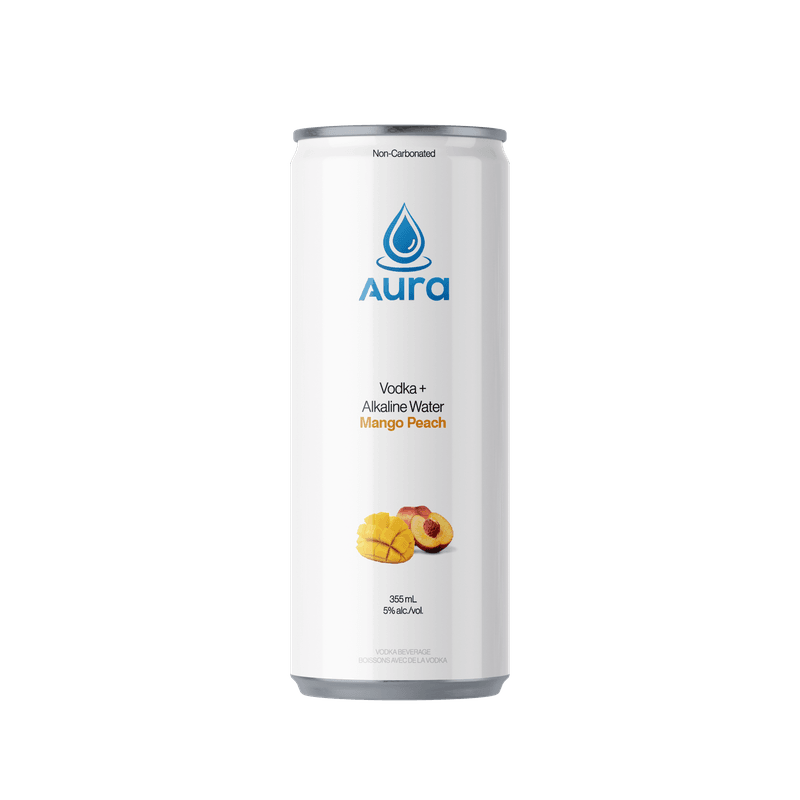
Aura is a still canned vodka water cocktail: premium distilled vodka, alkaline water at pH 8.5+, natural flavour, no added sugar, no artificial sweeteners, no preservatives, gluten-free, in 355 mL cans by the case of 24 — Cucumber Lime, Coconut Pineapple, Mango Peach. Run it through the six points and every answer is visible. Compare the flavours in our vodka water cocktails, or read the reasoning in why Aura.
Ready to try it? Aura is available across British Columbia, Alberta and Ontario. Our direct and wholesale ordering delivers to Ontario addresses only; in Alberta or British Columbia, use where to buy for AGLC-licensed private retailers, BC Liquor Stores and licensed private retailers near you.
Please enjoy responsibly, and only if you are of legal drinking age in your province. This article summarises published research for general interest and is not medical advice.
Sources
- Roberts C, Robinson SP. "Alcohol concentration and carbonation of drinks: the effect on blood alcohol levels." Journal of Forensic and Legal Medicine, 2007;14(7):398–405. doi:10.1016/j.jflm.2006.12.010. PMID 17720590. pubmed.ncbi.nlm.nih.gov/17720590
- Forbes SM, Vanderlee L, Hobin E. "Testing the influence of nutrient content claims and a health warning label on consumer perceptions of ready-to-drink alcoholic beverages: an online randomized experiment." Alcohol and Alcoholism, 2025;60(5):agaf051. doi:10.1093/alcalc/agaf051. PMID 40794902. pmc.ncbi.nlm.nih.gov/articles/PMC12342902
- Schoueri-Mychasiw N, Weerasinghe A, Stockwell T, et al. "Use as directed: do standard drink labels on alcohol containers help consumers drink (ir)responsibly? Real-world evidence from a quasi-experimental study in Yukon, Canada." Drug and Alcohol Review, 2020; vol. 40, no. 2, pp. 247–257. doi:10.1111/dar.13165. PMID 33078447. pmc.ncbi.nlm.nih.gov/articles/PMC8550267
- Statistics Canada. "Control and sale of alcoholic beverages and cannabis, April 1, 2024 to March 31, 2025." The Daily, 5 March 2026. www150.statcan.gc.ca
- Canadian Centre on Substance Use and Addiction. Canada's Guidance on Alcohol and Health, 2023. ccsa.ca
- Canadian Food Inspection Agency. "Alcoholic beverages: industry labelling requirements," Government of Canada. inspection.canada.ca
- Canadian Institute for Substance Use Research, University of Victoria. "Standard drinks," Know Alcohol. knowalcohol.ca/standard-drinks