
You have seen the claim: canned drinks are the only thing growing in beverage alcohol. What you have probably not seen is the arithmetic behind it. And "RTDs are booming" is not a usable fact if you are deciding what to put in the cooler this weekend, which aisle to search first, or how much shelf space to give a category. So here is the published ready to drink market data Canada government statisticians and provincial liquor authorities actually released — the figures, the exact periods they cover, and the parts that cut against the story.
Short answer: the category is growing, but far more slowly than the marketing suggests, and a meaningful share of the growth is regulatory rather than cultural.
The ready to drink market data Canada published in 2026
The authoritative national number comes from Statistics Canada's Control and sale of alcoholic beverages and cannabis release for April 1, 2024 to March 31, 2025, published 5 March 2026. For the fiscal year ending 31 March 2025:
- Total alcohol sales were $25.8 billion, down 1.6%, despite prices rising 1.6% over the same period.
- Volume fell 3.0% to 2,898 million litres — the fourth consecutive annual decline.
- Beer sales fell 1.6% to $9.1 billion. Wine fell 2.2% to $7.7 billion. Spirits fell 3.2% to $6.7 billion.
- Ciders, coolers and other refreshment beverages rose 4.8% to $2.4 billion — the only category to grow, for the second consecutive year.
- That category gained 0.6 percentage points of market share, to 9.3%. It is still the smallest of the four.
Two figures put the shift in perspective. Canadians of legal drinking age bought the equivalent of 8.0 standard drinks per week in 2024/2025, down from 8.7 the year before and 9.7 a decade ago. Meanwhile the cider-and-cooler category came to roughly 0.8 standard drinks per week per person of legal drinking age, on volume growth of 2.2% to 385 million litres. So the honest summary of Canadian beverage alcohol trends is not "everyone switched to cans." It is "people are drinking less overall, and the small slice that is cans held up while everything else fell."
RTD growth statistics by province: what grew, what shrank
Ontario
The LCBO's FY2024-25 annual report is the most detailed RTD disclosure any Canadian authority publishes. In FY2025, LCBO RTD sales grew 9.3%, or $69.6 million, to $814.7 million, and RTD share rose 108 basis points to 11.1% of LCBO merchandising alcoholic sales. The striking line is elsewhere in the report: the total Ontario spirits market including RTDs grew 2.5% to 191 million litres, and RTDs made up more than 67% of total Ontario spirits volume and "accounted for all the growth," while non-RTD spirits volume fell by almost 6 million litres. Cider went the other way entirely — down 11.8% to 14.8 million litres.
That last pair matters. "Ciders and coolers" is one bucket in the national data, but inside it, cider shrank while spirit-based cans grew. Anyone quoting the 4.8% national figure as an RTD number is blending two categories moving in opposite directions.
British Columbia
The BC Liquor Distribution Branch's Liquor Market Review for fiscal 2025/26 Q4 reports wholesale net dollars by category. Comparing the January–March quarter year over year, refreshment beverages rose from $86.1 million to $89.0 million (+3.4%) while beer fell 2.0% and spirits fell 0.6%. Within that $89.0 million, spirit-based coolers were $76.0 million — about 85% of the whole refreshment category in BC.
Alberta
AGLC's Liquor Quick Facts for 2023-24 shows wholesale sales for the year ended 31 March 2024: refreshment beverages (coolers, ciders, kombucha and ready-to-drink) rose 6.3% to $313.0 million while beer fell 0.7%, spirits fell 0.7% and wine fell 2.1%. Refreshment was about 11.2% of Alberta wholesale dollars and 17.0% of volume — a higher volume share than dollar share, because these are lower-priced, lower-ABV drinks.
How much of this is regulation, not taste?
In Ontario, a large share of the RTD number is a rule change. The LCBO report documents the timeline: regulatory changes announced May 2024, licensed grocery stores permitted to sell RTDs and large packs from 18 July 2024, convenience stores from 5 September 2024, and all eligible grocery and big-box stores from 31 October 2024. Eligible beer, cider and RTD products are capped at 7.1% ABV or less. Grocery and convenience together added $473 million in sales and 649 basis points of channel share in one year, while LCBO home consumer sales fell $544 million.
So when a canned cocktail brand Canada-wide reports double-digit Ontario growth, part is genuine demand and part is thousands of new doors opening. Both are real; they are not the same thing.
What you can do with this today
- In Ontario, stop searching only the liquor store. Since late 2024, eligible grocery, big-box and convenience stores can carry RTDs at 7.1% ABV or under. Most canned vodka waters sit well below that ceiling, so they are legal for those shelves.
- Check the ABV before you assume availability. The 7.1% line is the single rule that determines whether a can can appear outside the LCBO in Ontario.
- Buy for the season, not the shelf. BC refreshment wholesale in the July–September quarter ($142.1 million) ran about 60% above the January–March quarter ($89.0 million). Selection peaks in summer; if you want a specific flavour in February, order ahead.
- Verify claims yourself. Statistics Canada Table 10-10-0010-01 is the national source; BCLDB publishes its Liquor Market Review quarterly; LCBO publishes annually. Any RTD growth statistics without one of these behind them are worth a second look.
- Know your channel. Aura ships to Ontario addresses only through our own direct and wholesale ordering. In Alberta, look to AGLC-licensed private retailers; in BC, BC Liquor Stores and licensed private retailers. Start at where to buy.
The caveats, honestly
- The categories are not clean. StatCan's "ciders, coolers and other refreshment beverages" mixes cider (falling 11.8% in Ontario) with spirit-based cans (rising). AGLC's bucket even includes kombucha. There is no single official Canadian "RTD" line item.
- The sources disagree on BC. StatCan reports BC cider and cooler sales down 2.0% in 2024/2025, while BCLDB wholesale data for the January–March 2026 quarter shows refreshment up 3.4%. Different periods, different measures — retail sales versus wholesale shipments. Neither is wrong; they answer different questions.
- Wholesale is not consumption. BCLDB and AGLC figures track what retailers bought, not what anyone drank.
- Growth from a small base looks bigger than it is. 9.3% share nationally means roughly nine cents of every alcohol dollar. Beer is still 35.1%.
- One year is not a trend. Two consecutive years of growth in a category during four consecutive years of total volume decline is suggestive, not conclusive.
What this data does not show
None of these sources say anything about health, safety or how any drink affects a body. Market data measures transactions. A still canned vodka water contains the same alcohol as an equivalent serving of anything else — a lower-sugar or non-carbonated format is a formulation and comfort choice, not a health benefit, and nothing here should be read as suggesting a can is safer, gentler or less intoxicating. Canada's Guidance on Alcohol and Health (CCSA, 2023) places risk on a continuum by standard drinks per week, and Health Canada counts a 341 mL cooler at 5% ABV as one standard drink regardless of format.
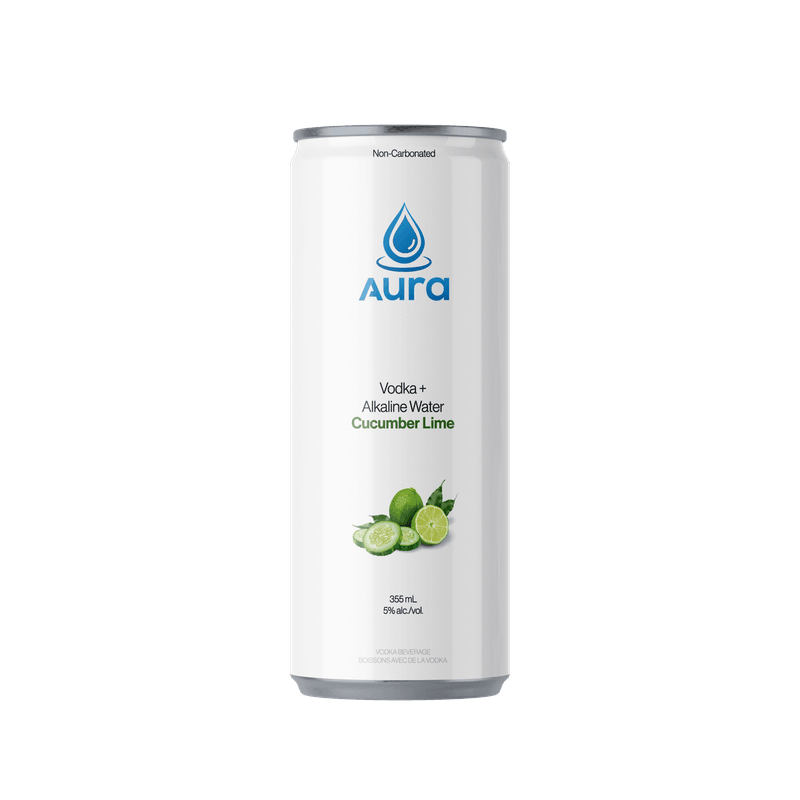
Aura sits in the growing slice of these numbers as a still vodka water: premium vodka, alkaline water at pH 8.5 or above, natural flavour, no carbonation, no added sugar, no artificial sweeteners, gluten-free. The contrast with a hard seltzer is spelled out in why Aura.
Ready to try the still side of the category the data keeps pointing at? Browse our vodka water cocktails — Cucumber Lime, Coconut Pineapple and Mango Peach in 355 mL cans, by the case of 24 — and use where to buy to find Aura across British Columbia, Alberta and Ontario. Please enjoy responsibly, and only if you are of legal drinking age in your province.
This article summarises published market, regulatory and public-health data for general interest. It is not medical advice.
Sources
- Statistics Canada. "Control and sale of alcoholic beverages and cannabis, April 1, 2024 to March 31, 2025." The Daily, catalogue no. 11-001-X, released 5 March 2026. Data from Table 10-10-0010-01. https://www150.statcan.gc.ca/n1/daily-quotidien/260305/dq260305b-eng.htm
- Liquor Control Board of Ontario. LCBO Annual Report FY2024-25. Toronto: LCBO, 2025. https://www.lcbo.com/content/dam/lcbo/Corporate Communications/LCBO Annual Report - FY2425 - EN.pdf
- BC Liquor Distribution Branch. Liquor Market Review, Fiscal 2025/26 Q4. March 2026. https://www.bcldb.com/sites/default/files/Liquor Market Review F25 26 Q4 March 2026.pdf
- Alberta Gaming, Liquor and Cannabis. Liquor Quick Facts 2023-24. AGLC, 2024. https://aglc.ca/sites/aglc.ca/files/2024-11/2023-24-Liquor-Quick-Facts.pdf
- Canadian Centre on Substance Use and Addiction. Canada's Guidance on Alcohol and Health. Ottawa: CCSA, 2023. https://www.ccsa.ca/canadas-guidance-alcohol-and-health