You had two or three drinks, went to bed at your usual time, and your watch handed you a bad grade in the morning: deep sleep down, restlessness up, resting heart rate well above baseline. Before you change anything, it is worth asking whether the device actually measured that. The short answer from sleep tracker accuracy research is: partly. Consumer wearables are very good at knowing you were asleep at all, mediocre at splitting that sleep into stages, and genuinely useful on the cardiac signals that alcohol moves most. Here is how to tell which number on your screen is evidence and which is a guess.
What sleep tracker accuracy research says about stage scoring
The most direct evidence comes from a 2025 polysomnography validation study in SLEEP Advances by Schyvens and colleagues, who put six commercial wrist-worn devices — Fitbit Charge 5, Fitbit Sense, Withings ScanWatch, Garmin Vivosmart 4, Whoop 4.0 and Apple Watch Series 8 — on 62 adults (52 male, 10 female; mean age 46.0 ± 12.6 years) for a night of in-lab polysomnography.
Two findings matter for anyone reading a morning summary:
- Sleep detection is strong. Sensitivity — correctly flagging a sleeping epoch as sleep — ranged from 91.68% to 96.27% across the six devices.
- Wake detection is weak. Specificity ranged from 29.39% to 52.15%. Lying still and awake looks a lot like sleep to a wrist sensor.
Stage-by-stage agreement was middling. Cohen's kappa against polysomnography ran from 0.53 for the Apple Watch Series 8 and 0.42 for the Fitbit Sense down to 0.22 for the Withings ScanWatch and 0.21 for the Garmin Vivosmart 4. The best deep-sleep performance in the study was Whoop 4.0, correctly identifying 69.63% of N3 epochs; the Apple Watch led on REM at 68.57%. Every device except the two Fitbits significantly overestimated total sleep time, by 6.31 to 39.87 minutes.
Practical translation: "you slept" is trustworthy. "You got 41 minutes of deep sleep" is an estimate with a wide error bar, and comparing it against a friend's different brand is close to meaningless.
Wearables alcohol sleep data: the signal that holds up
Where wearables get much more convincing is the cardiovascular side. A 2026 PLOS Digital Health analysis by Grosicki and colleagues linked self-reported drinking to Whoop 4.0 data from 20,968 adults across 5,109,185 person-days, of which 1,529,080 involved alcohol. Within the same person, one additional drink was associated with a nocturnal resting heart rate increase of 2.8 bpm in females (99.9% CI 2.7–2.9) and 2.4 bpm in males (99.9% CI 2.3–2.4), and heart rate variability declines of 3.8 ms and 3.3 ms respectively. Sleep duration fell progressively as intake rose, and next-day physical activity dropped. Effects were larger in women and in younger adults.
The same dataset picked up two behavioural levers. Drinking 60 minutes earlier than usual was associated with a resting heart rate 0.87 bpm lower and HRV 1.5 ms higher in females. And after five excess drinks, nights with more sleep showed resting heart rate 2.9 bpm lower and HRV 7.2 ms higher than short nights — the largest moderator in the paper.
A smaller controlled study points the same way on heart rate while complicating the sleep picture. Strüven and colleagues, in Nutrients (2025), tracked 40 healthy adults (63% female, mean age 30.5) with a Withings ScanWatch through three baseline days, three days of moderate alcohol (40 g/day for women, 60 g/day for men) and three days after. Nocturnal resting heart rate rose from 63.6 ± 9.2 to 66.6 ± 9.0 bpm (p < 0.001), then normalised to 64.9 ± 9.3. But the watch found no significant change in light sleep, deep sleep, sleep latency or awakenings — even as 45% of participants reported worse sleep quality, with significant self-reported increases in night-time awakenings (p < 0.001) and less restorative sleep (p = 0.017).
What laboratory research says alcohol and sleep actually do
For the ground truth, Ebrahim and colleagues reviewed the polysomnography literature in Alcoholism: Clinical and Experimental Research (2013). Their summary: at all doses, alcohol shortens sleep onset latency; slow-wave sleep increases in the first half of the night across dose, age and gender; total-night REM percentage decreases at moderate and high doses; and sleep disruption increases in the second half of the night. Alcohol front-loads the good part and charges you for it after roughly 3 a.m.
How to read your own data tomorrow morning
- Read the heart, not the pie chart. Nocturnal resting heart rate and HRV are where the large-scale wearable evidence is strongest. Treat the stage breakdown as a rough sketch.
- Compare to your own rolling baseline, ideally seven nights, not to a single "good" night or to anyone else's device.
- Look at the back half of the night. Falling asleep faster after a drink is expected and is not a win. Wake-after-sleep-onset in the final hours is the number that reflects the documented effect.
- Log the count and the clock. Per-drink effect sizes only mean something if you know how many standard drinks you had and when the last one landed — earlier was measurably better in the Whoop dataset.
- Run it more than once. With wake specificity between 29% and 52%, a 12-minute difference in "awake time" between two nights is noise. Repeat a matched drinking/non-drinking weeknight comparison three or four times before drawing a conclusion.
- Expect flattery on total sleep time. Four of the six devices tested overstated it by up to about 40 minutes — on sober nights too.
Caveats, and what the research does not show
The validation study was a single lab night with 62 mostly male participants, mean age 46, and firmware changes constantly — the algorithm on your wrist today is not the one that was tested. The 20,968-person analysis is observational, relies on self-reported intake, and was funded by Whoop, with several authors employed by the company and holding stock options; it describes acute within-person deviations, not long-term health outcomes, among self-selected wearable users. The 40-person study is small, ran nine days, took no blood alcohol measurements, and its authors flagged the smartwatch's unreliable REM tracking — a null result there is not proof of no effect.
Most importantly: none of this research tested any beverage brand, and nothing in it says that any product is healthier, safer, gentler on sleep or less intoxicating than another. The alcohol is the same alcohol whatever it comes in. In Canada, the Canadian Centre on Substance Use and Addiction's 2023 guidance places 1–2 standard drinks per week at low risk, 3–6 at moderate risk and 7 or more at increasingly high risk, and lists better sleep among the benefits of not drinking at all.
Where Aura fits — and where it does not
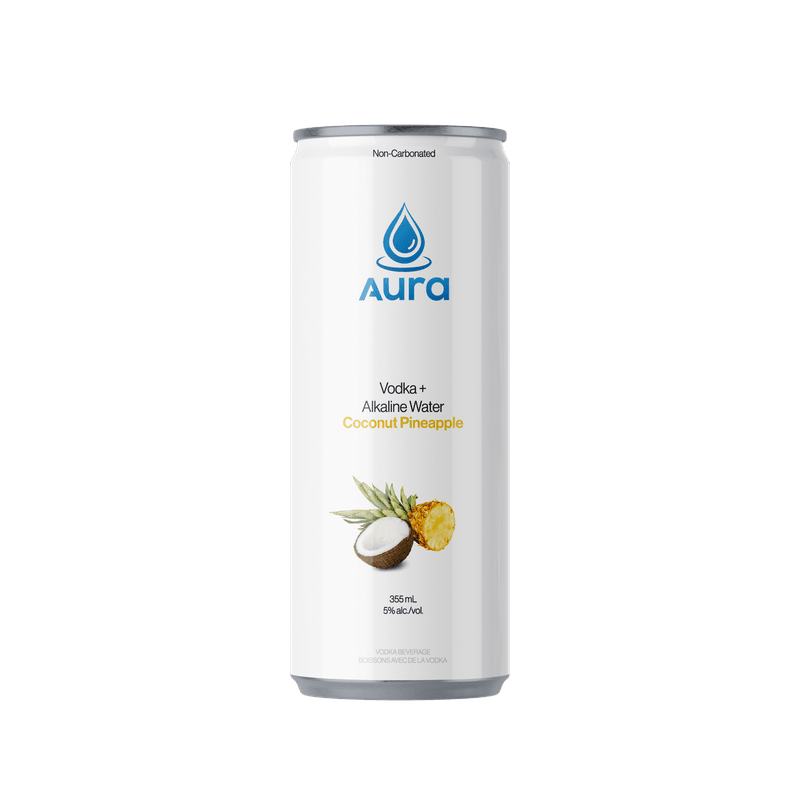
Aura is a Canadian canned vodka water: premium distilled vodka, alkaline water at pH 8.5+, and natural flavour. It is a still drink — zero carbonation, no bubbles, which is the whole point of the format and the reason it does not leave you bloated the way a hard seltzer or vodka soda can. No added sugar, no artificial sweeteners, no preservatives, gluten-free, in 355 mL cans across three flavours: Cucumber Lime, Coconut Pineapple and Mango Peach.
What a fixed-format can will not do is change what ethanol does to your sleep architecture. What it does help with is the one input your tracker cannot guess: how much you actually drank. A counted can beats an eyeballed pour, and every effect size above depends on getting that count right. That is the honest version of why Aura — a cleaner, still format you can count, not a health claim.
Ready to try it? Browse our vodka water cocktails in Cucumber Lime, Coconut Pineapple and Mango Peach, sold by the case of 24. Direct and wholesale ordering from Aura delivers to Ontario addresses only; in Alberta and British Columbia, check where to buy for AGLC-licensed private retailers, BC Liquor Stores and licensed private retailers near you. Please enjoy responsibly, and only if you are of legal drinking age in your province.
This article summarises published research for general interest and is not medical advice.
Sources
- Schyvens A-M, et al. A performance validation of six commercial wrist-worn wearable sleep-tracking devices for sleep stage scoring compared to polysomnography. SLEEP Advances. 2025;6(2):zpaf021. PMID 40303381. doi:10.1093/sleepadvances/zpaf021. Full text
- Grosicki GJ, Robinson AT, Joyner MJ, et al. Real-world effects of alcohol on heart rate, sleep, and physical activity by age and sex. PLOS Digital Health. 2026;5(3):e0001284. doi:10.1371/journal.pdig.0001284. Full text
- Strüven A, Schlichtiger J, Hoppe JM, et al. The Impact of Alcohol on Sleep Physiology: A Prospective Observational Study on Nocturnal Resting Heart Rate Using Smartwatch Technology. Nutrients. 2025;17(9):1470. PMID 40362779. doi:10.3390/nu17091470. Full text
- Ebrahim IO, Shapiro CM, Williams AJ, Fenwick PB. Alcohol and Sleep I: Effects on Normal Sleep. Alcoholism: Clinical and Experimental Research. 2013;37(4):539–549. doi:10.1111/acer.12006. Abstract
- Canadian Centre on Substance Use and Addiction. Canada's Guidance on Alcohol and Health: Final Report. Ottawa, ON: CCSA; 2023. ccsa.ca