You are three drinks into an evening and someone asks how many you have had. You say "three." That answer is almost certainly wrong — not because you are lying, but because the thing you are counting has no fixed size.
Here is the direct answer. The standard drink Canada uses as its official unit is not a glass, a bottle or a can. It is a fixed quantity of ethanol: 17.05 millilitres, or 13.45 grams, of pure alcohol — the definition set out in Canada's Guidance on Alcohol and Health, published by the Canadian Centre on Substance Use and Addiction (CCSA) in January 2023. Everything else is packaging around that number.
The standard drink Canada uses: 17.05 mL of pure alcohol
The CCSA report gives four equivalents worth memorising, because they are the only servings most people can count without arithmetic:
- A bottle of beer — 341 mL at 5% alcohol
- A bottle of cider — 341 mL at 5% alcohol
- A glass of wine — 142 mL (5 oz) at 12% alcohol
- A shot of spirits — 43 mL (1.5 oz) at 40% alcohol
Each works out to roughly 17.05 mL of ethanol. A CCSA footnote suggests Canada's figure was chosen because it matches the 341 mL, 5% beer bottle that long dominated the Canadian market. Standard drink size is not universal, though: the report notes it ranges internationally from 8 to 20 grams of pure alcohol. The US uses 14 g (about 18 mL), Australia 10 g — so a study run in California measures against a slightly bigger yardstick than ours.
How much alcohol in a can, a restaurant glass, and a home pour
One formula settles all three: millilitres × (ABV ÷ 100) ÷ 17.05 = standard drinks.
The can
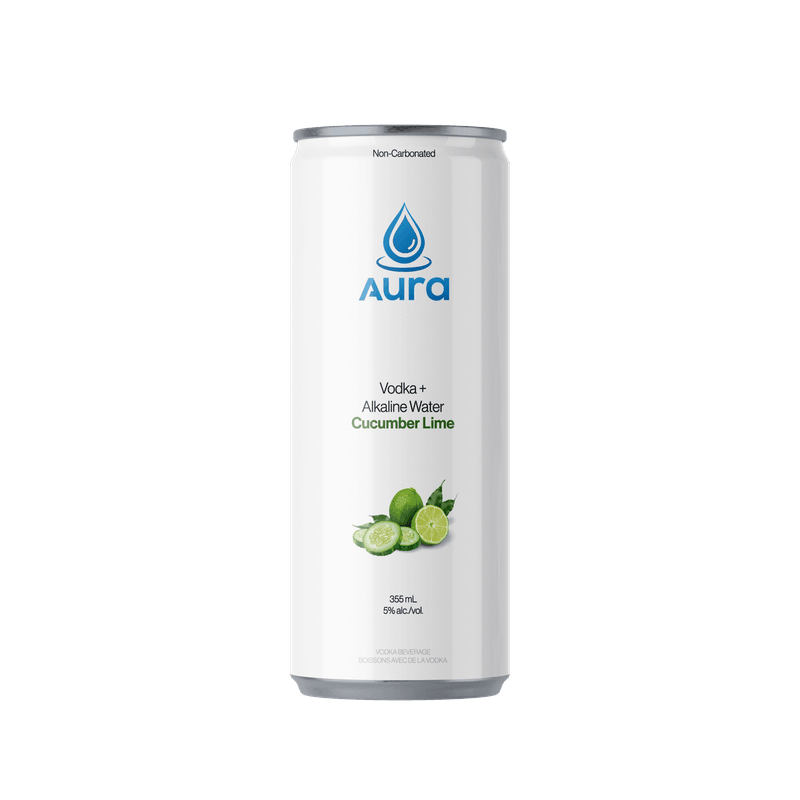
A 355 mL can at 5% alcohol contains 17.75 mL of ethanol: 1.04 standard drinks, just over one. That is the answer to "how much alcohol in a can," and it does not change with who handed it to you. A 473 mL tall can at the same strength is 1.39. Aura's vodka water cocktails are 355 mL at 5%, so one can is 1.04 every time.
The restaurant pour
Kerr and colleagues at the Alcohol Research Group sent researchers into 80 licensed establishments across 10 Northern California counties and measured 480 real drinks, determining alcohol content by brand or lab analysis (Alcoholism: Clinical and Experimental Research, 2008). Measured against the US standard of 0.6 fl oz of ethanol:
- Wine (n = 131): mean 0.86 fl oz — 43% larger. 98% exceeded one standard drink; 42% held at least one and a half.
- Draught beer (n = 56): mean 0.73 fl oz — 22% larger, ranging from 0.46 to 1.2 fl oz. One glass could be three quarters of a drink, or two.
- Mixed spirits drinks: 42% larger on average; the martini averaged 160% of a standard drink. Spirits drinks overall ranged from 0.3 to 2.0 fl oz of ethanol.
- Straight shots: equal to one standard drink, with little variation.
Converted to Canada's smaller 17.05 mL unit, the average restaurant wine is about 1.5 Canadian standard drinks, the average draught beer about 1.27, and the largest spirits drink measured — 59 mL of ethanol — roughly 3.5 standard drinks in one glass. The shot result explains the rest: shots were accurate because bartenders used a shot glass, a measuring device. Everything poured freehand drifted upward.
The home pour
Wilkinson, Allsop and Chikritzhs interviewed 844 current drinkers aged 65 to 74 in Perth, Australia, in their own homes, asking each to pour a usual serving into a usual glass (Drug and Alcohol Review, 2011). Men poured 32% more than an Australian standard drink, women 16% more. Even after being invited to correct their estimates, men still underestimated what they had poured by 23% and women by 16%.
Why free-pour studies find people underestimate
White and colleagues at Duke had 133 college students define and then free-pour a beer, a wine, a shot and a mixed drink (Alcoholism: Clinical and Experimental Research, 2005). Except for beer, students both defined and poured servings larger than the standard. The telling part: told the correct volumes, students' reported drinking went up — the same behaviour, recounted accurately, was more alcohol than they had first claimed.
Devos-Comby and Lange reviewed this literature and found the over-sizing effect held across studies, was largest for mixed drinks and spirits, then wine, then beer, and grew with vessel size (Current Drug Abuse Reviews, 2008). Their conclusion: consumption has probably been underestimated in earlier research.
Canadians are not exempt. In the CCSA's public consultation for the 2023 guidance, only 38% of contributors had previously heard of the 2011 low-risk guidelines, and among those who had used them, fewer than half (43%) called themselves extremely familiar with the concept of a standard drink.
What the research does not show
- "Everyone overpours" is too simple. Brunk, Becker and Bix found US undergraduates tended to underpour low-concentration beverages and overpour high-concentration ones (PLOS ONE, 2020). Error runs both ways.
- Averages hide it. Kohn and colleagues studied 192 students and found mean wine and liquor pours that looked fairly accurate — yet fewer than half of individuals poured correctly (37.4% beer, 35.1% wine, 22.2% liquor), and only 12.2% could define a standard glass of wine (Journal of Drug Education, 2017). Big errors in opposite directions cancel out in a mean.
- A popular claim failed to replicate. The idea that tall thin glasses beat short wide ones did not hold in real bars: Kerr and colleagues found glass shape had no effect on on-premise pours, though glass size did (Drug and Alcohol Review, 2009).
- The samples are limited. Most of this work is American or Australian, often on students, measured against 14 g or 10 g standards rather than Canada's 13.45 g. The Kerr restaurant data covers one region of California, is well over a decade old, and did not measure bottled or canned beer.
- None of it says a can is better for you. A pre-measured serving makes counting easier. It does not make the alcohol gentler. Nothing here suggests any canned product is healthier, safer or less intoxicating than another drink of the same size and strength.
How to count a canned drink honestly
- Read the can, then divide. Volume × ABV ÷ 1705 gives standard drinks. 355 mL at 5% = 1.04; 473 mL at 5% = 1.39; 355 mL at 7% = 1.46.
- Round up, never down. Four 355 mL, 5% cans is 4.2 standard drinks, not four.
- Count restaurant wine and mixed drinks as 1.5. On the Kerr data, that is closer to the truth than counting them as one.
- Calibrate your eye once. Pour your usual home drink into a measuring cup. Five minutes, one time.
- Count as you go. Reconstructing at the end of a night is precisely the task the research shows people fail.
- Know the benchmarks. CCSA's 2023 guidance puts weekly risk on a continuum: low at 2 standard drinks or fewer per week, moderate at 3 to 6, increasingly high at 7 or more, with per-occasion risk rising above 2 drinks.
This is the one genuinely useful thing a sealed can does: it removes the free pour. It is the shot glass from the Kerr study, applied to the whole drink. You are not estimating — you are reading a label.
Where Aura fits
Aura is a canned vodka cocktail: premium distilled vodka, alkaline water at pH 8.5+ and natural flavour, in Cucumber Lime, Coconut Pineapple and Mango Peach. It is a still drink — no carbonation — which is a difference in style from a seltzer, not a health claim. No added sugar, no artificial sweeteners, no preservatives, gluten-free. What matters here is simpler: 355 mL, 5% alcohol, 1.04 standard drinks, printed on the side. More on why Aura. Aura sells across British Columbia, Alberta and Ontario, though our own direct and wholesale ordering delivers to Ontario addresses only. In Alberta or BC, check where to buy — AGLC-licensed private retailers in Alberta, BC Liquor Stores and licensed private retailers in BC.
Do the arithmetic once tonight: multiply millilitres by ABV, divide by 1705, and see what comes back. If you would rather that number were settled in advance, browse our vodka water cocktails — same 355 mL can, same 1.04 standard drinks, every time. Please enjoy responsibly, and only if you are of legal drinking age in your province.
This article summarises published research for general interest and is not medical advice.
Sources
- Paradis, C., Butt, P., Shield, K., Poole, N., Wells, S., Naimi, T., Sherk, A., & the Low-Risk Alcohol Drinking Guidelines Scientific Expert Panels. (2023). Canada's Guidance on Alcohol and Health: Final Report. Ottawa, Ont.: Canadian Centre on Substance Use and Addiction. ISBN 978-1-77871-046-9. ccsa.ca
- Kerr, W. C., Patterson, D., Koenen, M. A., & Greenfield, T. K. (2008). Alcohol content variation of bar and restaurant drinks in Northern California. Alcoholism: Clinical and Experimental Research, 32(9), 1623–1629. doi:10.1111/j.1530-0277.2008.00741.x. PMID 18616674. Full text
- White, A. M., Kraus, C. L., Flom, J. D., Kestenbaum, L. A., Mitchell, J. R., Shah, K., & Swartzwelder, H. S. (2005). College students lack knowledge of standard drink volumes. Alcoholism: Clinical and Experimental Research, 29(4), 631–638. doi:10.1097/01.alc.0000158836.77407.e6. PMID 15834229. PubMed
- Wilkinson, C., Allsop, S., & Chikritzhs, T. (2011). Alcohol pouring practices among 65- to 74-year-olds in Western Australia. Drug and Alcohol Review, 30(2), 200–206. doi:10.1111/j.1465-3362.2010.00218.x. PMID 21355907. PubMed
- Devos-Comby, L., & Lange, J. E. (2008). "My drink is larger than yours"? A literature review of self-defined drink sizes and standard drinks. Current Drug Abuse Reviews, 1(2), 162–176. doi:10.2174/1874473710801020162. PMID 19630715. PubMed
- Brunk, E., Becker, M. W., & Bix, L. (2020). Empirical evaluation of the presence of a label containing standard drinks on pour accuracy among US college students. PLOS ONE, 15(11), e0241583. doi:10.1371/journal.pone.0241583. PMID 33151959. PubMed
- Kohn, C. S., Schultz, N. R., Bettencourt, K., & Dunn Carlton, H. (2017). Pour convergence: college students' definitions and free-poured volumes of standard alcohol servings. Journal of Drug Education, 47(1–2), 36–50. doi:10.1177/0047237917744329. PMID 29231063. PubMed
- Kerr, W. C., Patterson, D., Koenen, M. A., & Greenfield, T. K. (2009). Large drinks are no mistake: glass size, not shape, affects alcoholic beverage drink pours. Drug and Alcohol Review, 28(4), 360–365. doi:10.1111/j.1465-3362.2009.00056.x. PMID 19594789. PubMed