You turned the can over in the store, saw "zero sugar," and bought it. Three sips later there is a sweetness that doesn't belong, and a faintly bitter tail that lingers after you swallow. If you are looking for vodka drinks without artificial sweeteners, that moment is the whole problem: "zero sugar" is a claim about sugar, not a claim about sweeteners. In Canada those are two different regulated things, and the difference is printed on the can — in the ingredient list, not on the front.
Here is how to read it, in about fifteen seconds, plus what the published sensory research actually says about aftertaste.
How to spot vodka drinks without artificial sweeteners in fifteen seconds
Ignore the front of the can. Every word there was chosen to sell you something. Flip it over and read the ingredient list — and note that Canadian labelling rules are on your side here.
Most standardized alcoholic beverages (beer, wine, straight spirits) are exempt from listing ingredients, but pre-mixed canned cocktails are not. The Canadian Food Inspection Agency is direct about it: "All other products (such as sake, cocktails like martinis or mojitos, pernod, ouzo) require a complete list of ingredients and their components." And because sweeteners are regulated as food additives, CFIA further states that "Like all food additives, sweeteners must be declared in the list of ingredients of the prepackaged foods which they are present in." A canned cocktail sold in Canada has nowhere to hide one.
The names to scan for
- Sucralose — the most common one in canned drinks. It appears under its own name; there is no euphemism for it.
- Acesulfame potassium — also written acesulfame-K, ace-K or potassium acesulfame. Often blended with sucralose, because blending masks each one's off-notes.
- Aspartame — the easiest to catch. CFIA requires foods sweetened with aspartame to carry a phenylalanine statement in bold type at the end of the ingredient list, on the same continuous surface. If you see bold text after the last ingredient, that is what it is.
- Steviol glycosides — listed as steviol glycosides, stevia extract, or Reb A / Reb M. Plant-derived, but still a permitted sweetener additive under Canadian rules, not a loophole.
- Sugar alcohols — erythritol, maltitol, xylitol, sorbitol. These are sweeteners too, and their total content has to be declared in a Nutrition Facts table when one is present.
- Added sugars in disguise — cane sugar, agave, honey, "fruit juice concentrate," glucose-fructose. Not artificial, but if you're chasing a no sugar vodka drink, they count.
A shortcut that actually works
Count the ingredients. A genuinely clean label canned cocktail usually has three or four: spirit, water, natural flavour, maybe an acid like citric acid. Once the list runs to eight or nine items, something in there is doing sweetening or masking work.
Why "zero sugar" does not mean nothing sweet was added
This is the specific trap, and it is a legal one, not a marketing exaggeration. CFIA's criteria for the "no added sugars" nutrient content claim govern added sugars-based ingredients — a product can carry that claim and still contain a permitted sweetener.
The word that closes the gap is unsweetened. Under CFIA's specific claim requirements, a food may be called unsweetened only if it meets the conditions for "no added sugars" and "does not contain a sweetener set out in the List of permitted sweeteners." So: "zero sugar" and "no added sugar" are weak signals. "Unsweetened" is a strong one. The ingredient list is stronger than both.
There is a second wrinkle worth knowing. Under CFIA's exemptions from the Nutrition Facts table, "a beverage with an alcohol content of more than 0.5%" is usually exempt from carrying one — and the exemption is lost in situations including when the label "makes a representation about or implying nutritional or health related properties or nutrient content claims." Practical consequence: many alcoholic cans have no sugar line at all to check, so the ingredient list is your only real tool. And if a can does shout a nutrient content claim, it should also be showing you a Nutrition Facts table. A loud claim with no table is a reason to look harder.
What sweeteners actually do to aftertaste
Two things drive the lingering finish people complain about: the sweetener's own bitter component, and how long its sweetness hangs around after the sip.
On bitterness, Allen and colleagues (Chemical Senses, 2013) genotyped 108 participants and had them rate the bitterness of acesulfame potassium at 25 mM. Two single-nucleotide polymorphisms in the bitter receptor gene TAS2R31 were associated with perceived bitterness, with TAS2R9 alleles predicting additional variation; together the two SNPs explained 13.4% of the variance in perceived bitterness. That is the mechanism behind an argument you have probably had: the same can genuinely tastes bitter to you and clean to your friend.
On the lingering itself, Medeiros, Tavares and Bolini (Foods, 2022) profiled a peach juice matrix sweetened with sucrose, sucralose, neotame, two stevia extracts and a blend, using 13 trained panellists plus 120 consumers aged 19–48. The stevia extract with 40% rebaudioside A showed the highest bitterness and bitter aftertaste intensity (p ≤ 0.05), and consumer overall liking split sharply: sucrose 5.83, the sweetener blend 5.66 and sucralose 5.56, against 3.24 and 3.27 for the two stevia formulations — which the authors characterised as consumer rejection.
What the research does not show
Report it honestly, because the evidence cuts both ways:
- "Natural" did not win. In the Foods 2022 study the stevia samples were the least liked, and sucralose scored close to sucrose. Artificial does not automatically mean worse-tasting.
- The samples are small and the matrix is not a cocktail. Thirteen trained panellists, one peach juice base, no alcohol. Ethanol contributes its own sweetness and burn, and temperature and dilution change sweetener perception. These results do not transfer cleanly to a can of vodka water.
- Genetics explains a minority of the variation. 13.4% of variance means roughly 87% is down to other things — concentration, matrix, expectation, what you ate.
- Aftertaste is not a health claim. Sucralose, acesulfame potassium, aspartame and steviol glycosides are permitted additives that Health Canada has assessed for safety. Nothing above says a drink without them is healthier, safer or less intoxicating. The alcohol is the same either way.
How to build a genuinely unsweetened drink tonight
If you want no artificial sweeteners cocktails at home, the build is almost embarrassingly simple:
- 1.5 oz vodka, 5 oz still water, the juice of half a lime, three cucumber ribbons. No syrup, no cordial, no flavoured mixer — cordials and "skinny" mixers are where the sucralose usually enters.
- Use fresh citrus rather than bottled juice "from concentrate."
- Taste your drink once it has warmed slightly. Sweeteners are far more obvious at room temperature than ice-cold — it's the cheapest test you can run on any canned drink you already own.
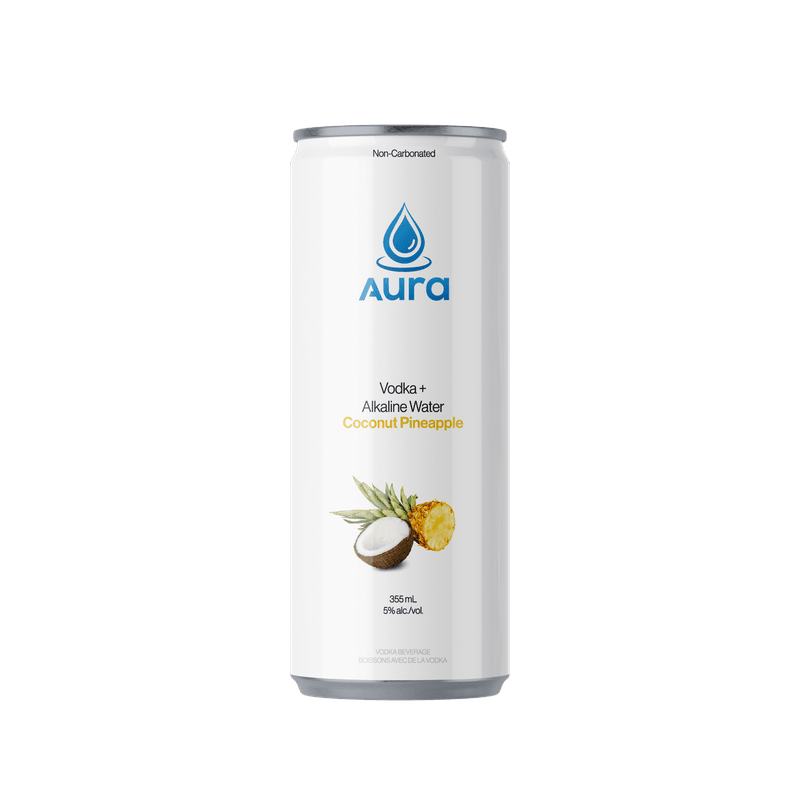
If you'd rather buy it than build it, that's the standard we hold ourselves to. Aura is premium distilled vodka, alkaline water (pH 8.5+) and natural flavour — no added sugar, no artificial sweeteners, no preservatives, and gluten-free. It's also still: zero carbonation, no bubbles, so no bloating, which makes it the flat alternative to a hard seltzer rather than another one. Three flavours — Cucumber Lime, Coconut Pineapple, Mango Peach — in 355 mL cans, sold by the case of 24. See our vodka water cocktails or read why Aura for the full formulation reasoning.
Order direct and we deliver by the case to Ontario addresses. In Alberta, look for Aura at AGLC-licensed private retailers; in British Columbia, at BC Liquor Stores and licensed private retailers — start at where to buy.
Next time you're in the aisle, give yourself fifteen seconds with the back of the can. Scan for sucralose, acesulfame potassium, aspartame and steviol glycosides, count the ingredients, and buy the shortest list. Then pour something you can taste all the way through. Please enjoy responsibly, and only if you are of legal drinking age in your province.
This article summarises published research for general interest and is not medical advice.
Sources
- Canadian Food Inspection Agency. Labelling requirements for alcoholic beverages. Government of Canada. inspection.canada.ca/en/food-labels/labelling/industry/alcoholic-beverages
- Canadian Food Inspection Agency. Labelling requirements for sweeteners and foods that contain sweeteners. Government of Canada. inspection.canada.ca/en/food-labels/labelling/industry/sweeteners
- Canadian Food Inspection Agency. Exemptions from the Nutrition Facts table. Government of Canada. inspection.canada.ca/en/food-labels/labelling/industry/nutrition-labelling/exemptions
- Canadian Food Inspection Agency. Criteria for the nutrient content claim "no added sugars" and Specific nutrient content claim requirements. Government of Canada. inspection.canada.ca/en/food-labels/labelling/industry/nutrient-content/specific-claim-requirements
- Allen AL, McGeary JE, Knopik VS, Hayes JE. Bitterness of the non-nutritive sweetener acesulfame potassium varies with polymorphisms in TAS2R9 and TAS2R31. Chemical Senses. 2013 Jun;38(5):379–89. PMID: 23599216. DOI: 10.1093/chemse/bjt017. pubmed.ncbi.nlm.nih.gov/23599216
- Medeiros A, Tavares E, Bolini HMA. Descriptive sensory profile and consumer study: impact of different nutritive and non-nutritive sweeteners on the descriptive, temporal profile, and consumer acceptance in a peach juice matrix. Foods. 2022;11(2):244. PMID: 35053976. DOI: 10.3390/foods11020244. pmc.ncbi.nlm.nih.gov/articles/PMC8775159