You are at the cooler working out which can does the least damage to the week, and the label is no help: most alcoholic drinks sold in Canada are not required to carry a Nutrition Facts table. So here is the direct answer on vodka water calories, plus the arithmetic to work out any can or glass yourself. Short version: in a drink with no added sugar, essentially every Calorie comes from the alcohol, and everything else on the shelf is that number plus whatever sugar the producer added.
Where vodka water calories actually come from
Canada's labelling rules use fixed energy conversion factors. The Canadian Food Inspection Agency's guidance on elements within the Nutrition Facts table sets 4 Calories (17 kJ) per gram for protein and carbohydrate, 9 Calories (37 kJ) per gram for fat, and 7 Calories (29 kJ) per gram for alcohol. Ethanol sits closer to fat than sugar, and it is there whether or not anything sweet joins it.
One more number converts any drink. The Canadian Centre on Substance Use and Addiction defines a standard drink in Canada's Guidance on Alcohol and Health (2023) as "17.05 millilitres or 13.45 grams of pure alcohol": ethanol weighs about 0.79 g per mL.
The 20-second calculation you can run on any label
Volume in mL × ABV as a decimal = mL of ethanol; × 0.79 = grams; × 7 = Calories. In one step: mL × ABV(%) × 0.055 ≈ Calories from alcohol.
A 355 mL can at 5% ABV is about 98 Calories before a single gram of sugar. At 4% it is about 78; at 7%, about 137. Strength and serving size, not the word on the front, drive most of the number.
Vodka water calories versus beer, wine, seltzer and sweetened RTDs
For conventional drinks, the USDA's FoodData Central SR Legacy database reports, per 100 grams:
- Beer, regular: 43 Calories, 3.9 g ethanol, 3.55 g carbohydrate (FDC 168746)
- Beer, light: 29 Calories, 3.1 g ethanol, 1.64 g carbohydrate (FDC 168749)
- Wine, table, white: 82 Calories, 10.3 g ethanol (FDC 174837)
- Wine, table, red: 85 Calories, 10.6 g ethanol (FDC 173190)
- Distilled spirits, 80 proof: 231 Calories, 33.4 g ethanol, 0 g carbohydrate (FDC 174815)
At CCSA's serving sizes: a 341 mL bottle of regular beer is near 145 Calories, a light beer near 100, a 142 mL glass of wine roughly 115 to 120, a 43 mL shot of 40% spirits about 95 — and with zero carbohydrate, that 95 is pure ethanol arithmetic.
The honest comparison: a zero-sugar hard seltzer and a still vodka water, both 355 mL at 5% ABV, land in the same place, holding the same things — alcohol, water, flavour. Carbonation carries no energy, so anyone claiming a still can is lower in Calories because it has no bubbles is selling you something. Choose still for texture and comfort: a preference, not a health claim.
Calories in canned cocktails: sugar is the whole variable
The gap opens as soon as syrup, juice or cream enters the can. FoodData Central reports, per 100 grams: canned tequila sunrise, 110 Calories and 11.3 g carbohydrate (FDC 168753); canned daiquiri, 125 Calories and 15.7 g carbohydrate (FDC 169573); canned piña colada, 237 Calories and 27.6 g carbohydrate (FDC 168750). At 355 mL that piña colada is a several-hundred-Calorie drink, yet all three carry only about 9 to 9.6 g of ethanol per 100 g. Compare calories in canned cocktails and you are mostly comparing added sugar.
So the lowest calorie alcoholic drinks share one profile: modest ABV, normal serving, nothing sweet added. No low calorie vodka drink escapes the 7 Calories per gram its alcohol contributes.
Why "light" claims on cans are regulated in Canada
Alcoholic drinks get a labelling carve-out, then lose it the moment they make a claim. Under the Food and Drug Regulations, "a beverage with an alcohol content of more than 0.5%" is generally exempt from a Nutrition Facts table — CFIA cites B.01.401(2)(b)(i) in its guidance on exemptions from the Nutrition Facts table. Per B.01.401(3), that exemption is lost when the label references energy or nutrients, makes a nutrient content claim, or carries a health-related representation. Print "only 90 Calories" and you have obliged yourself to print the table.
What "light" may mean is narrower than shoppers assume. Health Canada's Table of Permitted Nutrient Content Statements and Claims, incorporated by reference into the Regulations, sets the terms:
- "Low in energy" / "low Calorie" (item 2): 40 Calories or less per reference amount and serving of stated size.
- "Reduced in energy" (item 3): at least 25% less energy than a similar reference food.
- "Light" or "lite" (item 45): must meet item 3's reduced-in-energy conditions, or the equivalent for fat.
Note what item 45 does not say. "Light" is a comparison, not a threshold: 25% less than some other product. A "light" drink can still out-calorie an ordinary drink from another category. And section B.01.502, which prohibits representations characterizing a food's energy value or nutrient content, expressly does not apply to "a representation that characterizes the amount of alcohol in a beverage" (paragraph 2(j)) — so "light" may be pointing at strength, not energy. A third rule, section B.01.513, governs "light" used of a sensory characteristic. Three regimes, one word — reading the ABV is faster.
What the evidence does and does not support
The 7 Calories per gram figure is a labelling convention; what those Calories do is less settled. In Alcohol Consumption and Obesity: An Update (Traversy & Chaput, Current Obesity Reports, 2015), the authors note that "1 gram of alcohol provides 7.1 kcal (29 kJ)", that alcohol energy appears additive to other dietary sources, and that it has been reported to supply about 16% of total energy intake among US adult drinkers.
Their conclusion across prospective studies with follow-up "ranging from several months to 20 years" is more equivocal: "light-to-moderate alcohol intake is not associated with weight gain or changes in WC. Heavy drinking, however, has been more consistently associated with weight gain." They also describe a mechanism cutting against simple Calorie counting — chronic intake activates the hepatic microsomal ethanol-oxidizing system, which yields less ATP and diverts energy into heat — while noting that "the extent to which wasted energy" from alcohol "contributes to weight gain prevention is unclear."
Caveats
- USDA values are per 100 grams, not per 100 mL, and describe US products. Per-serving conversions here assume a density near 1 g/mL — fair for beer and wine, rougher for sweet cocktails. Treat them as estimates.
- Observational studies cannot establish causation, and self-reported intake is systematically under-reported.
- Fewer Calories is not safer. CCSA's 2023 risk continuum — low at 2 standard drinks or fewer per week, moderate at 3 to 6, increasingly high at 7 or more — counts grams of ethanol, not energy. Nothing here shows any drink is healthier, safer or less intoxicating; a gram of ethanol behaves the same whichever can it arrives in.
What to do at the store tonight
- Run mL × ABV × 0.055 on the can in your hand: that is your floor.
- Read the ingredient list, not the front panel: sugar and juice separate a 100-Calorie can from a 400-Calorie one.
- If a can says "light", ask what it is 25% lighter than, and whether it means alcohol instead.
- Track standard drinks alongside Calories — the CCSA continuum is the more consequential number.
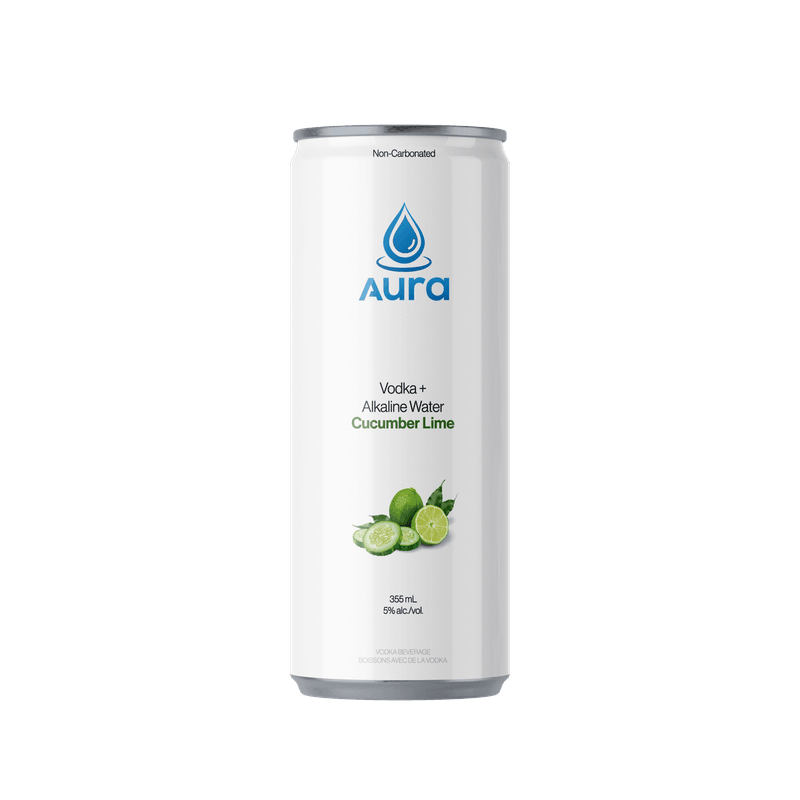
A still, unsweetened canned drink is straightforward here: premium distilled vodka, alkaline water and natural flavour, no added sugar, no artificial sweeteners, no preservatives — so the energy in the can is the alcohol, and nothing else. You can do that math in your head.
Browse our vodka water cocktails in Cucumber Lime, Coconut Pineapple and Mango Peach, see why Aura is built as the still alternative to hard seltzer, or find us via where to buy. Aura's direct and wholesale ordering delivers to Ontario addresses only; in Alberta, look for us at AGLC-licensed private retailers, and in BC at BC Liquor Stores and licensed private retailers. Aura is for those of legal drinking age — please enjoy responsibly.
This article summarises published research and Canadian labelling regulations for general interest. It is not medical advice.
Sources
- Canadian Food Inspection Agency. Elements within the Nutrition Facts table. Link
- Canadian Food Inspection Agency. Exemptions from the Nutrition Facts table. Citing FDR B.01.401(2)(b)(i), B.01.401(3). Link
- Health Canada. Nutrition Labelling — Table of Permitted Nutrient Content Statements and Claims, items 2, 3, 45. Modified 2025. Link
- Government of Canada. Food and Drug Regulations, C.R.C., c. 870, ss. B.01.502, B.01.513. Justice Laws Website, current to 2026.
- Paradis C, Butt P, Shield K, et al. Canada's Guidance on Alcohol and Health: Final Report. Canadian Centre on Substance Use and Addiction, 2023. ISBN 978-1-77871-046-9. PDF
- Traversy G, Chaput JP. Alcohol Consumption and Obesity: An Update. Current Obesity Reports. 2015;4(1):122–130. doi:10.1007/s13679-014-0129-4. PMID 25741455; PMCID PMC4338356. Link
- U.S. Department of Agriculture, Agricultural Research Service. FoodData Central, SR Legacy. FDC IDs 168746, 168749, 174837, 173190, 174815, 168753, 169573, 168750. Link