You are standing in a liquor aisle in Toronto, Calgary or Vancouver holding a can that says “natural flavour,” and you want a straight answer: did real fruit go into this? Here it is. On a Canadian label, natural flavored vodka water means the flavouring was derived from a plant or animal source rather than built from scratch in a lab — and nothing more than that. It is not a promise of juice, of pulp, or of nutrition. It tells you where the aroma came from, not how much fruit is in your glass.
That distinction is worth thirty seconds at the shelf, because “natural,” “flavoured” and “made with real fruit” are three separate regulatory animals in Canada. Below is how to read each one, why a still alkaline-water base carries a delicate flavour differently than a carbonated one does, and a ten-minute tasting you can run tonight.
What “natural flavored vodka water” means on a Canadian label
Two federal instruments do the work. The Canadian Food Inspection Agency (CFIA) publishes the Industry Labelling Tool, and behind it sit the Food and Drug Regulations (C.R.C., c. 870).
Start with the rule you can actually see on a can. Division 10 of the Food and Drug Regulations, section B.10.008, requires that for an artificial or imitation flavouring preparation, “the word ‘artificial’, or ‘imitation’ shall be an integral part of the name of such flavouring preparation and shall be set out in identical type and identically displayed with such name.” In plain English: if it is artificial, the label must say so, in the same type size as the flavour name. It cannot hide in grey six-point.
Then the word “natural” itself. CFIA’s guidance on method of production claims says a food described as natural must “not contain, or have ever contained, an added vitamin, mineral nutrient, artificial flavouring agent or food additive,” must not have had “any constituent or fraction thereof removed or significantly changed, except the removal of water,” and must not have been “subjected to processes that have significantly altered their original physical, chemical or biological state.” On flavour specifically, CFIA states that “substances that impart flavours that have been derived from a plant or animal source may claim to be ‘natural’.”
Read that carefully, because it is where most shoppers get misled. Those three criteria describe a food called natural. When “natural” sits directly in front of “flavour,” it is qualifying the flavouring’s origin, not certifying the whole beverage. Vodka is distilled, and distillation is a significant change. So treat natural flavour vodka as a sourcing statement about the aroma, not a halo over the can.
Natural flavour, artificial flavour and actual juice are three different claims
The second thing to know is that “flavour” on an ingredient list is a class term, not a recipe. CFIA’s guidance on the list of ingredients and allergens confirms that flavours may be grouped at the end of the ingredient list, and that the components of flavouring preparations generally do not need to be declared individually. So a single word can stand in for a compound preparation. That is legal and normal — but it means the ingredient list tells you the category, not the contents.
Juice is a separate question again. CFIA’s guidelines for highlighted ingredients and flavours set out that where juice content is below 25%, the word “juice” may not appear in the common name, though the product may be described as “flavoured”; juice claims made elsewhere on the label must be accompanied by the percentage of juice. The practical test: if you see a fruit picture but no percentage anywhere, you are almost certainly drinking flavour, not juice.
One more useful fact. Section B.01.008(2) of the Food and Drug Regulations exempts a short, named set of spirits — Scotch whisky, Irish whisky, Armagnac brandy, Cognac brandy, Bourbon whisky, Tennessee whisky, Tequila and Mezcal — and certain standardized products from carrying an ingredient list at all. A flavoured vodka water is not on that list, so you should expect one. If a canned cocktail does not give you an ingredient list, that is information too.
Why a still base carries a delicate flavour differently than carbonation
This part is genuinely well studied, and it is not marketing. Carbonation is not only texture — it is a taste input in its own right. In Science, Chandrashekar and colleagues (2009) showed by targeted genetic ablation in mice that “the sour-sensing cells act as the taste sensors for carbonation,” and that carbonic anhydrase 4 “functions as the principal CO2 taste sensor” (PMID 19833970).
In humans, Cowart (1998), in Chemical Senses, reported that adding CO2 to basic taste solutions produced “only small increases in ratings of total taste intensity” but “rather dramatic alterations in the quality profiles of stimuli … particularly for sweet and salty tastes” (doi:10.1093/chemse/23.4.397). And Di Salle and colleagues (2013), using functional MRI in Gastroenterology, found that “the presence of carbonation produced an overall decrease in the neural processing of sweetness-related signals,” with greater suppression for sucrose than for artificial sweeteners (PMID 23714381).
Aura is a still drink. There is no carbonation in the can at all — it is not a seltzer and not a vodka soda — so none of that CO2 signal is layered over the flavour. That is a difference in how the drink presents, not a claim that it is better for you. If you want the reasoning behind that formulation choice, it is set out on why Aura.
As for the alkaline base: Health Canada’s pH guideline technical document (2015) sets an operational guideline of pH 7.0 to 10.5 for finished drinking water and notes that many Canadian and U.S. systems deliberately distribute water above pH 8.5, with eight listed systems at pH 9.0 or above. Alkaline water is ordinary, not exotic.
What the research does not show
- None of these studies tested a canned vodka water, Aura included. They tested model taste solutions, sweeteners and carbonation in a lab.
- Cowart (1998) was a small human sensory study; the aroma literature on carbonation is genuinely mixed, with enhancement reported in some products and suppression in others.
- An fMRI signal is a brain response, not a measure of liking or preference.
- Nothing here suggests a still drink is healthier, safer or less intoxicating. The alcohol in the can is the same either way.
- Alkaline pH is not a health feature. Health Canada states plainly that “there is no evidence of an association between the pH of the diet (food or drinking water) and direct adverse health effects,” and that “the acids and bases found in drinking water are extremely diluted and, as such, do not influence the pH of the body.”
- Natural versus artificial is a rule about origin and disclosure. Canadian regulators do not rank one as safer or more nutritious than the other.
How to taste the difference at home
- Pour 60 mL from a fridge-cold can into a wine glass. Pour a second 60 mL and leave it on the counter for 15 minutes.
- Reset your palate with plain still water at the same temperature. Do this before every sample.
- Swirl the cold glass, cup your palm over it for ten seconds, lift and sniff. Note how many distinct notes you can name.
- Repeat with the warmed glass. Warmth releases more volatiles: a multi-component flavour tends to unfold into several notes, while a single-note aroma tends mainly to get louder.
- Time the finish. Count the seconds until the flavour is gone, and note whether it fades in stages or stops abruptly.
- Compare against a carbonated seltzer last, and interpret it cautiously — per the studies above, the CO2 is changing the sweet and sour reading, so it is not a like-for-like test of flavour dose.
- Only then read the can: check for “artificial” or “imitation” beside the flavour name, for a juice percentage, and for added sugar or sweeteners.
Be honest about the limits of this exercise. You cannot reliably classify a flavour as natural or artificial by taste alone, and no home test substitutes for the label. What the tasting does teach you is how a flavour is constructed — and that is the skill that makes a label legible.
A 30-second checklist for a clean label canned cocktail
- Is “artificial” or “imitation” printed in the same type size beside the flavour name? If yes, B.10.008 is doing its job.
- Does “juice” appear in the common name, or is a percentage declared? No percentage means flavour, not juice.
- Is there an ingredient list at all, and can you read every word on it?
- Are sugars and sweeteners named, under any of their aliases?
- Is the drink carbonated or still? The can will say.
- Remember that “clean label” is a marketing phrase with no legal definition in Canada. The regulated words are the ones that matter.
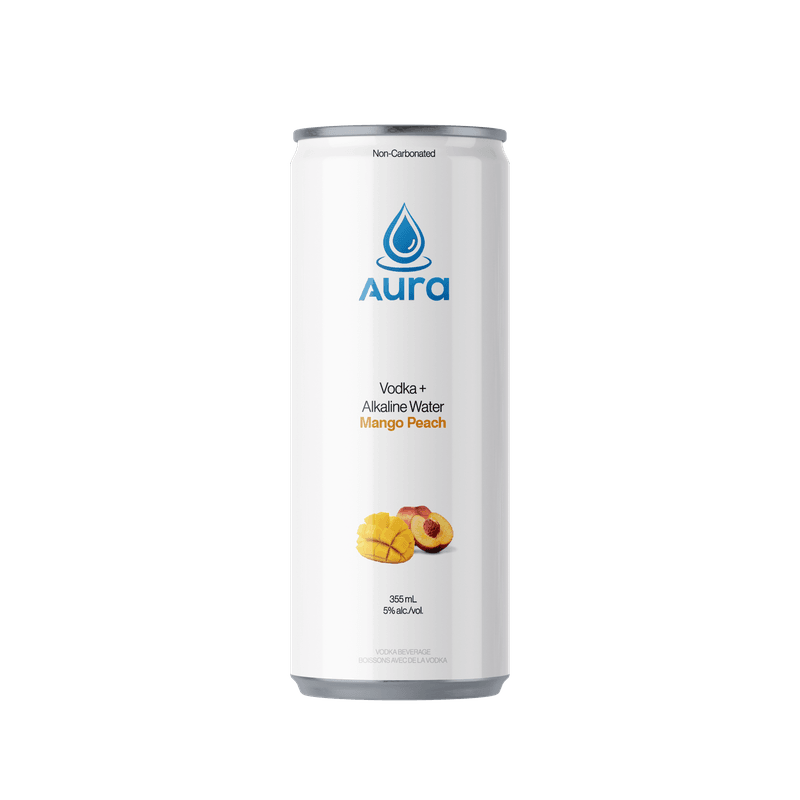
Aura runs to that standard: premium distilled vodka, alkaline water at pH 8.5 or above, and natural flavour — no added sugar, no artificial sweeteners, no preservatives, gluten-free, and no carbonation. Three flavours, 355 mL cans, sold by the case of 24.
Ready to run the test yourself? Browse our vodka water cocktails in Cucumber Lime, Coconut Pineapple and Mango Peach. Our direct and wholesale ordering delivers to Ontario addresses only; if you are in British Columbia or Alberta, check where to buy and look for Aura at BC Liquor Stores and licensed private retailers in BC, or at AGLC-licensed private retailers in Alberta. Please enjoy responsibly, and only if you are of legal drinking age in your province.
This article summarises published research for general interest and is not medical advice.
Sources
- Canadian Food Inspection Agency. Method of production claims on food labels (Industry Labelling Tool). inspection.canada.ca
- Canadian Food Inspection Agency. List of ingredients and allergens on food labels (Industry Labelling Tool). inspection.canada.ca
- Canadian Food Inspection Agency. Guidelines for highlighted ingredients and flavours. inspection.canada.ca
- Government of Canada. Food and Drug Regulations, C.R.C., c. 870, ss. B.01.008 and B.10.008. laws-lois.justice.gc.ca
- Chandrashekar J, Yarmolinsky D, von Buchholtz L, Oka Y, Sly W, Ryba NJP, Zuker CS. “The taste of carbonation.” Science. 2009;326(5951):443–445. doi:10.1126/science.1174601. PMID: 19833970. pubmed.ncbi.nlm.nih.gov
- Cowart BJ. “The addition of CO2 to traditional taste solutions alters taste quality.” Chemical Senses. 1998;23(4):397–402. doi:10.1093/chemse/23.4.397. doi.org
- Di Salle F, Cantone E, Savarese MF, et al. “Effect of carbonation on brain processing of sweet stimuli in humans.” Gastroenterology. 2013;145(3):537–539.e3. doi:10.1053/j.gastro.2013.05.041. PMID: 23714381. pubmed.ncbi.nlm.nih.gov
- Health Canada. Guidelines for Canadian Drinking Water Quality: Guideline Technical Document — pH. Ottawa, August 2015. Cat. H144-28/2016E-PDF. healthycanadians.gc.ca