If you switched to diet drinks or sweetener packets to cut sugar, the 2023 WHO sweetener guideline probably left you with one question: did I just swap one problem for another? The short answer is that the guideline is narrower than the headlines. It says non-sugar sweeteners are not a useful tool for long-term weight control or disease prevention. It does not say that sucralose, aspartame or stevia are toxic, and it was not a safety assessment. Below is what the review behind it actually found, where the evidence is weak, and what you can do with that today in Canada.
What the WHO sweetener guideline actually recommends
On 15 May 2023 the World Health Organization advised against using non-sugar sweeteners (NSS) to control body weight or to reduce the risk of noncommunicable diseases. The sweeteners named include acesulfame K, aspartame, advantame, cyclamates, neotame, saccharin, sucralose, stevia and stevia derivatives.
Three details matter more than the headline:
- It is a "conditional" recommendation. WHO's own release says policy decisions based on it may need discussion within each country's context. That wording reflects uncertainty, not a firm verdict.
- It applies to everyone except people with pre-existing diabetes. It also does not cover toothpaste, skin creams, medications, or low-calorie sugars and sugar alcohols (polyols).
- It is not a safety ruling. The guideline document says plainly that its guidance "is not based on toxicological assessments of the safety of individual non-sugar sweeteners."
WHO's Director for Nutrition and Food Safety, Francesco Branca, summed up the intent: NSS "are not essential dietary factors and have no nutritional value. People should reduce the sweetness of the diet altogether, starting early in life."
What the review behind it found on weight and health
The guideline rests on a WHO-commissioned systematic review and meta-analysis by Rios-Leyvraz and Montez, published in April 2022. It pooled two very different kinds of evidence, and they point in different directions.
Randomised trials: a small, short-term weight benefit
In randomised controlled trials, which were mostly short, people given more NSS ended up slightly lighter. As summarised by epidemiologists at the University of Cambridge, the trials showed about 0.71 kg lower body weight, roughly 136 fewer kcal per day and about 38.4 g less sugar per day. WHO's review page notes that trials suggested NSS "may have little impact on glucose metabolism" and that lower weight was seen "when coupled with energy restriction in the short-term."
Cohort studies: associations with worse long-term outcomes
Long-term observational (cohort) studies told a different story. In the same Cambridge summary, higher NSS intake was associated with a 0.14 kg/m² higher BMI and higher risks of obesity (76%), type 2 diabetes (23%), mortality (12%), stroke (19%) and, among pregnant women, preterm birth (25%). WHO judged that any short-term benefit was outweighed by these potential long-term risks.
The key word is associated. Cohort studies observe what people already do. They cannot show that the sweetener caused the outcome.
Sucralose, aspartame and stevia: what was and wasn't said
Is sucralose safe?
The WHO guideline lists sucralose by name, but only as one of the sweeteners the weight-control advice covers. It makes no finding that sucralose is unsafe at permitted levels, because it did not assess toxicity. In Canada, Health Canada lists sucralose among its approved sugar substitutes and notes that sweeteners "are subject to rigorous controls under the Food and Drugs Act and Regulations," with a safety assessment required before approval.
Aspartame research: a separate 2023 assessment
Aspartame got its own, separate review two months later. On 14 July 2023, WHO, the International Agency for Research on Cancer (IARC) and the Joint FAO/WHO Expert Committee on Food Additives (JECFA) released their results. IARC classified aspartame as "possibly carcinogenic to humans" (Group 2B), citing "limited evidence" for liver cancer (hepatocellular carcinoma) in humans and limited evidence in animals and on mechanisms. JECFA, which assesses risk at realistic intakes, kept the acceptable daily intake at 0 to 40 mg per kg of body weight. Its worked example: a 70 kg adult would need more than 9 to 14 cans of diet soft drink a day, at 200 to 300 mg of aspartame per can, to exceed that limit, assuming no other sources. Health Canada has permitted aspartame since 1981.
Stevia
Stevia and its derivatives are named in the WHO guideline the same way sucralose is: not recommended as a weight-control tool, with no toxicity finding. Health Canada says purified stevia extract (steviol glycosides) "has undergone a full safety review and has been approved for use in various foods sold in Canada." Being "natural" did not exempt stevia from the WHO advice.
The caveats: what the research does not show
- Low certainty. The Cambridge summary notes the overall quality of evidence in the review was graded "low certainty." That is why the recommendation is conditional.
- Reverse causation is a real risk. People who already have weight or blood-sugar concerns are more likely to choose diet products. A cohort study can then link sweeteners to those conditions even if the sweetener played no role.
- Not every expert agrees. In the European Journal of Clinical Nutrition, Khan and colleagues (2023) argued that WHO gave too little weight to the trials, some lasting six months to a year with no sign the effect faded with duration. They also argued WHO left out cohort analyses designed to reduce bias. One such meta-analysis they cite, covering 14 cohorts and 416,830 participants, linked swapping sugary drinks for NSS drinks with lower weight and lower risk of obesity, coronary heart disease and death.
- Sweeteners were mostly analysed as a group. The headline findings do not separate the effects of sucralose from those of aspartame or stevia.
- Some nutrition bodies still see a role. The British Nutrition Foundation acknowledged the conditional grading but said NSS can remain a useful tool, alongside other strategies, for cutting free sugar.
How to read artificial sweeteners health headlines
When the next "sweetener linked to…" story appears, run it through four questions:
- Is it a hazard or a risk? IARC's Group 2B describes the strength of evidence that something could cause cancer. It says nothing about how much. JECFA's intake limit is the number that speaks to real-world exposure.
- Trial or observation? Trials test cause and effect but are often short. Cohorts follow people for years but can't rule out confounding.
- Compared with what? Replacing a sugary drink with a sweetened one is a different question from replacing it with water.
- Who does it apply to? The WHO advice excludes people with diabetes, who should follow their own care team's guidance.
What you can do today
- If you use sweeteners to manage weight, don't count on them doing the work long term. The WHO sweetener guideline points toward lowering overall sweetness instead.
- Don't panic about the occasional diet drink. Neither WHO nor Health Canada has declared approved sweeteners unsafe at normal intakes.
- Recalibrate your palate gradually: plain water with citrus or cucumber, unsweetened tea, and fruit instead of sweetened snacks.
- Read labels. Check the ingredient list for sweeteners such as sucralose, aspartame, acesulfame K or steviol glycosides so you know what you are actually drinking.
Where Aura fits, and where it doesn't
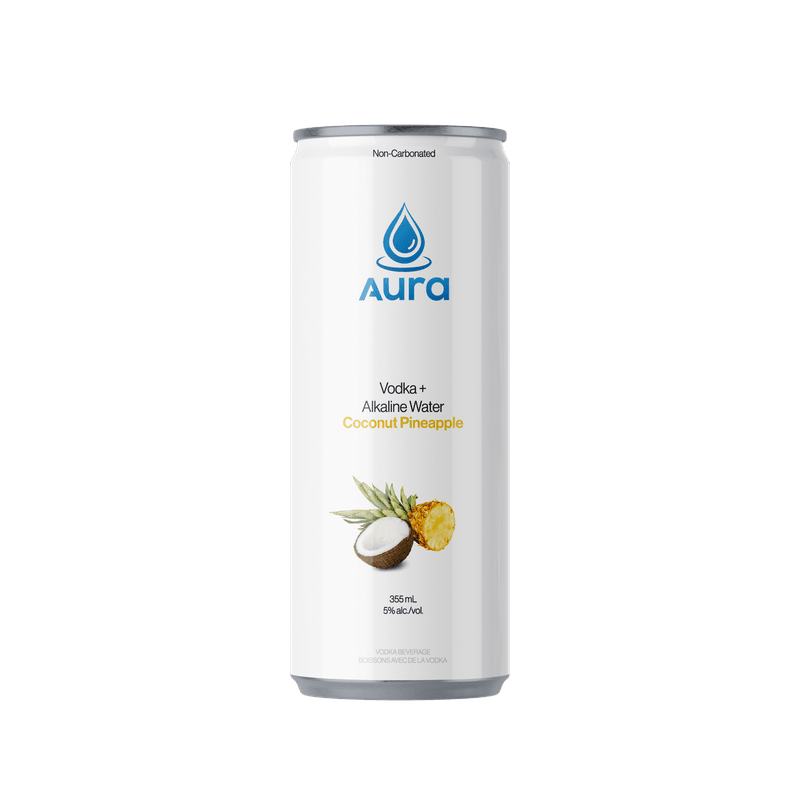
Aura is a still canned vodka water: premium vodka, alkaline water (pH 8.5+) and natural flavour, with no added sugar and no artificial sweeteners, so the sweetener debate simply doesn't apply to what's in the can. It also has zero carbonation, with no bubbles, which is why we say no bubbles means no bloating. That is a matter of taste and comfort, not health. Aura contains the same alcohol as any vodka drink, and nothing above suggests it is healthier, safer or less intoxicating. Read more about why Aura or browse our vodka water cocktails: Cucumber Lime, Coconut Pineapple and Mango Peach.
Ready to try one? Aura comes in 355 mL cans, sold by the case of 24, and is available across British Columbia, Alberta and Ontario. Our direct and wholesale orders deliver to Ontario addresses only. In BC and Alberta, find Aura at your local licensed retailer through our where to buy page: BC Liquor Stores and licensed private retailers in BC, and AGLC-licensed private retailers in Alberta. Please enjoy responsibly, and only if you are of legal drinking age in your province.
This article summarises published research for general interest and is not medical advice.
Sources
- World Health Organization. "WHO advises not to use non-sugar sweeteners for weight control in newly released guideline." News release, 15 May 2023. who.int
- World Health Organization. Use of non-sugar sweeteners: WHO guideline. Geneva: WHO; 2023. ISBN 9789240073616. who.int
- Rios-Leyvraz M, Montez J. Health effects of the use of non-sugar sweeteners: a systematic review and meta-analysis. Geneva: World Health Organization; 2022. ISBN 9789240046429. who.int
- World Health Organization, IARC, JECFA. "Aspartame hazard and risk assessment results released." News release, 14 July 2023. who.int
- Health Canada. "Sugar substitutes." Government of Canada (modified 2023-06-28). canada.ca
- Khan TA, Lee JJ, Ayoub-Charette S, et al. "WHO guideline on the use of non-sugar sweeteners: a need for reconsideration." European Journal of Clinical Nutrition. 2023;77(11):1009–1013. doi:10.1038/s41430-023-01314-7. PMC10630128
- Del Grosso L. "What does the World Health Organization's guidance that non-sugar sweeteners are not effective for weight loss or disease prevention mean for consumers?" Epidemiology Unit, University of Cambridge, 3 July 2023. epi.ims.cam.ac.uk
- British Nutrition Foundation. "Statement on WHO non-sugar sweeteners guideline." 2023. nutrition.org.uk