
If a sip of straight vodka or whisky makes you wince, you are not imagining it and you are not "doing it wrong." So, why does alcohol taste bitter to some people and barely register for others? The short answer: ethanol itself tastes bitter and burns, and how strongly you feel that depends partly on your bitter taste genetics and partly on how concentrated the drink is. The good news is that the second part is something you can change today.
Why does alcohol taste bitter? The short answer
Ethanol is not a neutral carrier for flavour. In a 2015 study in Chemosensory Perception, Alissa Nolden and John Hayes had 100 adults aged 21 to 55 taste plain ethanol in water at 4, 8, 16, 32 and 48% alcohol by volume and rate sweetness, bitterness, drying and burning. Most sensations got stronger as concentration rose, but the leading sensation changed. At 8% and 16%, bitterness dominated (mean ratings of 7.4 and 13.5 on the scale used). At 32% and 48%, burning and tingling took over (29.7 and 44.7). Most bottled spirits sold in Canada sit around 40%, which is squarely in the "burn" zone.
So part of what people call "bitter" in a straight spirit is really a mix of bitterness and burn, and both scale with strength. On top of that, people differ in how loudly their bitter receptors respond.
Bitter taste genetics: TAS2R38 and the PROP taster test
Humans have about 25 bitter taste receptor genes, known as TAS2Rs, and they carry an unusually high amount of variation from person to person. The best studied is TAS2R38. Researchers often measure its effect with PROP (6-n-propylthiouracil), a bitter compound that some people find intensely bitter and others barely notice. That gives the familiar labels: non-tasters, medium tasters and "supertasters."
TAS2R38 comes in two common versions, usually written PAV (the "taster" form) and AVI (the "non-taster" form). Everyone carries two copies, so you can be PAV/PAV, PAV/AVI or AVI/AVI.
What a PROP taster experiences with alcohol
The landmark paper here is by Valerie Duffy, Linda Bartoshuk and colleagues, published in Alcoholism: Clinical and Experimental Research in 2004. In 84 healthy adult drinkers, PAV/PAV carriers found PROP the most bitter and AVI/AVI carriers the least. People who rated PROP more bitter also rated a 50% ethanol sample as more intense, and they reported drinking less. Average reported intake was about 285 drinks per year in the AVI/AVI group, 180 in PAV/AVI and 133 in PAV/PAV.
A 2016 follow-up by Nolden, McGeary and Hayes in Physiology & Behavior tested 106 adults and found that PAV homozygotes rated 50% ethanol, applied to the back of the tongue, as more bitter than other genotypes. A second gene region, TAS2R3/4/5, was linked to ethanol bitterness too. That supports the everyday "supertaster alcohol" experience: for some people, straight spirits really do taste harsher.
What studies link taster status to drink preferences
- Intake, not just taste. Duffy and colleagues found that genotype predicted reported alcohol intake (F(2,81) = 3.60, p < 0.05), and PROP bitterness predicted intake beyond age and sex.
- A partial confirmation. In a 2011 Chemical Senses study, Hayes and colleagues confirmed the TAS2R38–alcohol intake link and found a TAS2R16 variant tied to intake. But those same variants did not explain how bitter, or how liked, a sampled Scotch whisky was.
- Different bitter foods, different genes. In that same study, espresso bitterness was linked to TAS2R3/4/5 and grapefruit juice bitterness to TAS2R19. Hating black coffee does not automatically mean you will find vodka bitter.
- Concentration-specific sensitivity matters. Nolden and Hayes (2015) found that how intensely people rated individual sensations from ethanol explained some of the variation in how often they drank beer, wine and straight spirits.
What the research does not show: the caveats
This is an interesting area, but it is easy to oversell. Keep these limits in mind:
- Small samples. The key sensory studies tested roughly 84 to 106 people, mostly young-to-middle-aged adults of European ancestry. Duffy's team also recruited deliberately for a range of taste sensitivity, and the authors noted that genotype did not fully account for supertasting.
- Mixed replication. In a family study of the Collaborative Study on the Genetics of Alcoholism (Wang and colleagues, 2007), the TAS2R38 link to drinking amount appeared only in African-American women, and the researchers found no evidence that TAS2R38 influences alcohol dependence.
- Lab samples aren't real drinks. Pure ethanol on a cotton swab is not a cocktail. Hayes's team found the genes linked to intake did not predict reactions to an actual whisky.
- Association, not destiny. These are self-reported drinking habits and correlations. Your genes do not decide how much you drink, and taster status is not a measure of risk or tolerance.
- Burn vs bitter is hard to separate. The 2016 authors noted that untrained tasters may struggle to tell bitterness from burning.
Why flavour and dilution change the experience
You can't change your TAS2R38 genotype, but you can change what reaches your tongue. Here's what follows from the research and what you can do today:
- Dilute. Because burn dominates at 32–48% alcohol and most sensations rise with concentration, adding water, ice or a mixer moves a spirit out of the harshest range. Bitterness may still be noticeable at lower strengths, since it led the ratings at 8–16%, but the overall intensity is lower.
- Add aroma and flavour. Citrus, cucumber or fruit gives your palate something else to focus on, so bitterness is less of the story.
- Taste-test like a scientist. If you suspect you're a PROP taster, compare the same spirit neat, with a splash of water and in a long, fully diluted drink. Notice which version you'd actually reach for again.
- Don't force it. If neat spirits taste unpleasant to you, that's a legitimate preference. It isn't a palate you need to "train" past.
Where Aura fits
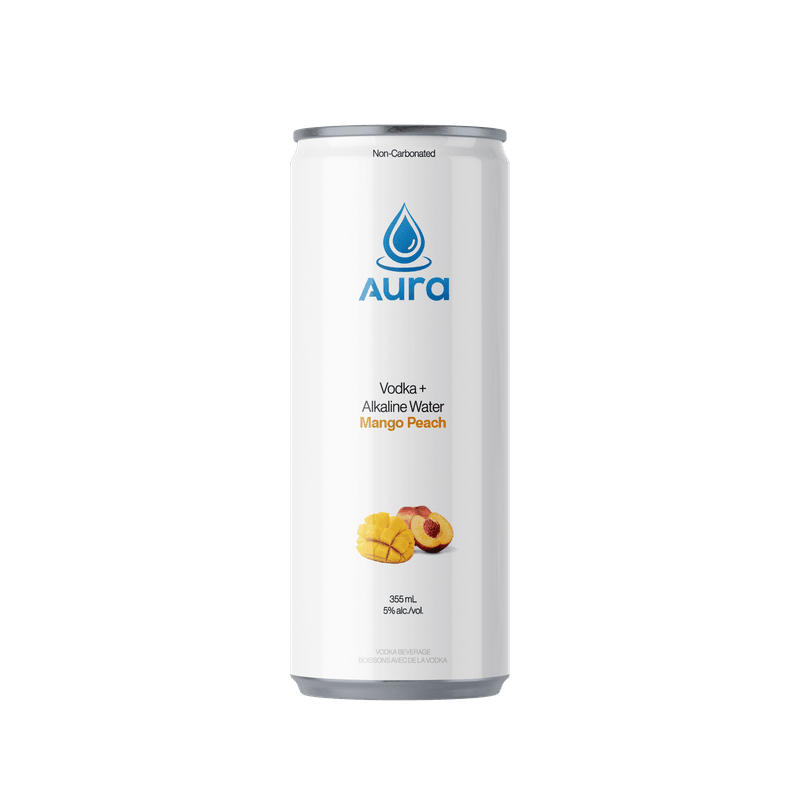
Aura is built around that dilution logic: premium distilled vodka with alkaline water (pH 8.5+) and natural flavour, in Cucumber Lime, Coconut Pineapple and Mango Peach. Aura is still, not a seltzer. There's no carbonation, so no bubbles and no bloating. It has no added sugar, no artificial sweeteners and no preservatives, and it's gluten-free. You can explore our vodka water cocktails or read why Aura is made this way.
To be clear, the alcohol in a can of Aura is the same alcohol you'd find anywhere else. A lighter, more approachable taste is a matter of preference. It does not make a drink healthier, safer or less intoxicating, and none of the research above suggests otherwise.
Drink thoughtfully
Whatever you pour, Canada's Guidance on Alcohol and Health from the Canadian Centre on Substance Use and Addiction (2023) describes risk as a continuum. It says that at one to two standard drinks a week you are likely to avoid alcohol-related consequences, and it warns that more than two standard drinks on one occasion raises the risk of harm. Please enjoy responsibly, and only if you are of legal drinking age in your province.
Curious how a still, flavoured vodka water tastes if straight spirits have always been too harsh for you? Aura is available across British Columbia, Alberta and Ontario. Our own direct and wholesale orders deliver to Ontario addresses only. In BC, look for Aura at BC Liquor Stores and licensed private retailers. In Alberta, look at AGLC-licensed private retailers. Find your nearest option on our where to buy page.
This article summarises published research for general interest and is not medical advice.
Sources
- Duffy VB, Davidson AC, Kidd JR, Kidd KK, Speed WC, Pakstis AJ, Reed DR, Snyder DJ, Bartoshuk LM. Bitter receptor gene (TAS2R38), 6-n-propylthiouracil (PROP) bitterness and alcohol intake. Alcoholism: Clinical and Experimental Research. 2004;28(11):1629–1637. doi:10.1097/01.ALC.0000145789.55183.D4. PMID 15547448. PMC1397913
- Hayes JE, Wallace MR, Knopik VS, Herbstman DM, Bartoshuk LM, Duffy VB. Allelic variation in TAS2R bitter receptor genes associates with variation in sensations from and ingestive behaviors toward common bitter beverages in adults. Chemical Senses. 2011;36(3):311–319. doi:10.1093/chemse/bjq132. PMID 21163912. PMC3038275
- Nolden AA, Hayes JE. Perceptual qualities of ethanol depend on concentration, and variation in these percepts associates with drinking frequency. Chemosensory Perception. 2015;8:149–157. doi:10.1007/s12078-015-9196-5. PMID 27594968. PMC5006941
- Nolden AA, McGeary JE, Hayes JE. Differential bitterness in capsaicin, piperine, and ethanol associates with polymorphisms in multiple bitter taste receptor genes. Physiology & Behavior. 2016;156:117–127. doi:10.1016/j.physbeh.2016.01.017. PMID 26785164. PMC4898060
- Wang JC, Hinrichs AL, Bertelsen S, et al. Functional variants in TAS2R38 and TAS2R16 influence alcohol consumption in high-risk families of African-American origin. Alcoholism: Clinical and Experimental Research. 2007;31(2):209–215. doi:10.1111/j.1530-0277.2006.00297.x. PMID 17250611. Link
- Canadian Centre on Substance Use and Addiction. Canada's Guidance on Alcohol and Health. 2023. ccsa.ca