Same vodka, same lime, same glass, but the drink you mixed at the cottage tasted different from the one you made at home in the city. If you have ever wondered why water tastes different from place to place, the short answer is dissolved minerals. Every tap and every bottle carries its own mix of calcium, magnesium, sodium, potassium, bicarbonate, chloride and sulphate. Trained taste panels can pick up those differences. Because water is often the largest ingredient in a highball or a diluted spirit, the mineral profile of your water quietly changes the drink. Here is what the research shows, what it doesn't, and what you can do about it tonight.
Why water tastes different: it's what's dissolved in it
Pure H2O tastes of almost nothing. What you taste in drinking water is mostly what has dissolved into it on the way from rain to tap: minerals picked up from rock and soil, plus whatever treatment adds. The World Health Organization's background document on the subject lists the main constituents as "calcium, magnesium, sodium, and potassium cations and carbonate, hydrogencarbonate, chloride, sulfate, and nitrate anions" (WHO, 2003).
Scientists sum these up as total dissolved solids (TDS), usually reported in milligrams per litre (mg/L). WHO notes that TDS is most often estimated from electrical conductivity, since dissolved ions carry current. The conversion factor changes with the type of water, so a cheap handheld meter only gives a rough number.
How much does mineral content vary? A University of Copenhagen review of bottled water found that mineral levels can differ "by 2 to 6 orders of magnitude between bottled water brands." Calcium reached up to 730 mg/L, magnesium 450 mg/L and sodium 1,900 mg/L in some samples, though most stayed below 100 mg/L (Marcussen, Holm & Hansen, 2013). Tap water varies by region as well, depending on whether a municipality draws from a lake, a river or groundwater.
What taste panels say about TDS and water taste
The classic palatability scale
The most-quoted numbers on TDS water taste come from a panel study published in 1969 by Bruvold and Ongerth in the Journal of the American Water Works Association. WHO summarises it: panels rated water "excellent" below 300 mg/L, "good" at 300–600 mg/L, "fair" at 600–900 mg/L, "poor" at 900–1,200 mg/L and "unacceptable" above 1,200 mg/L. Very low TDS isn't automatically better, though. WHO adds that water with extremely low TDS "may also be unacceptable because of its flat, insipid taste" (WHO, 2003).
In Canada, Health Canada sets an aesthetic objective of ≤500 mg/L for TDS. This is not a health limit. Its stated purpose is to "minimize the occurrence of complaints based on unacceptable taste, odour or excessive scaling." The guidance also notes that acceptance depends on the source water, local conditions, what people are used to, pH and water temperature (Health Canada, 2025).
Which minerals people actually like
TDS is only a total. Two waters with the same TDS can taste quite different, so the ratio of minerals matters too. A Barcelona research group looked at this directly. In one study, trained panellists blind-tasted 20 bottled mineral waters, then 25 tap and bottled waters, and rated each from 0 (worst flavour) to 10 (best). The preferred samples had moderate TDS, relatively high bicarbonate, sulphate, calcium and magnesium, and relatively high pH. High sodium, potassium and chloride "were scored low by many of the panelists." Residual chlorine didn't lower the ratings, but it did let panellists tell tap water from bottled (Platikanov et al., 2013).
A follow-up study used 69 untrained volunteers and 25 waters. It reached the same conclusion: people "preferred waters rich in calcium bicarbonate and sulfate, rather than in sodium chloride." The authors note this matched the earlier trained-panel results (Platikanov et al., 2017). The Copenhagen review lands in a similar place. It concludes that water with TDS "in the range of 100 to 400 mg/L results in good sensory quality." It also explains that the main cations add salty, sour, sweet or bitter notes depending on concentration, while minerals such as iron, copper and magnesium can come across as metallic or astringent (Marcussen et al., 2013).
Even tiny amounts may count. A 2025 study with 30 trained assessors tested blends of potassium chloride and magnesium sulphate at levels near the threshold of detection. It found that perceived sweetness drove liking up and astringency drove it down, and that the two salts interacted rather than simply adding together (Li et al., 2025).
How water minerals shape the taste of a mixed drink
None of these studies tested cocktails. They tested plain water. Still, it's a reasonable inference that whatever a panel tastes in plain water is still there once you add spirit and fruit. Water reaches a drink in three ways: as the mixer, as meltwater from ice, and as the water already in the spirit. Here is how water minerals taste in practice, based on the panel findings:
- Salty or flat. Waters high in sodium and chloride were the least liked. They can make a citrus drink taste briny instead of bright.
- Round and soft. Calcium and bicarbonate at moderate levels were the most liked. They tend to give body without obvious flavour.
- Metallic or chalky. Iron, copper and high magnesium can add astringency, which fights delicate flavours like cucumber or coconut.
- Too pure. Very low-TDS water, such as distilled water, can taste flat and leave a drink tasting thin.
The best water for cocktails: what to do today
- Taste your water on its own first. Pour your tap water and one or two bottled waters at room temperature and sip them side by side. If one tastes salty, metallic or "pool-like," it will taste that way in your drink too.
- Read the label. Most bottled waters list TDS or individual minerals. Based on the panel research, the best water for cocktails is a moderate-mineral water, roughly within the 100–400 mg/L range the Copenhagen review describes, that is higher in calcium and bicarbonate than in sodium and chloride.
- Check your municipality's water report. Many Canadian cities publish annual drinking-water quality reports with hardness and dissolved-solids figures. Look up your own; local numbers vary too much to generalise.
- Make ice from water you would drink neat. Melting ice can make up a large share of a stirred or shaken drink, so off-flavours in your ice end up in the glass.
- Avoid distilled water for mixing. Panels rated very low-TDS water flat. A little mineral content usually makes for a better drink.
- Keep the variable constant. If you're comparing spirits or recipes, use the same water each time so you are tasting the spirit, not the tap.
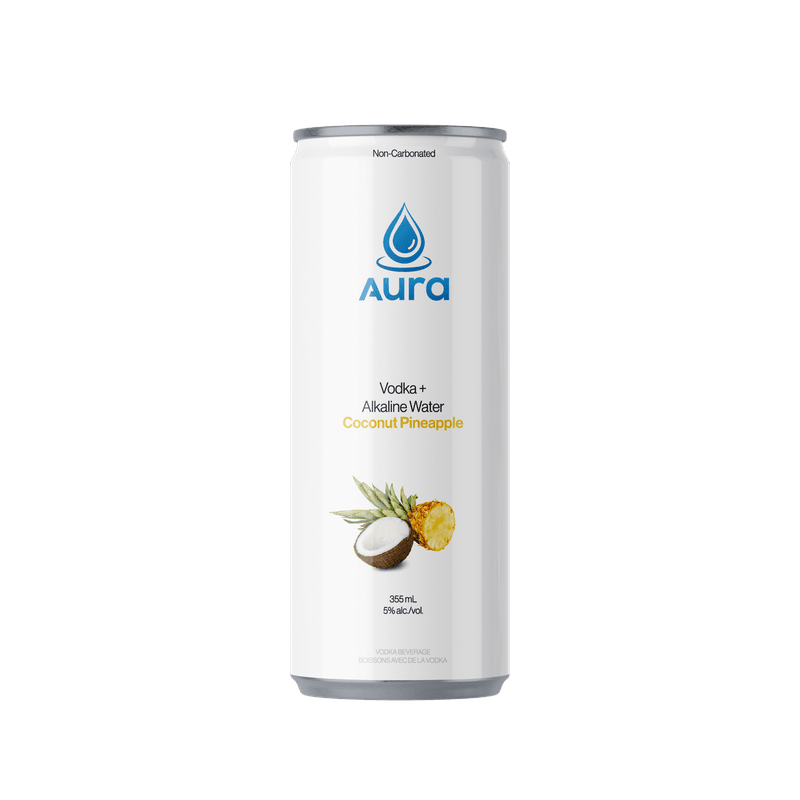
This is also why we designed Aura as a fixed recipe. Each can pairs premium distilled vodka with alkaline water (pH 8.5+) and natural flavour, with no added sugar, no artificial sweeteners and no preservatives. It is gluten-free and completely still, with zero carbonation, unlike a seltzer or vodka soda. Because the water is part of the recipe, a can of Cucumber Lime tastes the same in Toronto as it does in Calgary. Read more about why Aura chose still, alkaline water.
Caveats: what the research does not show
- Old, small or regional data. The famous 300/600/900/1,200 mg/L scale comes from a single 1969 study. The Barcelona panels tasted 20–25 waters each, mostly sold in Spain, and people tend to prefer the water they're used to.
- Correlation, not cause. The chemometric models link liking to mineral patterns across a set of samples. They don't prove that adding a given mineral will improve any particular water.
- Preference is personal. The Copenhagen review stresses that sensory evaluation "strongly depend[s] on personal preferences and sensitivities."
- No cocktail trials. We found no peer-reviewed panel study of mixed drinks made with different waters. The drink advice above is an informed extrapolation, not a tested result.
- Taste is not health. TDS guidelines in Canada are aesthetic, not health-based. Neither alkaline water nor the absence of bubbles makes an alcoholic drink healthier, safer or less intoxicating. The alcohol is the same either way.
Try a consistent pour
Want a vodka water that tastes the same every time, without guessing what's in your tap? Explore our vodka water cocktails in Cucumber Lime, Coconut Pineapple and Mango Peach, in 355mL cans by the case of 24. Aura is sold in British Columbia, Alberta and Ontario. Our own direct and wholesale ordering delivers to Ontario addresses only. In Alberta, look for AGLC-licensed private retailers, and in BC, BC Liquor Stores and licensed private retailers. Find them on our where to buy page. Please enjoy responsibly, and only if you are of legal drinking age in your province.
This article summarises published research for general interest and is not medical advice.
Sources
- World Health Organization. Total dissolved solids in Drinking-water: Background document for development of WHO Guidelines for Drinking-water Quality. WHO/SDE/WSH/03.04/16. Geneva: WHO; 2003 (originally published 1996). cdn.who.int
- Health Canada. Guidelines for Canadian Drinking Water Quality: Guideline Technical Document – Total Dissolved Solids (TDS). Ottawa: Health Canada; 2025. canada.ca
- Platikanov S, Garcia V, Fonseca I, Rullán E, Devesa R, Tauler R. Influence of minerals on the taste of bottled and tap water: a chemometric approach. Water Research. 2013;47(2):693–704. doi:10.1016/j.watres.2012.10.040. PMID: 23200507. PubMed
- Platikanov S, Hernández A, González S, Cortina JL, Tauler R, Devesa R. Predicting consumer preferences for mineral composition of bottled and tap water. Talanta. 2017;162:1–9. doi:10.1016/j.talanta.2016.09.057. PMID: 27837803. PubMed
- Marcussen H, Holm PE, Hansen HCB. Composition, flavor, chemical foodsafety, and consumer preferences of bottled water. Comprehensive Reviews in Food Science and Food Safety. 2013;12(4):333–352. doi:10.1111/1541-4337.12015. PMID: 33412686. doi.org
- Li X, Shen X, Zhou M, et al. Sensory preference of drinking water influenced by subthreshold-level mineral salt mixtures. Food Science & Nutrition. 2025;13(12):e71339. doi:10.1002/fsn3.71339. PMC